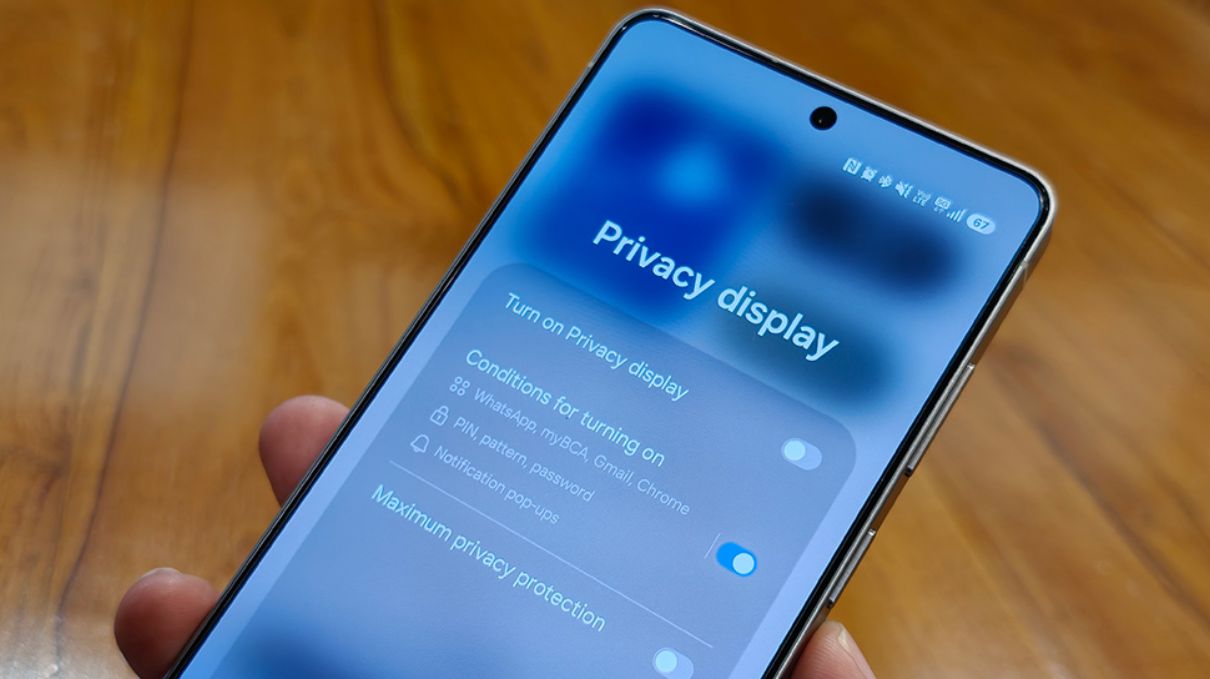
Privacy features are quickly becoming a new battleground in premium smartphones, and Xiaomi is now being linked to a display-level answer of its own. Reports suggest the company is preparing an anti-peep screen feature through HyperOS 4, potentially bringing visual privacy to more users without requiring a new phone.
What makes the rumored approach stand out is its software-first direction. Rather than relying mainly on a redesigned display panel, Xiaomi is said to be looking at a system-level solution that could work across a wider range of devices.
That strategy would make the feature more flexible to deploy. If it arrives through an operating system update, users of older Xiaomi phones could also benefit, instead of waiting for a new hardware generation.
The idea is similar to the Privacy Shade concept seen on BlackBerry Android phones. In that model, only a small visible area remains clear for the user, while the rest of the screen stays protected from outside viewing.
Xiaomi’s reported direction also differs from Samsung’s current approach. Samsung has introduced Privacy Display on the Galaxy S26 Ultra, using Flex Magic Pixel to narrow the screen’s viewing angle at a physical level.
That hardware-based method makes content harder to read from the side in public spaces. Xiaomi’s software-based version is expected to avoid the kind of brightness compromise that has been reported with Samsung’s technology.
A broader path for older devices
A software-driven privacy display would give Xiaomi a wider distribution path. Because the feature would not depend entirely on new panel hardware, the company could roll it out through HyperOS updates on more models.
That could be especially important for users who want privacy protection without replacing their current device. It also fits a broader trend in which software is becoming a major part of smartphone privacy innovation.
Even so, the technical details remain limited. Xiaomi has not fully revealed how the feature will work, and there is still room for the company to add dedicated hardware support later to refine the experience.
Why the feature matters in premium phones
The growing attention around anti-peep screens shows how privacy has become a stronger selling point in premium smartphones. Manufacturers appear to be responding to the need for better protection of personal information in everyday use.
If Xiaomi brings this feature to HyperOS 4, it could become a meaningful point of differentiation in a competitive market. A solution that is both more inclusive and less dependent on major hardware changes may appeal to users who want privacy with minimal trade-offs.
The move also reinforces the idea that display privacy no longer has to depend only on panel redesigns. Xiaomi is now being linked to a system-level approach that could make this kind of protection arrive faster and reach more devices across its ecosystem.
-
-

-
-