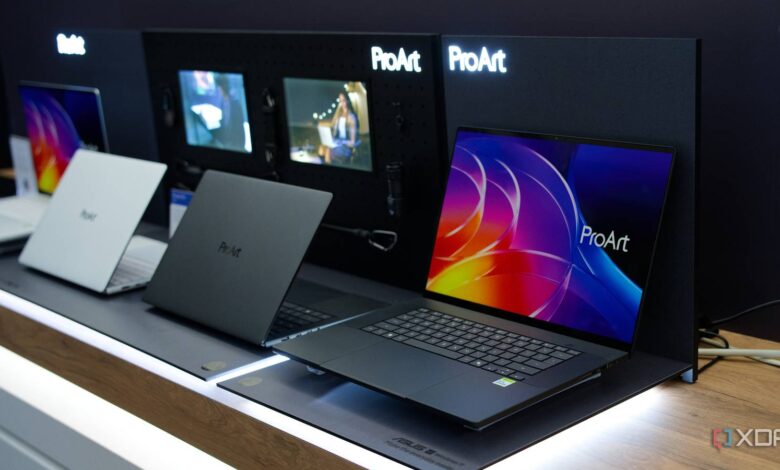
ASUS is pushing the ProArt line closer to workstation territory with two new laptops that put local AI computing at the center of the experience. The ProArt P16 and ProArt P14 are the first laptops in the world to adopt NVIDIA RTX Spark, and that alone shifts the conversation around what a creator laptop can do.
The direction is clear: ASUS and NVIDIA are not aiming at a standard thin-and-light device. Instead, the company is positioning these models as portable work machines built for heavy creative and AI workloads without depending fully on the cloud.
RTX Spark changes the core idea of a creator laptop
At the heart of the new ProArt lineup is NVIDIA RTX Spark, a superchip AI platform built on Unified Memory architecture. ASUS highlights it as a major step for power efficiency and for handling demanding AI tasks directly on a laptop.
The system is claimed to deliver up to 1 petaflop of AI performance. It also supports up to 128GB of unified memory, which is meant to smooth data movement between graphics and AI workloads without the friction that often slows complex workflows.
That local-first approach is also intended to support personal AI agents running directly on the operating system. In practical terms, that means several processes can stay on-device rather than relying completely on internet access or external cloud services.
Aiming at workstation-like workloads
ASUS is framing the new ProArt models as laptops that come unusually close to workstation-class behavior. The company’s internal testing suggests the machines can handle large 3D scenes using more than 90GB of memory without major issues.
The same hardware is also said to shorten AI-based 4K video creation significantly. For developers working with large AI models, the laptop is described as capable of running Large Language Models with up to 120 billion parameters.
Another headline figure is local context support of up to 1 million tokens. That specification underscores how aggressively ASUS is targeting AI creative and development workflows, not just conventional content production.
Two models, two use cases
The new lineup is split into the ProArt P16 and ProArt P14. Both are presented as the first laptops in the world to use this advanced architecture, but each one is aimed at a different kind of user.
The ProArt P16 is designed for those who want a larger display and maximum performance. It is positioned for professionals who need strong productivity in a portable form without giving up much on capability.
The ProArt P14 takes a more mobile approach. ASUS has made it compact, thin, and light, while still giving it the same heavy AI computing strength underneath.
Beyond the laptop itself
ASUS is not stopping at the two notebooks. The company is also adding a ProArt Mini PC to complete a creator ecosystem for desk-based workflows where space efficiency matters.
On the software side, ASUS is integrating exclusive creator apps optimized for generative AI. There is also a smart AI agent aimed at helping with project management and daily workflow tasks to make creative work more efficient.
Taken together, the hardware and software strategy shows a broader shift in ASUS’s professional lineup. The focus is moving beyond raw specifications and toward a full local AI workflow built around creative users who need more than a traditional laptop can usually offer.