


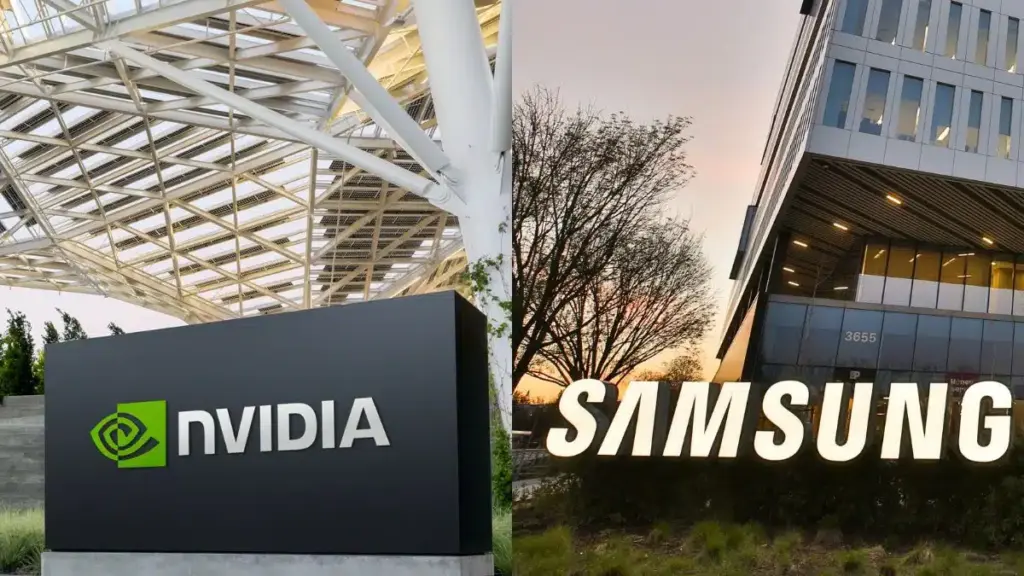
Samsung is pressing harder for a larger role in NVIDIA’s AI ecosystem, and the latest meeting between Jensen Huang and Jun Young-hyun underscored how strategic that effort has become. The discussion in South Korea centered on advanced semiconductors and the long-term race to supply the memory and chip technology that will power the next wave of AI systems.
At the center of that race is high-bandwidth memory, or HBM, a component that has become essential for feeding data quickly into GPUs. As demand for AI hardware continues to rise, suppliers that can deliver faster and more reliable memory are gaining a more important place in the chain.
HBM4E And HBM5 Are Emerging As Key Priorities
The meeting reportedly covered HBM4E and HBM5, two memory generations that are expected to matter for future AI platforms. NVIDIA depends heavily on fast memory to sustain GPU performance, which is why chip makers are competing to secure their place in that supply line.
Samsung has already received approval to supply memory chips for NVIDIA’s next-generation platform. The company has also sent upgraded HBM4E samples, a move that signals a more aggressive push to strengthen its position against other major memory makers.
This effort is about more than one product line. It reflects Samsung’s broader attempt to become a stronger long-term partner in a market where AI hardware demand keeps expanding.
AI Hardware Demand Is Reshaping The Market
NVIDIA sits at the center of the global AI boom because its GPUs underpin many artificial intelligence systems. That central role has made its supplier network increasingly important, especially as the need for high-performance components grows with each new AI deployment.
For Samsung, that growth is an opportunity to expand beyond its traditional identity as a memory producer. The company is trying to build a larger manufacturing role in the AI supply chain, where consistent access to advanced chips can determine who benefits most from the industry’s rapid expansion.
Samsung and NVIDIA already share a working relationship across several projects. That existing cooperation gives the two companies a foundation for deeper talks around future chip technology.
Existing Projects Give The Partnership More Depth
The two companies have collaborated on chips for self-driving cars. They have also worked together on an AI accelerator based on technology from startup Groq.
Under that arrangement, Samsung is scheduled to manufacture Groq’s LP30 AI inference chip, with shipments expected to begin in the second half of this year. That timeline reflects how quickly AI hardware orders continue to move through the market.
Samsung’s role in the Groq project shows that its relationship with NVIDIA is not limited to memory supply. It also places the company inside the manufacturing side of the broader AI hardware ecosystem.
For NVIDIA, working with multiple partners offers flexibility as demand accelerates. It helps reduce reliance on a single source while the need for advanced components keeps climbing.
The Stakes For Samsung Are Getting Higher
The talks with NVIDIA highlight how much Samsung stands to gain if it secures a larger share of these deals. A bigger role in supply and manufacturing would strengthen its standing in the global AI chip market.
HBM remains the most strategic battleground because of its value and importance in modern AI systems. If Samsung can expand its reach in HBM4E, HBM5, and future platforms, it could secure a stronger foothold in one of the fastest-growing parts of the semiconductor industry.
By sending upgraded samples and building on its approval as a supplier, Samsung is signaling that it wants to move faster and compete more aggressively. The meeting between Huang and Jun Young-hyun shows that the contest is no longer just about chip performance, but also about who can build the strongest partnerships to support the next phase of AI growth.
As demand for GPUs, AI accelerators, and high-speed memory rises together, the Samsung-NVIDIA relationship may shape more than one product cycle. It could influence how future AI hardware is built, sourced, and scaled across the market.