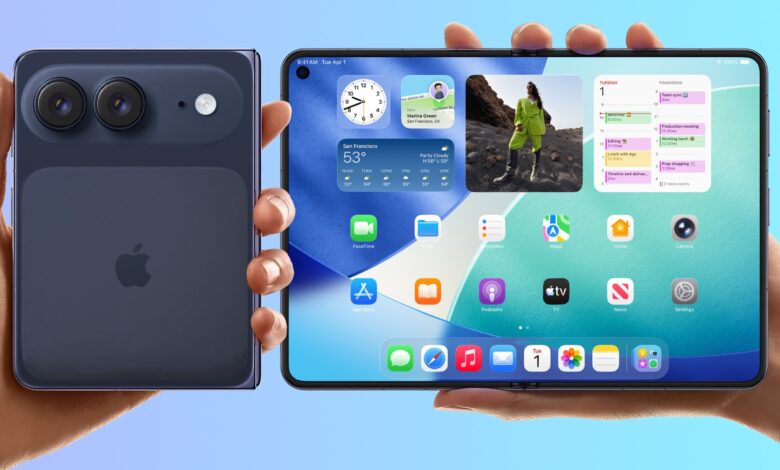
Apple’s next major iPhone shift is becoming easier to read in the software itself. New references spotted in the beta source code of iOS 27 suggest the company is preparing for a foldable device, even though Apple has not publicly confirmed the name or final design.
The strongest clues come from strings such as “foldState,” “angleDegrees,” “mechanicalAngleDegrees,” and “isanglevalid.” Together, they point to a system designed to recognize whether the device is folded, opened, or sitting at a specific hinge angle.
Software clues point to a more adaptive device
Those code terms matter because a foldable phone needs more than a flexible display. It also needs software that can respond precisely to how far the device is opened and how the interface should change in each position.
That is where the new framework hints become important. Apple appears to be preparing iOS not just for a larger screen, but for interactions that shift with the physical shape of the hardware.
According to the software analysis by M1Astra, some current iOS 27 features already appear more suitable for a model widely described as iPhone Ultra. One example is a full-screen widget setup that fills an entire display area.
On a foldable device, that approach could become more flexible. A single widget might occupy only half of the unfolded screen, leaving room for more natural multitasking on a larger panel.
Hints of a wider workspace are already visible
Another clue comes from the updated iPhone Mirroring feature. The Mac display function can now appear in a window roughly the size of an iPad screen, which suggests Apple is thinking beyond the traditional iPhone layout.
A larger workspace like that could help support a more spacious interface on a foldable model. It would also fit the direction implied by iOS 27, where the software seems to be moving toward broader, more adaptable screen behavior.
The hinge-angle references make that direction even clearer. Reading and validating the mechanical angle would be useful for a device that can switch between open, partially open, and fully folded states without losing interface stability.
A foldable-style use case is starting to emerge
That kind of behavior also raises the possibility of a Flex Mode-like experience similar to what Android foldables offer. In that setup, the phone can stay half-open so content appears on one side while controls or input tools appear on the other.
For users, that could turn the device into a compact multitasking tool. Video playback could continue without constant hand support, and a keyboard could occupy one section while content remains visible on the other.
Apple has not announced such a feature, but the software signals point in that direction. Support for angle measurement and validation is typically the kind of groundwork needed for adaptive layouts that react to the device’s posture.
September is now the key window to watch
The timing of these discoveries has also strengthened expectations around a fall launch. In Apple’s product cycle, that points directly to September, the month long associated with new iPhone announcements.
If that schedule holds, the foldable model may appear alongside the iPhone 18 lineup. The volume of specific framework references in iOS 27 makes the software preparation look far enough along for a device nearing release.
For now, the “iPhone Ultra” label remains an informal way of referring to Apple’s foldable candidate. What is already evident is that iOS 27 is being shaped to support a new category of iPhone behavior, and the software trail is making a September reveal look increasingly plausible.