


Apple is moving parental controls deeper into the core of its devices, with a broader safety update that reaches iPhone, iPad, and Mac. The change gives parents tighter authority over apps, websites, screen time, and the contacts children can reach.
The update matters because Apple is not only adding new tools. It is also redesigning Screen Time to make day-to-day monitoring clearer, while tying the changes to iOS 27, iPadOS 27, and macOS 27, which are set to arrive later this year.
New rules for younger users
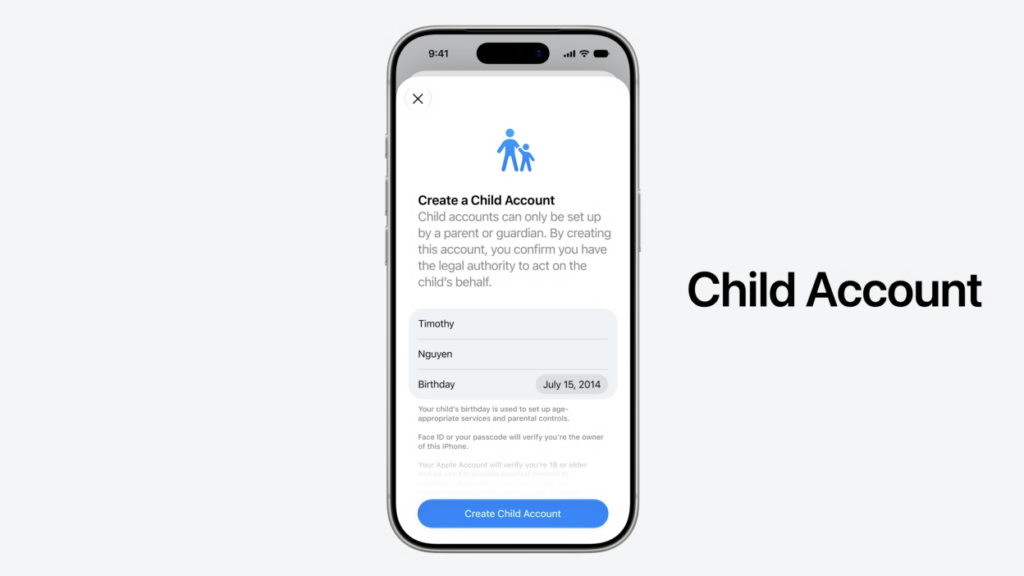
For children under 13, Apple says a child account will be required. The account is designed to deliver age-appropriate access, including restrictions on adult websites, media suited to the child’s age, and age-based limits inside the App Store.
Apple also extends the child account framework to users up to 18 years old. That places age restrictions at the center of the experience across the company’s ecosystem, rather than treating them as an optional add-on.
The company is also offering curated app recommendations for families. Parents can start with a small set of essential apps, choose from Apple’s prebuilt packages, or hand-pick the apps they consider appropriate.
That approach gives families more flexibility in how a device is opened up over time. Additional apps can be added later, instead of giving broad access from the start.
Ask to Buy expands to web browsing
Ask to Buy remains one of Apple’s main family controls. It requires a parent’s approval before a child can download App Store apps, whether the apps are free, paid, or include in-app purchases.
Apple is now adding Ask to Browse for Safari. With this feature, parents can require approval before a child opens a new website, and the system works on iPhone, iPad, and Mac.
The new browsing control shows that Apple is extending oversight beyond apps. Internet use has become a large part of how children interact with devices, and the company is responding with a stronger filter at the web level.
Parents will also get more control over who children can contact through Messages, FaceTime, and Phone. Approval can be required before a child connects with a new contact.
Stronger protection for sensitive content
Apple is also expanding Communication Safety. The feature, which already blurred detected nudity in Messages and FaceTime, will now be enabled by default for users under 18.
The latest update adds intervention for sadistic and violent content as well. If the system detects images or videos containing gore or violence, the device can block the content.
That marks a broader shift in Apple’s approach to child safety. Protection is no longer limited to sexual content and now includes visual material that may be disturbing or harmful.
For families sharing Apple devices, the default activation of Communication Safety for users under 18 may be the most noticeable change. It applies to the communication tools children use most often in daily life.
Screen Time gets a clearer design
Apple is also introducing Time Allowances, a new feature that gives parents more detailed control over usage by app category. They can set limits for areas such as Entertainment, Games, and Social Media.
The company says the system also includes age-based recommendations. Parents can additionally create daily Screen Time schedules to decide when and how long a device may be used.
Screen Time itself has been redesigned in the new software. Apple says the updated view gives parents a quick summary of average device use and the apps children use most often.
The redesign makes oversight more practical because the key data appears faster. Parents do not need to dig through as many menus just to understand daily usage patterns.
Availability and broader family guidance
All of these child safety features will arrive through the Screen Time update in iOS 27, iPadOS 27, and macOS 27 in the fall. Based on Apple’s usual software schedule, the controls are expected to land in September.
Apple also says it is working with the American Academy of Paediatrics, or AAP. The goal is to adapt the AAP’s Family Media Plan into a resource parents can use alongside Apple devices and services.
That collaboration suggests Apple is pairing technical controls with wider media guidance for families. The company is not only adding device-level restrictions, but also linking them to a more practical framework for everyday use.