


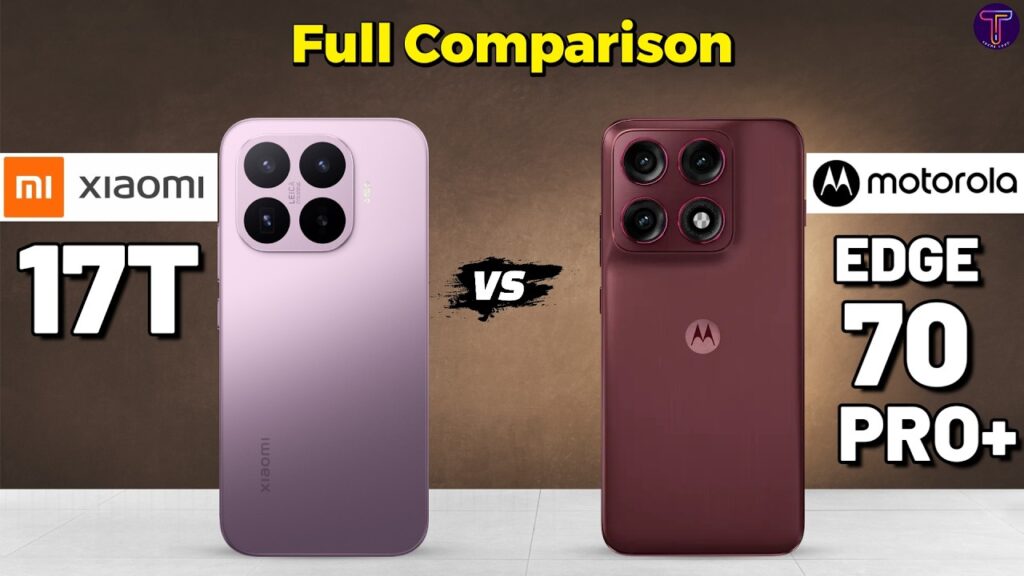
Motorola Edge 70 Pro+ enters the premium mid-range race with a sharper value proposition than Xiaomi 17T. It starts at 47,999 rupees, while Xiaomi 17T is priced from 59,999 rupees.
That gap matters because the Motorola phone does not appear to sacrifice the core experience. It matches Xiaomi in chipset class, battery size, and water resistance, while also gaining advantages in display, materials, camera flexibility, and charging speed.
Performance stays close
Both phones sit on nearly the same performance level. Xiaomi 17T uses the MediaTek Dimensity 8500-Ultra, while Motorola Edge 70 Pro+ runs on the MediaTek Dimensity 8500-Extreme.
The two chipsets are described as the same platform with differences tied more to branding than raw architecture. Each one comes with an octa-core CPU, a boost clock of up to 3.4 GHz, an Arm Mali-G-720 GPU, and an NPU 880 for AI tasks.
For everyday multitasking and graphics-heavy use, that means there is no major gap between them. Motorola also offers more flexibility in memory, with 12 GB or 16 GB LPDDR5x RAM and 256 GB or 512 GB storage options.
Xiaomi 17T is not far behind in this area, but its configuration is more limited. It comes with 12 GB LPDDR5x RAM and storage choices of 256 GB or 512 GB.
Motorola’s screen has the bigger advantage
The clearest separation appears on the display. Motorola Edge 70 Pro+ uses a curved 6.8-inch Extreme AMOLED panel with a 144 Hz refresh rate, HDR10+, 100% DCI-P3 coverage, more than one billion colors, up to 450 ppi, and a peak brightness of 5200 nits.
Xiaomi 17T responds with a 6.59-inch eye-care AMOLED screen, a 120 Hz refresh rate, 100% DCI-P3 support, 68 billion colors, PWM dimming up to 3840 Hz, and a peak brightness of 3500 nits.
Xiaomi’s eye-care tuning may appeal to users who spend long hours looking at a screen. Even so, Motorola is stronger on size, refresh rate, and brightness, which makes it more compelling for scrolling, gaming, and media playback.
More premium materials at a lower price
Motorola also looks more polished on the outside. Edge 70 Pro+ uses an aircraft-grade aluminum frame, Gorilla Glass 7i on the front, and a vegan rear panel designed to resist fingerprints and improve grip.
Xiaomi 17T uses a sandwich design with a plastic middle frame, Gorilla Glass 7i protection on the display, and a glass back. It still feels modern, but the material mix is less upscale than Motorola’s build.
Weight also favors Motorola at 190 grams, compared with Xiaomi’s 200 grams. Both phones carry IP68 and IP69 ratings, so water and dust protection is equal on paper.
Cameras and battery tilt the field again
Camera hardware gives Motorola another edge. Edge 70 Pro+ comes with a triple 50 MP rear setup built around a Sony LYTIA main sensor, plus a 50 MP front camera.
Xiaomi 17T uses a 50 MP + 50 MP + 12 MP rear array and a 32 MP selfie camera. Xiaomi also includes Leica collaboration, which may matter to buyers who value its imaging tuning.
Battery capacity is identical at 6500 mAh, but charging speed is not. Motorola supports 90 W TurboPower wired charging, while Xiaomi tops out at 67 W HyperCharge.
That difference gives Motorola a practical advantage in daily use, especially for buyers who want faster top-ups between long sessions. Combined with the lower launch price, it strengthens the case for the Edge 70 Pro+ as the more compelling buy.
On balance, Xiaomi 17T still offers a strong package with a capable display, Leica branding, and solid specifications. But Motorola Edge 70 Pro+ edges ahead in enough important areas to make the lower-priced model feel like the smarter all-around choice.