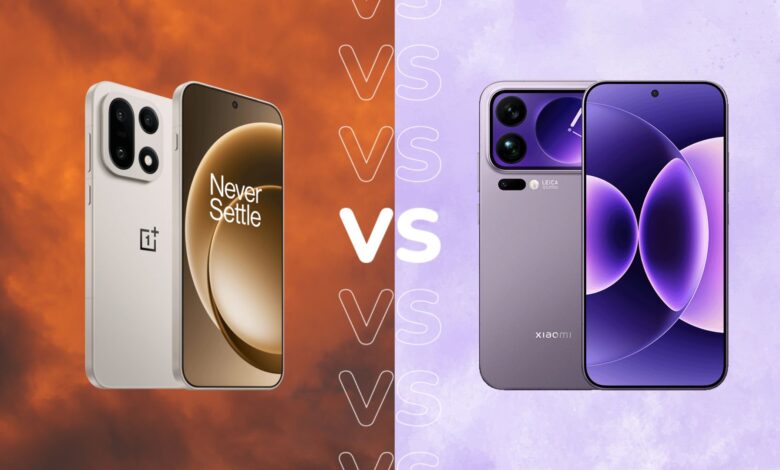
At a glance, Xiaomi 17T Pro and OnePlus 15 look like close rivals with only a narrow price gap between them. In reality, the two phones are built around very different priorities, which makes the final choice more important than the price difference itself.
Xiaomi 17T Pro leans toward photography value, while OnePlus 15 pushes harder on all-round flagship completeness. That split shows up in the chipset, display, charging, durability, and even the smaller details that affect daily use.
Different flagship philosophies
OnePlus 15 is positioned as the more balanced premium phone. It combines a top-tier chipset, an LTPO display, fast charging, a stronger fingerprint scanner, and tougher protection ratings.
Xiaomi 17T Pro takes a more focused approach. Its appeal is centered on Leica-tuned imaging, a very bright display, and a slightly lower asking price.
Price is close, but the value equation is not
Xiaomi 17T Pro is priced at around ₹75,000. OnePlus 15 sits at around ₹80,000.
That gap is small in flagship terms, so the decision depends less on savings and more on which features will matter most over time.
| Model | Price |
|---|---|
| Xiaomi 17T Pro | ₹75,000 |
| OnePlus 15 | ₹80,000 |
Performance favors OnePlus 15
Xiaomi 17T Pro uses the MediaTek Dimensity 9500, while OnePlus 15 runs on Snapdragon 8 Elite Gen 5. The Qualcomm chip is placed higher in the Android performance hierarchy.
OnePlus also benefits from the Adreno 840 GPU, which should help with gaming, sustained efficiency, and demanding apps. Both phones offer up to 16GB of RAM and up to 1TB of UFS 4.1 storage, so memory and storage are evenly matched.
Display trade-off between brightness and fluidity
Xiaomi 17T Pro carries a 6.83-inch AMOLED panel with a 144Hz refresh rate and a peak brightness of 3,500 nits. That makes it especially useful in bright outdoor conditions.
OnePlus 15 uses a 6.78-inch LTPO AMOLED display with a 165Hz refresh rate. Its adaptive refresh behavior gives it an edge in smooth scrolling and gaming.
For users who value panel technology and fluid motion, OnePlus 15 leads. For those who spend more time under harsh light, Xiaomi 17T Pro offers the brighter screen.
Camera is where Xiaomi 17T Pro gains ground
Both phones use 50MP main cameras, but Xiaomi 17T Pro gets a larger 1/1.31-inch sensor with Leica tuning. OnePlus 15 also uses a 50MP main sensor, but it is smaller at 1/1.56 inch.
That larger Xiaomi sensor gives it an advantage for main-camera shots, while Leica tuning adds a distinct character for users who prefer its color and rendering style.
The telephoto race is even more decisive. Xiaomi 17T Pro includes a 50MP periscope with 5x optical zoom, compared with OnePlus 15’s 50MP periscope and 3.5x optical zoom.
For portraits and long-range shots, Xiaomi 17T Pro has the stronger zoom setup. OnePlus 15 answers with a more powerful ultrawide camera, since its 50MP ultrawide is far ahead of Xiaomi’s 12MP module.
| Camera Area | Xiaomi 17T Pro | OnePlus 15 |
|---|---|---|
| Main camera | 50MP, 1/1.31-inch, Leica tuning | 50MP, 1/1.56-inch |
| Telephoto | 50MP, 5x optical zoom | 50MP, 3.5x optical zoom |
| Ultrawide | 12MP | 50MP |
The front cameras are matched at 32MP, but OnePlus 15 adds autofocus and 4K60 recording. On video, both phones reach flagship-level capability, with Xiaomi 17T Pro offering 8K, 4K120, HDR10+, and Log, while OnePlus 15 supports 8K, 4K120, and Dolby Vision.
Battery and charging tilt toward OnePlus
Xiaomi 17T Pro carries a 7,000mAh battery, while OnePlus 15 increases that figure to 7,300mAh. Charging is also faster on the OnePlus side, with 120W wired charging compared with Xiaomi’s 100W.
Both devices support 50W wireless charging, but OnePlus 15 adds reverse wireless charging, reverse wired charging, and bypass charging. That makes it the more flexible option for heavy daily use and gaming sessions.
Smaller details also favor OnePlus
Both models use premium materials with aluminum frames, but their protection levels are not identical. Xiaomi 17T Pro uses Gorilla Glass 7i and carries IP68 certification.
OnePlus 15 uses Victus 2 glass and adds IP68/IP69 protection, which gives it a stronger durability profile. It also uses an ultrasonic fingerprint scanner, while Xiaomi 17T Pro relies on an optical sensor.
Another difference appears in the USB port, where Xiaomi 17T Pro uses USB Type-C 2.0 and OnePlus 15 moves up to USB Type-C 3.2 for faster data transfer.
Software and audio round out the package
Both phones run Android 16, but they ship with different software layers. Xiaomi uses HyperOS 3, while OnePlus 15 comes with OxygenOS 16, which is generally considered cleaner.
In audio, Xiaomi 17T Pro includes stereo speakers with Dolby Atmos and Hi-Res Audio. OnePlus 15 also offers stereo sound and Hi-Res Audio, though it does not add Dolby Atmos.
For buyers focused on camera value, Xiaomi 17T Pro stands out with Leica tuning, a larger main sensor, 5x optical zoom, and the lower price. For those who want one flagship that feels stronger in nearly every daily category, OnePlus 15 has the broader advantage.