


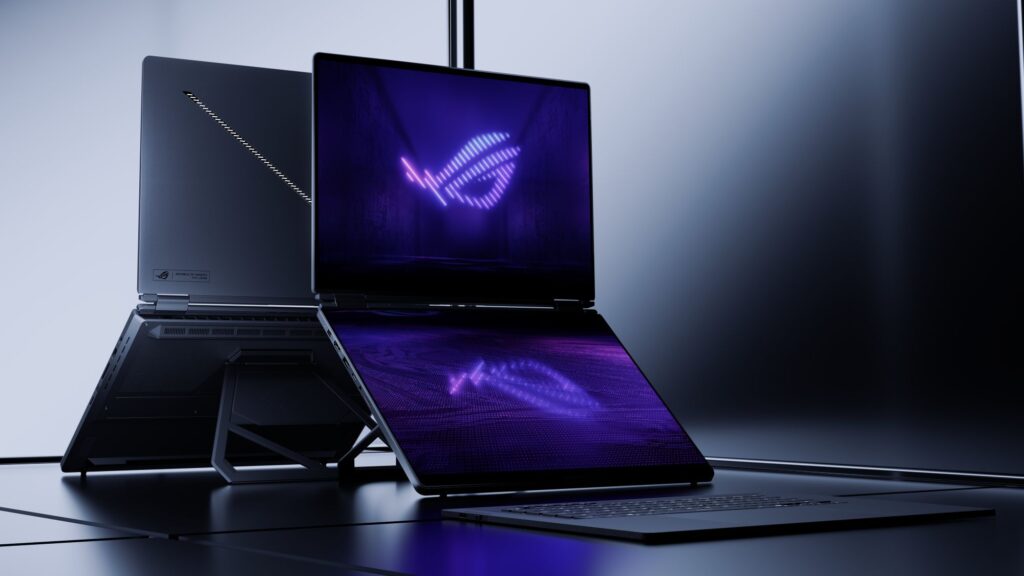
ASUS is pushing the Zenbook DUO 2026 beyond the novelty of a dual-screen laptop. The device is framed as a serious productivity tool for people who routinely juggle multiple apps, windows, and workflows at the same time.
That positioning matters because the model is not aimed at casual users alone. It is built for professionals, content creators, programmers, and hybrid workers who need more space to work without carrying a larger machine.
Two full-size OLED panels define the experience
The main attraction is the pair of identical 14-inch ASUS Lumina OLED touchscreens. Both panels are designed to deliver sharp visuals, accurate color, and strong contrast, giving the laptop a workspace that feels much closer to a compact dual-monitor setup.
For video editors, designers, and analysts, that extra screen real estate can reduce the need to constantly switch between windows. Timeline editing, tool panels, previews, research tabs, and dashboards can stay visible at the same time on a single portable device.
Built to switch between work styles
ASUS has kept the Zenbook DUO concept flexible rather than fixed. The laptop can function like a conventional notebook with a physical keyboard, but it can also open into a portable workstation when the second screen is fully deployed.
The hinge supports up to 180 degrees, which creates several usage modes for meetings, collaboration, and desk work. The detachable keyboard adds another layer of flexibility because the full surface can be used as display space when the keyboard is set aside.
AI-ready hardware supports heavier workloads
Beyond the dual-screen layout, the Zenbook DUO 2026 is built on a modern platform optimized for AI tasks. ASUS uses a latest-generation processor with a dedicated NPU, or Neural Processing Unit.
That hardware helps accelerate on-device AI features that can improve video calls, reduce background noise, manage power use more efficiently, and speed up creative workflows in professional applications. It also aligns with the broader shift toward AI-focused laptops in 2026.
Fast memory, storage, and cooling keep it responsive
To support demanding multitasking, ASUS equips the laptop with high-speed LPDDR5X memory and PCIe 5.0 SSD storage. The result is faster app launches, quicker data transfers, and smoother handling of large projects.
Users who run dozens of browser tabs alongside design software, programming tools, and video calls are the clearest target audience. ASUS also adds a new cooling system to help maintain stability during editing, 3D design, and rendering workloads.
| Key Area | What ASUS Offers |
|---|---|
| Display | Two identical 14-inch ASUS Lumina OLED touchscreens |
| Productivity | Multiple work modes, including laptop, collaboration, and vertical desktop use |
| Performance | Latest-generation processor with NPU |
| Memory and Storage | LPDDR5X and PCIe 5.0 SSD |
| Connectivity | Thunderbolt 4, HDMI 2.1, and Wi-Fi 7 |
Connectivity and battery life are part of the pitch
ASUS also includes Thunderbolt 4, HDMI 2.1, and Wi-Fi 7 to keep the laptop flexible for external displays, accessories, and fast wireless connections. For mobile professionals, that reduces the need to rely on extra dongles in everyday use.
Even with two OLED screens, the company is still trying to keep battery life competitive. The laptop uses a large battery and supports fast charging, so users can return to work more quickly after a top-up.
Overall, the Zenbook DUO 2026 is aimed at users who want a portable machine with a much larger working area than a standard laptop can provide. It is most relevant for creators, software engineers, data analysts, and business professionals who can make full use of the dual-screen format.