


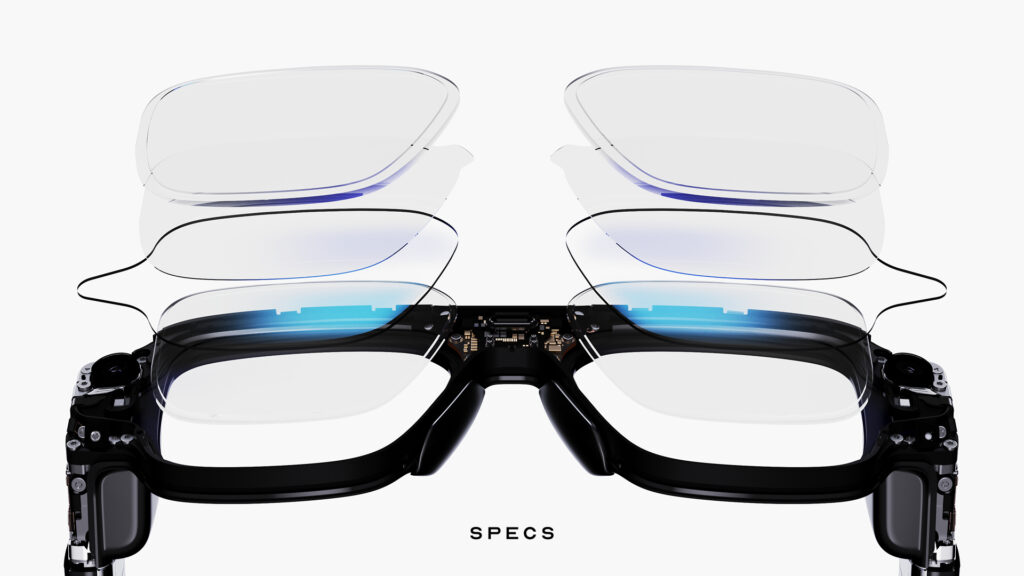
Snap has finally moved its Specs augmented reality glasses from prototype territory into the public market. The launch marks a notable shift for the company, which is now selling its smart glasses directly to consumers for the first time.
The move matters because Specs is being positioned not as a simple camera-equipped accessory, but as a transparent AR computer worn on the face. That puts Snap into a sharper rivalry with devices such as Ray-Ban Meta and the Meta Orion prototype.
A more serious bid for everyday AR
Snap is emphasizing that Specs is designed as a standalone device with no cable and no puck. That approach is important in AR hardware, where external modules often remain a barrier to comfort and daily use.
The company is also leaning on a wider field of view and what it describes as a stronger AR experience. In practice, that makes Specs look like a product meant for more than casual recording or simple notifications.
Specs is built with a thick frame to house its components, a design choice that echoes the strategy seen in Meta’s smart glasses. Even so, Snap is trying to frame the device as a step toward wearable computing rather than a niche gadget.
Display, camera, and hardware details
The glasses come in two sizes, 47 millimeters and 52 millimeters, with weights of 132 grams and 136 grams respectively. Both versions are designed to support prescription lenses.
For visuals, Snap uses its own liquid crystal on silicon, or LCoS, display technology. The system is said to deliver a 51-degree field of view and support up to 16 million colors.
Both lenses can project digital content directly into the wearer’s view. Snap also says the lenses can shift from transparent to darker in about 10 seconds to adapt to surrounding light.
The device includes a visible-light camera and an infrared camera. A central LED on the frame lights up when video is being recorded, making the capture mode more obvious to people nearby.
Two Snapdragon chips handle the workload
Inside, Specs is powered by two Qualcomm Snapdragon processors, although Snap has not disclosed the exact chip models. One chip handles computer vision tasks, while the other manages AR experiences and Lens features.
That split is meant to support fast hand tracking with low latency. Snap says the result should make digital objects feel more naturally integrated with the real world.
Specs also supports audio and video playback, Bluetooth notifications, and an AI-based assistant. Those additions make the glasses more versatile than a one-purpose AR display.
Battery life, charging, and price
Snap says the glasses can run for up to four hours on a single charge. A charging case adds four more full charges, bringing total use time to around 20 hours.
Charging uses a magnetic connector attached to the side of the glasses. The same cable can also connect to a smartphone, computer, or game console, allowing content to be shown directly on the Specs display.
Pricing is set at $2,195, and preorders are already open in the United States, the United Kingdom, and France. First shipments are scheduled for the fall season, between September and November 2026.
With that timetable, the market will soon find out whether Specs can turn Snap’s long-running smart glasses effort into a genuine consumer product that can pressure Ray-Ban Meta and widen the appeal of AR wearables.