


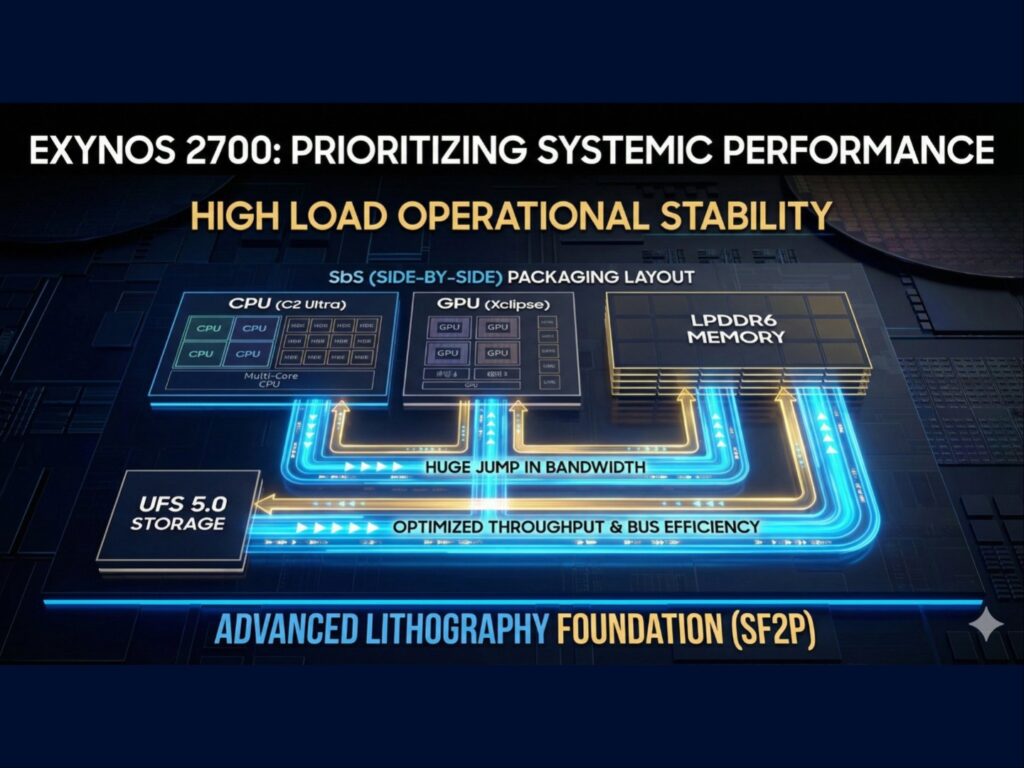
Samsung’s Exynos 2700 is reportedly advancing without major obstacles, and that alone makes the Galaxy S27 one of the most important flagships in the company’s chip strategy. The project matters because it could expand the role of Samsung’s in-house processor line at a time when Qualcomm still dominates much of the premium phone market.
Park Yong-in, President and Head of Samsung Electronics’ System LSI Business Unit, said development of Exynos 2700 is “going smoothly” and confirmed that the chip is being aimed at flagship models. The statement adds weight to the idea that Samsung is preparing the next generation of Exynos for a larger role in its top-tier phones.
Samsung’s internal decision still matters
Even if System LSI completes the chip as planned, the final call is expected to rest with MX, Samsung’s Mobile eXperience division. That team is likely to weigh both performance and cost before deciding whether Exynos 2700 makes the cut for the Galaxy S27 series.
The decision is important because Samsung does not always use the same chipset across every market. Its flagship Galaxy S lineup has often relied on a dual-chip strategy, with some regions receiving Snapdragon-powered devices and others getting Exynos variants.
If Samsung keeps that pattern, the Galaxy S27 and Galaxy S27+ could ship with either Snapdragon 8 Elite Gen 6, in Pro or standard form, or Exynos 2700. In other words, the chip’s arrival would not automatically mean that every Galaxy S27 model switches to Exynos.
Exynos could take a bigger share
Industry discussion suggests Exynos may account for as much as 50% of Galaxy S27 usage, up from about 25% on the Galaxy S26. If that happens, it would mark a major increase in Samsung’s reliance on its own silicon for its flagship phones.
That shift would also strengthen the position of Exynos in a segment where Qualcomm has long held a strong advantage. Still, observers do not see the target as easy to achieve, especially if Qualcomm offers Samsung’s MX division a more attractive price.
Cost remains a central factor in chipset selection for premium phones. Samsung must balance raw performance with product positioning and margin pressure, which makes the final chipset mix a strategic decision rather than a purely technical one.
Broader push to reduce external dependence
The progress of Exynos 2700 fits into a wider Samsung plan to build more of its own mobile hardware foundation. The company is not only refreshing its chip roadmap, but also trying to reduce dependence on outside suppliers in its flagship lineup.
Samsung is also keeping flexibility across other devices. One topic in circulation is the possibility that Exynos 2600, which is expected in some Galaxy S26 models, could also appear in the Galaxy Z Flip 8 in selected regions.
That approach shows Samsung is still comfortable assigning chips by region and device category. It gives the company room to manage supply, cost, and competitiveness depending on the market.
For the Galaxy S27, the next step will depend on two things: whether Exynos 2700 reaches production without disruption, and whether MX decides it compares favorably with Qualcomm’s option. For now, the signs remain positive, and Samsung has already indicated that the chip is intended for flagship use.