


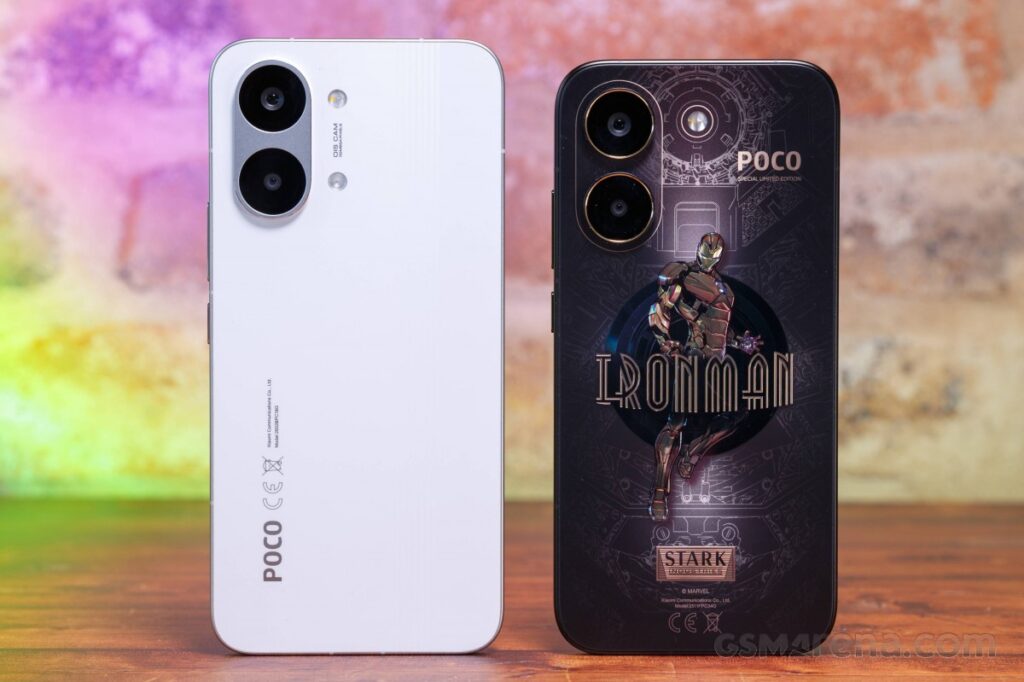
The premium midrange race is getting tighter as iQOO 15R and POCO X8 Pro Max push two very different strengths into the same price band. One leans on outright performance and a 144Hz display, while the other makes its case with a huge battery and a lower entry price.
That contrast is what makes the matchup worth watching. Both phones are built for buyers who want near-flagship speed without paying flagship money, but the final choice depends on whether gaming smoothness or endurance matters more.
Performance stays close, but the balance shifts
iQOO 15R uses Qualcomm Snapdragon 8 Gen 5 built on a 3 nm process, paired with an Adreno 829 GPU, LPDDR5x Ultra 9600Mbps RAM, and UFS 4.1 storage of up to 1 TB. POCO X8 Pro Max takes a different route with MediaTek Dimensity 9500s on 3 nm, an Immortalis-G925 MC12 GPU, 12GB of RAM, and UFS 4.1 storage in 256GB and 512GB variants.
On benchmark numbers, POCO X8 Pro Max posted an AnTuTu score of 2.855.421, with CPU at 866.113, GPU at 942.072, MEM at 459.997, and UX at 587.239. iQOO 15R followed closely with 2.799.803 on AnTuTu 11.1.0, including CPU 829.648, GPU 971.754, MEM 362.223, and UX 636.178.
The results show how narrow the gap is. POCO leads in total score, CPU, and memory, while iQOO takes the GPU and UX portions, which can matter for gaming feel and interface responsiveness.
Gadget360 described iQOO 15R as extremely smooth for daily use and said Snapdragon 8 Gen 5 makes it comfortable for gaming even with many apps still running in the background. David GadgetIn also highlighted POCO X8 Pro Max as attractively priced for the premium midrange class, noting that its Dimensity 9500s sits close to the Dimensity 9400 Plus used in Xiaomi 15T Pro devices around the 10 million rupiah range.
Battery and build separate the two more clearly
The biggest divide appears in battery capacity. iQOO 15R comes with a 7.600 mAh battery and 100W fast charging, while POCO X8 Pro Max stretches that further with 8.500–9.000 mAh and the same 100W charging support.
GSMArena called the POCO battery the most impressive part of the phone, saying the 8.500 mAh capacity delivered exceptional endurance and placed it among the longest-lasting devices it had reviewed. iQOO still answers with a lighter and slimmer body, measuring 7.9 mm thick and weighing about 202 grams.
By comparison, POCO is listed at roughly 218–220 grams, which makes it the heavier option for users who prioritize stamina over portability. Both devices also support Wi-Fi 7, NFC, USB Type-C, and 5G, while their durability ratings are split between IP68/IP69 for iQOO and IP68/IP69K for POCO.
Display choices point to different user habits
iQOO 15R features a 6.59-inch 1.5K AMOLED panel with a 144Hz refresh rate and HDR10+, making it the more obvious choice for users who want a compact but fast screen. POCO X8 Pro Max responds with a larger 6.83-inch OLED display at 1.5K resolution, a 120Hz–144Hz refresh rate, and peak brightness of around 3200–3500 nits.
Youtuber Cupu said iQOO has the edge in refresh rate because it offers 144Hz versus POCO’s 120Hz mode in some use cases. He also pointed out that iQOO’s always-on display offers an always option, while POCO does not fully match that behavior.
The result is a clear split in usage style. iQOO appears better suited to competitive gaming and faster touch response, while POCO is the more comfortable pick for media consumption thanks to its larger panel.
Cameras are similar on paper, but not in focus
Both phones rely on a 50 MP main camera with OIS and an 8 MP ultrawide lens. iQOO 15R adds a 32 MP selfie camera, while POCO X8 Pro Max uses a 20 MP front camera.
iQOO also stands out for video, with 4K 60fps recording on both the rear and front cameras. That detail makes it more appealing for vloggers or users who often record gameplay and selfie clips in higher quality.
Its daylight photos are described as clean, with natural color and a tidy dynamic range. The phone also offers digital crop focal length options at 23mm, 35mm, and 50mm.
POCO X8 Pro Max uses a 50 MP main sensor with an f/1.5 aperture and OIS, and its 2x zoom output is considered strong for this price class. Its video quality is still described as midrange-level, but portraits are noted for a more natural look and better front-camera stabilization.
The final decision comes down to priorities rather than a broad winner. iQOO 15R makes the stronger case for gamers, faster screen handling, and 4K front video, while POCO X8 Pro Max is easier to justify for buyers who value a much larger battery, 512GB storage, and a lower starting price.