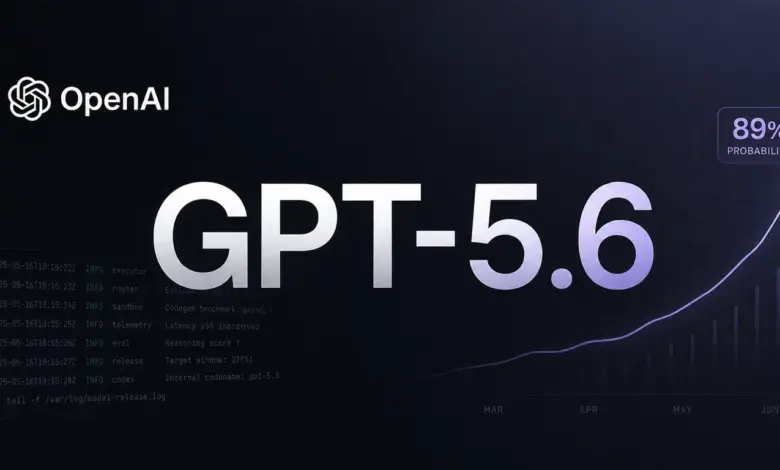
Attention around GPT-5.6 is rising because the model is being linked to stronger reasoning, cleaner coding output, and longer context handling. At the same time, early reports suggest users may have to accept noticeably slower responses in exchange for that extra precision.
Those impressions have spread through verified users, developers, and internal testers, even though OpenAI has not confirmed the model publicly. The discussion has intensified among ChatGPT Pro users, who say the system has felt different since mid-June 2026.
Cleaner code and more logical answers
Much of the reaction centers on output quality rather than raw speed. Users say answers feel more coherent, complex instructions are easier to follow, and coding results require fewer corrections than before.
Developer Anshu Chimala shared a visual comparison that highlighted the difference in web design work. He said a landing page that previously took 3–4 iterations could now be completed in a single attempt, with a result that looked more polished and functional.
One tester went further, describing the change as more than a minor refinement. In that view, the experience felt like moving to a genuinely new model rather than a routine update.
Reasoning appears to be the main jump
The strongest claims around GPT-5.6 focus on multi-step problem solving. The model is said to be better at building strategies, keeping long-term goals intact across smaller sub-tasks, and avoiding logical mistakes that were more common in earlier versions.
An engineer said a web development project that normally took 20–40 minutes and 5–7 revisions could now be finished in a single workflow. That reduced the need for human intervention and made the process feel more stable.
There is also internal rumor around a “Juice Value” increase from 768 to 960. If accurate, that would point to greater inference capacity and more consistent reasoning.
Much larger context support is also rumored
GPT-5.6 is said to arrive in three variants: Mini, Standard, and Pro. Mini is reportedly aimed at general users and lighter applications, Standard at professionals and students, and Pro at developers, researchers, and enterprise teams.
Another widely discussed claim is a context window that could reach 1.5 million tokens. That would extend far beyond the current version, which is said to sit at 1 million tokens.
Such capacity would make it possible to analyze an entire company codebase in one session. It could also help the model handle a full novel or hundreds of pages of research while keeping conversations coherent for longer.
Coding remains the most watched test case
Developer interest is especially high because coding appears to be one of the clearest areas of improvement. GPT-5.6 is reported to handle system architecture, modular code generation, automatic debugging, and even physics and 3D graphics simulation more effectively.
Conor Dart is said to have used the model to build a browser-based 3D game with gravity, collisions, and camera controls. The process reportedly took more than an hour, but the final result was considered better than expected.
The model is also described as strong in high-quality SVG generation, responsive UI and UX design, and complex API integration. In certain internal benchmarks, GPT-5.6 Pro was placed above Claude 4 Opus and GLM-5.2 for specific programming tasks.
Speed appears to be the main compromise
Despite the stronger output, several testers say GPT-5.6 is much slower than its predecessor. Chris, a benchmarker, compared GPT-5.6 Pro with GPT-5.5 Extra High and found response times were 2–3 times longer.
He also noted that the quality of the output was much higher, with factual mistakes and logical inconsistencies dropping sharply. That suggests OpenAI may be prioritizing accuracy and depth over raw speed.
For professional users, that trade-off may be acceptable if the model delivers more stable final results. For casual users, the slower pace may be harder to overlook.
Competition is heating up at the same time
The rumors come as the global AI race becomes more crowded. Anthropic has recently launched an agent system based on Claude, Zhipu AI has introduced GLM-5.2, and Google is reportedly preparing Gemini 2.5 with a focus on multimodal reasoning.
Industry sources also say OpenAI is pushing down usage costs. GPT-5.6 is rumored to be priced far lower per token than rivals, especially Anthropic, which is known to be expensive at scale.
Market predictions point to the fourth week of June 2026 as the most likely launch window. Supporters of that timeline point to active A/B testing among Pro users, backend infrastructure changes, and high release probability on prediction platforms.
For now, none of this has been confirmed by OpenAI. The signals still come from social posts, user testing, and unverified leaks, but the volume of reports has made GPT-5.6 one of the most closely watched AI rumors of the month.