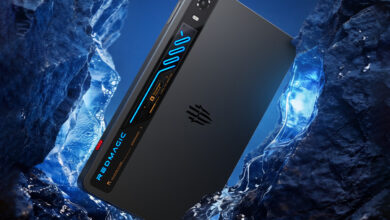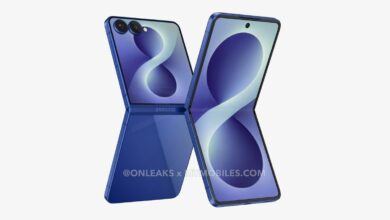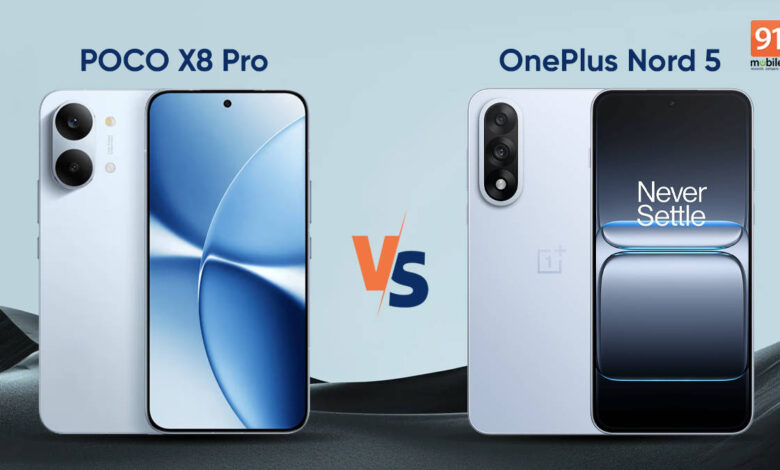
The OnePlus Nord 6 and Poco X8 Pro show how two mid-range phones can chase very different buyers. One puts more emphasis on raw performance and a fuller feature set, while the other counters with a lower price, faster charging, and a more premium build.
For users who want a device that can handle gaming, long battery life, and a stronger selfie camera, the Nord 6 has the clearer edge. The Poco X8 Pro still remains compelling for buyers who value materials, audio features, and a tighter budget.
Performance is where the gap starts
The OnePlus Nord 6 uses Snapdragon 8s Gen 4 paired with an Adreno 825 GPU. The Poco X8 Pro relies on the Dimensity 8500 Ultra with a Mali-G720 MC8 GPU.
On paper, that gives the Nord 6 the stronger performance package, especially for gaming. Both phones can be configured with up to 12GB of RAM and 512GB of UFS 4.1 storage, so the main difference comes from the chipset and graphics hardware.
OnePlus also gives the Nord 6 newer wireless hardware, including Wi-Fi 7 and Bluetooth 6.0. Poco still uses Wi-Fi 6, although Bluetooth 6.0 is present on both models.
Battery versus charging speed
Battery life is another area where the Nord 6 is hard to ignore. The global version carries a 7,500mAh battery, while the India version goes up to 9,000mAh.
The Poco X8 Pro is no slouch with its 6,500mAh battery, but it still falls behind in pure capacity. Charging is where Poco flips the script, because it supports 100W fast charging compared with 80W wired charging on the Nord 6.
Reverse charging is close between the two. The Nord 6 reportedly supports up to 27W on the India model, and the Poco X8 Pro also offers 27W reverse charging.
Displays are strong, but not identical
The Nord 6 features a 6.78-inch AMOLED panel with a 165Hz refresh rate, HDR10+ support, and a peak brightness of 3,600 nits. The Poco X8 Pro uses a 6.59-inch AMOLED display with a 120Hz refresh rate, Dolby Vision, and a peak brightness of 3,500 nits.
That makes the OnePlus the better fit for users who care about smoother animation and a higher refresh rate. Poco still has a strong display story thanks to Dolby Vision, even if its refresh rate is lower.
Protection also favors the Nord 6. It uses Crystal Guard with Mohs Level 8 scratch resistance, while the Poco X8 Pro comes with Gorilla Glass 7i rated at Mohs Level 5.
Camera differences are most visible at the front
Both phones take a similar approach to rear imaging, with a 50MP main camera with OIS and an 8MP ultrawide lens. That keeps the rear-camera contest relatively even on paper.
The front camera is where OnePlus pulls ahead. The Nord 6 uses a 32MP selfie camera with autofocus and 4K video support, while the Poco X8 Pro has a 20MP front camera limited to 1080p video.
Rear video recording is matched at 4K 60fps on both devices, but the Nord 6 still benefits from 4K recording on the front camera as well. That gives it a clearer advantage for video calls, vlogging, and creator-focused use.
Materials and audio give Poco its own appeal
The Poco X8 Pro stands out with an aluminum frame and Gorilla Glass 7i, while the Nord 6 uses a plastic frame and plastic back panel. Both phones carry IP68/IP69K protection, but the Nord 6 adds MIL-STD-810H certification for extra durability confidence.
Audio is another area where Poco has a stronger story. It offers stereo speakers with Dolby Atmos and Hi-Res Audio, while the Nord 6 keeps stereo speakers without those added audio features.
For users who watch movies or listen to music directly from the phone speaker, the Poco X8 Pro has the more complete entertainment package.
Software and pricing decide the final choice
Both devices ship with Android 16, but the Nord 6 runs OxygenOS 16 while the Poco X8 Pro uses HyperOS 3. OnePlus is the more attractive option for buyers who prefer a cleaner software experience.
Price is the final separator. The Poco X8 Pro costs around $375 or ₹35,000, while the OnePlus Nord 6 is priced at around $460 or ₹39,000.
That difference makes the Poco the stronger value play, but the Nord 6 justifies its higher price with faster performance, a larger battery, a quicker display, a stronger selfie camera, and newer connectivity. For buyers choosing between completeness and affordability, the decision depends on which side of the compromise matters more.