


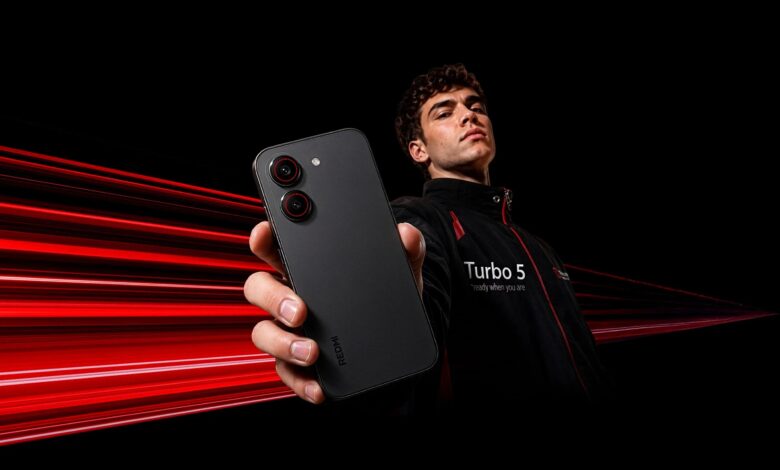
Redmi Turbo 5 and OnePlus Nord 6 are aimed at buyers who want serious gaming performance without paying flagship prices. Both phones combine high-refresh AMOLED displays, large batteries, and powerful chipsets built for long play sessions.
For gaming-focused users, however, Redmi Turbo 5 appears to hold the edge. Benchmark results and graphics behavior give it a slight advantage in demanding titles and extended sessions, even if the overall picture is more balanced than the headline numbers suggest.
Performance leans toward Redmi Turbo 5
Redmi Turbo 5 uses the MediaTek Dimensity 8500 Ultra with a Mali-G720 MC8 GPU. OnePlus Nord 6 is powered by the Snapdragon 8s Gen 4 and the Adreno 825 GPU.
According to Nanoreview benchmark figures, Redmi Turbo 5 scores around 2,809,170 in AnTuTu, while OnePlus Nord 6 reaches about 2,366,913. That gap points to stronger overall performance and heavier graphics capability on the Redmi side.
The picture changes in Geekbench single-core testing, where OnePlus Nord 6 posts roughly 2,116 compared with Redmi Turbo 5 at around 1,729. Multi-core results are much closer, with Redmi Turbo 5 at about 6,949 and OnePlus Nord 6 at around 6,851.
In practical use, that means Redmi Turbo 5 looks more convincing for games such as Genshin Impact, PUBG Mobile or BGMI, and Call of Duty: Mobile. The advantage is most noticeable when graphics settings are raised and playtime stretches longer.
Display size and speed favor OnePlus Nord 6
OnePlus Nord 6 offers a 6.78-inch AMOLED display with a 165Hz refresh rate, a 1272 x 2772 resolution, and peak brightness of 3,600 nits. Redmi Turbo 5 comes with a 6.59-inch AMOLED panel, a 120Hz refresh rate, a 1268 x 2756 resolution, and a 3,500-nit peak brightness rating.
For gaming, the Nord 6 has the larger and faster panel, which can make supported games feel smoother and give players more room to work with on screen. That setup is especially appealing for users who care about visual fluidity and a more expansive viewing area.
Redmi Turbo 5 counters with a more compact body. Its smaller size may be easier to hold for long gaming sessions, especially for users who prefer a tighter, more manageable grip.
Battery life is where Nord 6 pulls ahead
Power endurance is another major difference between the two. Redmi Turbo 5 carries a 7,540 mAh battery with 100W fast charging and 27W reverse wired charging.
OnePlus Nord 6 goes further with a 9,000 mAh battery, 80W fast charging, 6.5W reverse charging, and bypass charging. For gamers, that larger capacity should translate into longer sessions before reaching for a charger.
Redmi Turbo 5 responds with the faster charging rate, which may suit users who prefer quick top-ups instead of waiting for a longer charging cycle. That makes the choice between the two more about usage style than raw battery size alone.
Daily use also depends on the smaller details
Both phones run Android 16, and OnePlus Nord 6 ships with OxygenOS 16. Both devices also carry IP68 and IP69K ratings, giving them strong protection credentials for a gaming-oriented pair.
On the build side, Redmi Turbo 5 uses an aluminum frame, while OnePlus Nord 6 relies on plastic. That gives the Redmi model a more premium feel in hand, even though the OnePlus device answers with a larger screen and bigger battery.
Camera hardware is similar in the main setup, with both phones using a 50 MP main camera with OIS and an 8 MP ultrawide lens. Redmi Turbo 5 adds a 20 MP front camera, while OnePlus Nord 6 uses a 32 MP selfie camera.
In regular use, both main cameras are described as detailed in daylight with good dynamic range. OnePlus Nord 6 is said to be more consistent with color and processing in difficult lighting, while Redmi Turbo 5 tends to produce livelier photos that may suit social sharing better.
Which one makes more sense
OnePlus Nord 6 is the stronger choice for buyers who want a larger display, a bigger battery, and a better front camera. It also offers 8 GB or 12 GB of RAM and 256 GB or 512 GB of storage, making it the more flexible option on paper.
Redmi Turbo 5 remains the more compelling pick for gamers who prioritize benchmark strength, graphics performance, a compact body, aluminum frame, and 100W charging. With 8 GB of RAM and 256 GB of storage, it looks tailored to users who care most about frame rates and sustained gaming comfort.