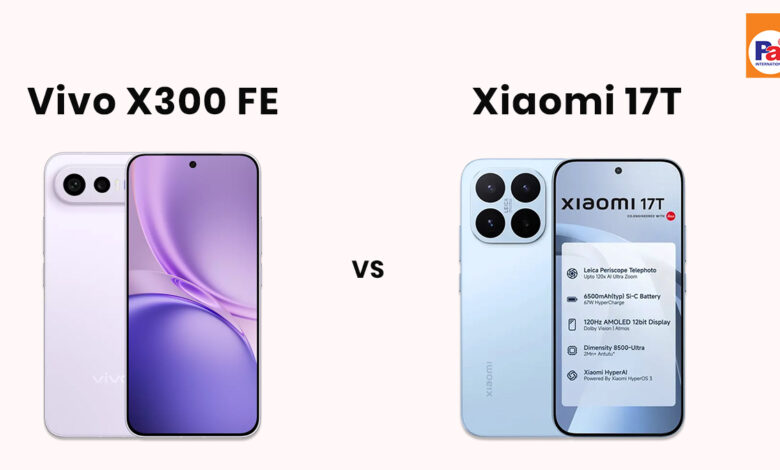
At around $900, the Xiaomi 17T Pro and Vivo X300 arrive with the kind of balance that forces buyers to choose a clear priority. One pushes harder on battery life, charging speed, and multimedia features, while the other leans into cameras, compactness, and long-term support.
The comparison is especially close because both phones sit in nearly the same price band, with Xiaomi 17T Pro listed at around $900 or ₹75,000 and Vivo X300 at around $900 or ₹76,000. That narrow gap makes the differences in design, endurance, imaging, and software far more important than raw price.
Shared performance, different strengths
On core performance, the two flagships are effectively matched. Both use the MediaTek Dimensity 9500 built on a 3nm process, paired with up to 16GB of RAM and up to 1TB of UFS 4.1 storage.
Graphics performance is also close. Xiaomi uses the Mali-G1 Ultra MC12, while Vivo relies on Arm G1-Ultra, with both positioned in the same performance class.
Xiaomi’s battery and charging lead the value case
The clearest advantage for Xiaomi 17T Pro comes from its power package. It carries a 7,000mAh battery, which is larger than the 6,040mAh unit in the global version of the Vivo X300.
Charging is faster in almost every direction as well. Xiaomi supports 100W wired charging, 50W wireless charging, and 22.5W reverse wired charging, while Vivo offers 90W wired charging and 40W wireless charging.
That combination gives Xiaomi a stronger case for heavy users who want longer uptime and less time attached to a charger. It also strengthens the phone’s appeal for buyers who prioritize battery confidence over a more compact footprint.
Compact design and display brightness favor Vivo
Vivo X300 counters with a smaller 6.31-inch LTPO AMOLED display, 120Hz refresh rate, HDR10+, HDR Vivid, and a peak brightness of 4,500 nits. Xiaomi 17T Pro uses a larger 6.83-inch AMOLED panel with a 144Hz refresh rate, Dolby Vision, HDR10+, and peak brightness of up to 3,500 nits.
The Xiaomi screen is better suited to users who want a larger canvas for video and gaming, while the Vivo panel is built for those who prefer a more compact device with very high brightness. The difference between them is less about quality and more about what kind of phone feels better in daily use.
Vivo also has the stronger durability story. It comes with a glass body, aluminum frame, IP68/IP69 certification, and an ultrasonic fingerprint sensor, while Xiaomi offers Gorilla Glass 7i, an aluminum frame, and IP68 protection.
Camera hardware gives Vivo the edge, but Xiaomi is stronger for video
For photography, Vivo X300 looks more versatile. Its rear system combines 200MP, 50MP telephoto 3x, and 50MP sensors with Zeiss optics, which gives it a stronger overall camera lineup on paper.
Xiaomi 17T Pro uses a 50MP main camera, a 50MP telephoto 5x camera, and a 12MP ultrawide setup with Leica optics. It remains a premium configuration, but Vivo’s arrangement is broader in scope and more flexible for still photography.
The front camera also tilts the field toward Vivo. The X300 includes a 50MP autofocus selfie camera with 4K 60fps recording, while the Xiaomi has a 32MP front camera with 4K support.
Xiaomi responds with a more advanced rear video package. It supports recording up to 8K, 4K 120fps, Log, and HDR10+, whereas Vivo tops out at 4K 120fps HDR.
That makes Xiaomi the more interesting option for creators who care about video flexibility and higher-end capture modes. Vivo still has the better photographic balance, but Xiaomi adds tools that matter more to serious video users.
Software support and connectivity complete the split
Both phones ship with Android 16, but their software strategies differ. Xiaomi 17T Pro runs HyperOS 3, while Vivo X300 uses OriginOS 6 and is promised 5 major Android upgrades.
That longer update commitment gives Vivo an important advantage for buyers who plan to keep a flagship for several years. Software longevity often matters just as much as the hardware spec sheet at this price level.
Connectivity is also split in ways that may matter depending on usage. Both models include Wi‑Fi 7 and an IR blaster, but Xiaomi offers Bluetooth 6.0 and USB 2.0, while Vivo uses Bluetooth 5.4 and USB 3.2.
Vivo’s USB 3.2 port gives it the faster wired transfer path, which can matter for file-heavy users. Even so, Xiaomi’s stronger battery, faster charging, and more advanced video features keep it highly competitive in overall value.
In the end, Xiaomi 17T Pro is the more aggressive all-round package for battery-minded buyers, while Vivo X300 is the smarter pick for users who want camera flexibility, a smaller body, and longer software support.