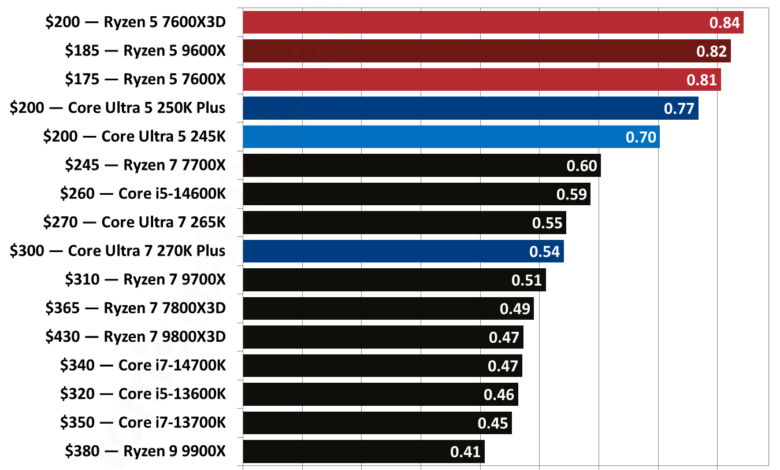
For mid-range PC buyers, the most important question is no longer which CPU wins by the widest margin. The gap between AMD’s Ryzen 7 9700X and Intel’s Core Ultra 5 250K Plus is small enough in gaming that price and multi-core output now matter more.
That shift makes Intel’s refreshed chip look surprisingly compelling. In several productivity benchmarks, the Core Ultra 5 250K Plus opens a clear lead, while gaming results remain close enough that the lower price becomes hard to ignore.
Productivity is where Intel pulls ahead
In Cinebench 2024, the Core Ultra 5 250K Plus scores 139 in single-core performance, while the Ryzen 7 9700X reaches 137. The difference is only about 1 percent, which puts both chips in nearly the same class for lightly threaded work.
The bigger separation appears in multi-core testing. Intel posts 1853 in Cinebench 2024, compared with 1313 for AMD, giving the Core Ultra 5 250K Plus an advantage of roughly 41 percent.
Geekbench 6 tells a similar story, though the single-core result is slightly closer for AMD. Ryzen 7 9700X scores 3331 in single-core, ahead of the Core Ultra 5 250K Plus at 3225 by around 3 percent.
Multi-core performance again favors Intel. The Core Ultra 5 250K Plus records 21397 in Geekbench 6, while the Ryzen 7 9700X lands at 17511, a margin of about 22 percent.
That makes Intel the stronger pick for workloads such as video editing, animation, and other tasks that can use more cores. Ryzen still holds up well in single-threaded work, but the pattern across benchmarks consistently leans toward Intel for heavy productivity.
Gaming stays much closer than expected
The gaming tests were run at 1080p with a Radeon RX 9070 and DDR5 6000 MT/s memory, with FPS results reported by the YouTube channel thegamrone. In Counter-Strike 2, the Core Ultra 5 250K Plus reaches 460 FPS, slightly ahead of the Ryzen 7 9700X at 445 FPS.
Intel also edges out AMD in God of War Ragnarok and Cyberpunk 2077, posting 166 FPS versus 165 FPS and 140 FPS versus 139 FPS. Those margins are so small that they barely change the overall picture.
Ryzen responds with wins in several other games. Assassin’s Creed Mirage runs at 164 FPS on the Ryzen 7 9700X and 160 FPS on the Core Ultra 5 250K Plus, while Horizon Forbidden West shows 168 FPS versus 160 FPS.
The AMD chip also leads in Hogwarts Legacy, Silent Hill f, Dying Light The Beast, and Stalker 2. Even so, most of the results stay close enough to be treated as essentially even in practical use.
Across the game lineup, Ryzen 7 9700X averages only about 0.6 percent faster. That is a tiny difference, and the result supports the idea that gaming performance between the two processors is effectively tied.
There is one caveat worth noting. The Core Ultra 5 250K Plus supports DDR5-7200 and is said to scale better with DDR5 7200, 8000, or 9200 MT/s memory, while the comparison here used DDR5 6000 MT/s.
Specifications explain the split
On paper, the two chips take very different approaches. The Ryzen 7 9700X uses a traditional core design on AMD’s AM5 platform, while the Core Ultra 5 250K Plus uses Intel’s hybrid layout with P-cores and E-cores on LGA 1851.
| Specification | AMD Ryzen 7 9700X | Intel Core Ultra 5 250K Plus |
|---|---|---|
| Architecture | Zen 4 | Arrow Lake Refresh |
| P-Core / Thread | 6 / 12 | 6 / 6 |
| E-Core / Thread | – / – | 12 / 12 |
| Total Core / Thread | 6 / 12 | 18 / 18 |
| Maximum Clock | 5.5 GHz | 5.3 GHz |
| L3 Cache | 32 MB | 30 MB |
| Memory Support | DDR5-5600 | DDR5-7200 |
| PCIe | Gen 5 | Gen 5 |
| Socket | AM5 | LGA 1851 |
| TDP | 65W Typical | 88W Max; 105W Typical | 142W Max (Extended) | 125W Typical | 159W Max |
| Manufacturing Process | 4nm, 6nm | 3nm |
AMD counters with a higher boost clock, larger L3 cache, and lower power consumption. Intel answers with far more total cores and support for faster memory, which helps explain the benchmark gap in multi-threaded workloads.
Price may decide the winner
Performance alone does not settle the argument because the pricing gap is meaningful. The Ryzen 7 9700X costs $239.99 at Micro Center and $259.23 at Amazon, while the Core Ultra 5 250K Plus is listed at $199.99 at Micro Center and $219.99 at Amazon.
That lower entry point gives Intel a stronger value case for mid-range builders who want to keep costs under control without giving up gaming performance. When productivity matters too, the Core Ultra 5 250K Plus becomes even more attractive.
The Ryzen 7 9700X still makes sense for buyers who care about efficiency, higher clock speed, and near-identical gaming results. But with lower pricing, better multi-core performance, and the possibility of faster gaming gains with higher-speed DDR5, Intel’s chip ends up looking like the more practical mid-range choice.
In a segment where the smallest differences often shape buying decisions, the Core Ultra 5 250K Plus has the stronger overall value story. The Ryzen 7 9700X is still competitive, but it now has to justify a higher price against a rival that matches it closely in games and beats it convincingly in productivity.