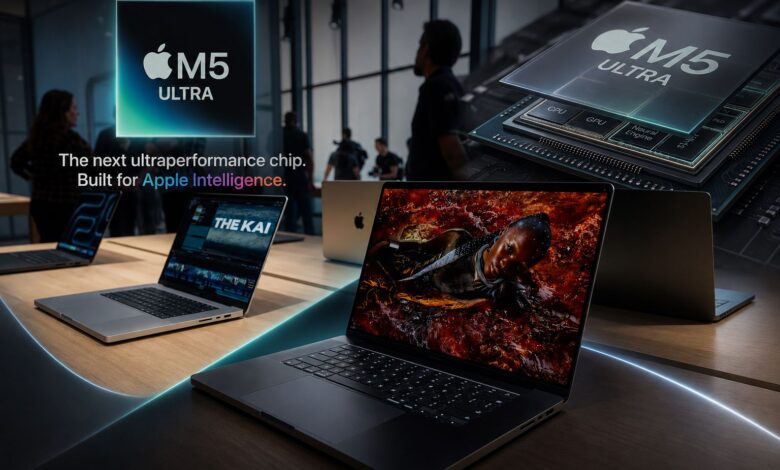
Apple is reportedly reshaping its chip roadmap in a way that breaks with its usual pattern. Instead of expanding the M6 family with Pro and Max versions, the company is said to be moving faster toward M7.
The shift points to a clear priority change toward AI-ready computing. If the report is accurate, the standard M6 may be the only version to reach the lineup, with Apple reserving its larger ambitions for the next generation.
A strategy built around AI performance
Bloomberg journalist Mark Gurman reports that Apple is accelerating the transition to its next chip generation. That would mean the M6 family would not receive the full spread of performance tiers seen in earlier cycles.
The move appears to reflect rising global demand for hardware that can handle artificial intelligence workloads more efficiently. Apple is reportedly aiming to put more resources into M7, which is being designed for larger-scale AI processing.
The company’s direction suggests that raw CPU gains are no longer the only priority. In the current market, chipmakers are under increasing pressure to deliver stronger AI performance, and Apple Silicon seems to be following that trend.
What M7 is expected to change
M7 is described as the centerpiece of Apple’s new hardware strategy. The chip family is said to bring much stronger graphics capabilities than its predecessor, which would matter for many modern AI tasks.
That emphasis on GPU power is important because many AI workloads rely heavily on graphics acceleration. By pushing M7 forward, Apple appears to be preparing a platform better suited to generative computing and data-intensive processing.
Skipping M6 Pro and M6 Max also signals a more aggressive product roadmap. Rather than following a gradual upgrade cycle, Apple seems to be choosing a faster jump to the platform it considers more relevant to the market right now.
M6 still looks meaningful
Even without the higher-end variants, the standard M6 is still expected to be a major step forward. It is not being framed as a weak release, but rather as an important transition before Apple leans harder into M7.
One of the expected changes is a new memory architecture. That is likely to bring much higher memory bandwidth, allowing data transfer to move more smoothly across the chip.
Apple is also said to improve the CPU and GPU. The M6 could deliver a faster main processor, while the graphics configuration may reach up to 12 cores.
That would exceed the 10-core ceiling of the previous generation. The increase suggests that Apple still plans a noticeable graphics upgrade, even if it stops short of Pro and Max territory.
The Neural Engine is also expected to receive a dedicated boost for AI applications. That matters because modern smart features depend not only on the CPU or GPU, but also on a more efficient neural processing unit.
Multimedia performance is expected to improve as well. M6 may offer better high-end video encoding and decoding support, which would help creative and productivity workflows.
| Chip | Expected Direction | Notable Detail |
|---|---|---|
| M6 | Standard version only | New memory architecture, up to 12-core GPU, improved Neural Engine |
| M7 | Priority next generation | Stronger graphics focus for larger-scale AI workloads |
Where M6 may land
In the reported scenario, standard M6 chips would likely be used in entry-level Macs and some iPads. That placement fits Apple’s segmentation strategy, giving base devices a substantial upgrade without waiting for the more AI-focused platform.
This would allow Apple to keep refreshing mainstream devices while shifting its main engineering focus elsewhere. For users, it means the next chip cycle may no longer follow the old expectation that every generation arrives with a complete Pro and Max ladder.
For now, the shift remains a report and not an official Apple announcement. But if the plan is accurate, M7 could become a key milestone in how Apple Silicon adapts to the rising demands of AI computing.