


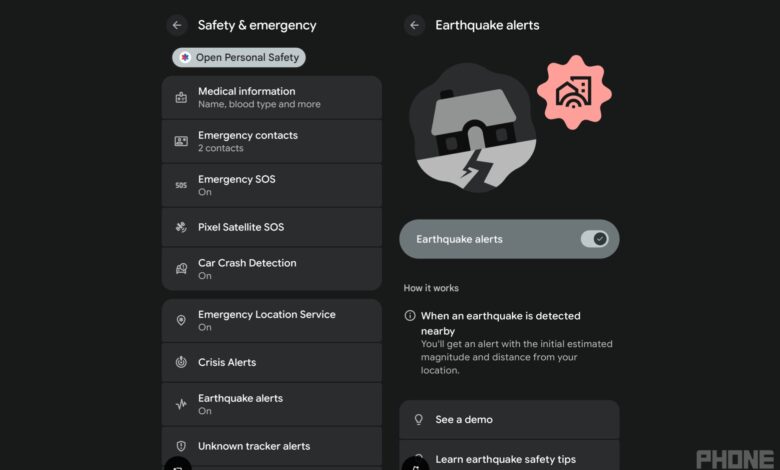
Some Android users in Venezuela received an earthquake alert only seconds before strong shaking began. The notice came from Google’s built-in warning system, which is designed to detect early seismic signals and push alerts before the stronger waves arrive.
That brief window was small, but in an emergency it mattered. Even a few seconds can help people move away from danger, stop what they are doing, or look for shelter before the main impact hits.
How the alert system works
The feature behind the warning is the Android Earthquake Alerts System. It does not predict earthquakes in advance, but instead uses the earliest movement detected by a network of Android phones to estimate whether a stronger quake may follow.
Millions of Android devices use accelerometers that can sense motion. When many phones in the same region register a similar vibration pattern, Google’s algorithm estimates the quake’s location and strength, then sends an automatic alert to users in the affected area.
Because it relies on first-wave detection, the system can only provide a very short lead time. Even so, that small delay can still be useful because it gives people a chance to pause, move, and prepare before the stronger shaking reaches them.
What happened in Venezuela
The warnings drew attention after a major earthquake struck Venezuela on Wednesday, 24 June 2026. Social media users said the notification appeared just moments before the stronger tremor was felt.
According to the United States Geological Survey, Venezuela experienced a twin earthquake event. The first quake measured magnitude 7.2 and struck at 18:04 local time, about 17.6 miles northwest of Montalban at a depth of around 8.2 miles.
The second quake followed with a magnitude of 7.5. Its epicenter was located about 21 miles northwest of Montalban, and USGS said the first quake was a foreshock while the main quake arrived only 39 seconds later.
| Event | Magnitude | Location | Time Gap |
|---|---|---|---|
| First quake | 7.2 | 17.6 miles northwest of Montalban, depth around 8.2 miles | Foreshock |
| Main quake | 7.5 | 21 miles northwest of Montalban | 39 seconds after the first quake |
Why those seconds mattered
The extremely short gap between the foreshock and the main quake is what made the phone alerts stand out. In a sequence like this, a warning system may provide the only usable pause before the stronger shaking begins.
That is also why the Android alert in Venezuela attracted so much attention online. It was not a prediction of the disaster, but a fast response from a system built to recognize danger after the earthquake had already started.
Heavy damage followed
The earthquake sequence caused severe destruction, including in Caracas, where parts of walls reportedly collapsed and the inside of homes became visible from the street. In Caraballeda, La Guaira state, aerial images showed buildings destroyed after the quake.
Thousands of rescuers, relatives, and volunteers continued digging through concrete day and night in search of survivors. The disaster was reported to have killed nearly 1,500 people, while tens of thousands of others were also reported missing.
The Venezuela case shows both the value and the limit of smartphone-based earthquake alerts. The system cannot stop an earthquake or forecast the exact moment it will happen, but when the ground begins to move, it can still provide a narrow but meaningful chance to react.