


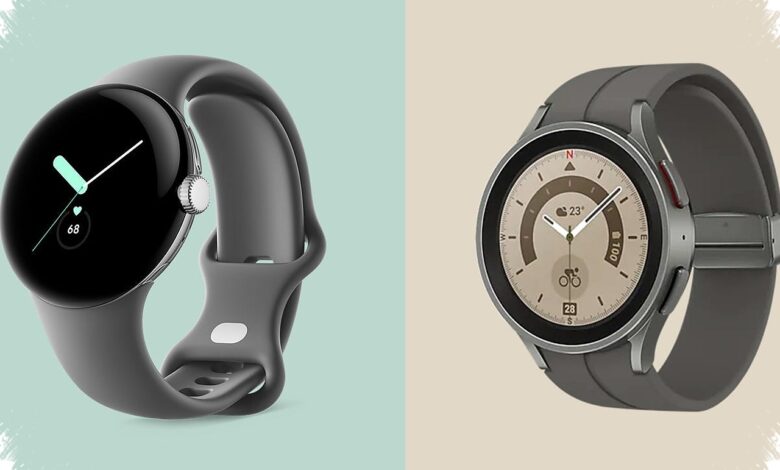
In the Android smartwatch market, the most noticeable difference for users is no longer just design or features. Durability and software support have become the clearest signs of how long a watch can stay useful, and Samsung currently looks stronger on both fronts.
That advantage matters because a smartwatch often lasts up to five years, even though the battery usually starts weakening after about three years. Once that happens, real-world longevity depends on how well the device handles impact, extreme conditions, and ongoing software updates.
Galaxy Watch 8 brings tougher protection
On physical durability, the Galaxy Watch 8 has a clear edge over the Pixel Watch 4. Both watches carry an IP68 rating, which means they are dust resistant and can survive immersion in water at a depth of at least 1 meter for 30 minutes.
They also share a 5ATM rating for water pressure resistance up to 164 feet. But Samsung adds MIL-STD-810H certification to the Galaxy Watch 8, a military standard that covers exposure to heat, cold, vibration, salt fog, dust, sand, and high humidity.
Google is not weak in this area, since the Pixel Watch 4 is also described as effective against water and dust. Even so, the broader durability profile still favors Samsung for users who want a watch that feels more prepared for rough daily use.
| Model | Protection | Extra Note |
|---|---|---|
| Galaxy Watch 8 | IP68, 5ATM | MIL-STD-810H military certification |
| Pixel Watch 4 | IP68, 5ATM | Water and dust resistance, no military rating mentioned |
Repairability gives Pixel Watch 4 one major advantage
Google does have one meaningful strength in this comparison: serviceability. The Pixel Watch 4 can have its battery and display replaced if damage occurs, even though it does not carry the same military certification as Samsung’s watch.
For long-term ownership, that can be a major benefit. Still, when the focus is pure resistance to shock and harsh environments, the Galaxy Watch 8 remains the more convincing option.
Software support also shifts the balance
Longevity is not only about the body and battery, because software support has its own expiration date. Samsung again has the lead here by offering one more year of updates than Google.
Google promises at least three years of updates for the Pixel Watch. That promise appears consistent with the first model, which launched in 2022 and received its final update in 2025.
Samsung extends support further. The Galaxy Watch 4, released in 2021, received the One UI 8 update in December 2025, giving it four years of support in total.
Why one extra year matters
Many people stop using a smartwatch not because the design feels outdated, but because software support has ended. At that stage, the battery may still work, but the user can miss newer health features that often justify buying a smartwatch in the first place.
That is why Samsung’s extra year makes a real difference. It gives users more time before the device enters a legacy phase, when its features begin to lag behind newer models.
The overall picture is fairly clear
If durability and software lifespan are the main priorities, Samsung is ahead on both counts. The Galaxy Watch 8 is built to handle harsher conditions, while the Galaxy Watch 4 shows that Samsung continues to support older devices for a meaningful period.
Google still offers a capable Android smartwatch, and the Pixel Watch 4 has the repairability advantage. But for buyers who want an Android watch that appears more likely to last, Samsung looks more convincing right now.