
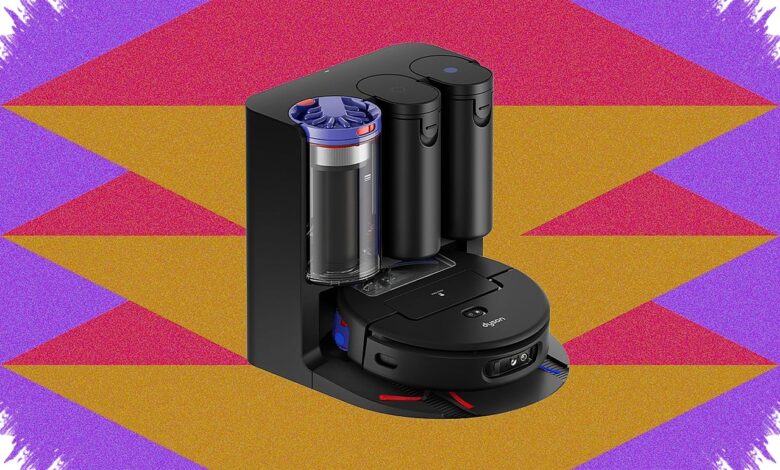
Dyson is pushing harder into the premium robot vacuum market with the Spot+Scrub AI, and its most unusual advantage is not the AI label. The real distinction is the bagless dock, a design choice that sets it apart from many high-end rivals still relying on disposable dust bags.
For users who want fewer consumables and a more practical long-term setup, that alone makes the model worth watching. In a category where much of the competition looks similar, Dyson is trying to win attention through hardware decisions that affect everyday use.
A dock that skips disposable bags
The Spot+Scrub AI uses Dyson’s cyclone-based dock instead of a bagged system. Dust is separated by centrifugal force, so users do not need to buy replacement bags over time.
During testing in an office setting for nearly two weeks, the mechanism handled dust well and did not show clogging issues. That gives the dock a practical appeal that is easy to understand, especially for buyers comparing premium robot vacuums.
| Feature | Spot+Scrub AI | Practical Effect |
|---|---|---|
| Dock type | Bagless cyclone dock | No disposable dust bags needed |
| Dust handling | Centrifugal separation | Designed to reduce clogging |
| Cleaning coverage | About 70 square meters per charge | Suitable for a sizable area in one cycle |
AI that works on the device itself
Dyson also gives the Spot+Scrub AI a more serious approach to obstacle avoidance. It uses a camera and green LED lighting to identify objects on the floor, then processes the analysis on the device rather than relying on cloud computing.
In testing, the robot avoided cables, children’s toys, and other small objects that often disrupt automatic cleaning. That kind of detection matters because real-world rooms are rarely clear when the vacuum starts moving.
Different thinking in mopping design
The mopping system also separates Dyson from most competitors. Instead of the dual rotating disc pads commonly used by other robot vacuums, the Spot+Scrub AI uses a roller mop built around a different cleaning approach.
The roller is continuously cleaned with 60-degree Celsius hot water, then dried with 45-degree Celsius warm air when the robot returns to the dock. Dyson also says the roller can reach closer to walls than conventional systems and can lift by about 10 millimeters on carpet to reduce wetting risk.
Battery life and physical limitations
Battery efficiency is another area where the model appears more capable than Dyson’s older robotic cleaner. The Spot+Scrub AI can clean around 70 square meters on a single charge, and its power is said to be twice that of the Dyson 360 Vis Nav.
Still, the hardware has a clear limitation. With a height of around 10 cm, the robot may struggle to fit under low furniture such as some sofas, shelves, or short-legged cabinets.
App control remains an important part of the package
The companion app covers the functions expected from a premium robot vacuum. Users can create room maps, divide areas into zones, schedule cleaning, choose vacuuming and mopping modes, and set no-go zones.
The app also shows the robot’s position in real time, cleaning history, and battery status. Notifications appear when the water tank needs refilling, dirty water needs emptying, or the mop roller needs maintenance.
How it fits in the premium market
In Indonesia, the Dyson Spot+Scrub AI is priced at Rp 18,8 juta. That places it directly against premium models from Dreame, Ecovacs, and Eufy, all of which also offer strong suction and automated mopping systems.
For that reason, the Spot+Scrub AI is likely to appeal most to buyers who want Dyson’s specific approach: a bagless cyclone dock, on-device AI obstacle detection, and a roller mop system that handles water and drying in a more distinctive way.
It is less compelling for shoppers who only compare raw value. But for those looking for a robot vacuum that brings a clear design identity to the premium segment, Dyson now has its most mature effort yet.