


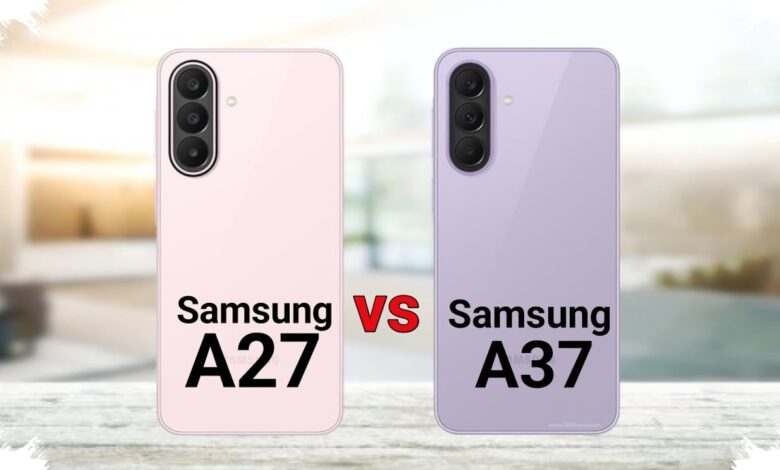
Samsung’s Galaxy A27 and Galaxy A37 may look nearly identical at first glance, but the gap becomes much clearer once the two phones are used side by side. In a market where their prices are now close, the Galaxy A37 emerges as the more complete option for most buyers.
The difference is not limited to one area. Display brightness, charging speed, speaker output, camera hardware, video capture, and durability all tilt in favor of the Galaxy A37, while the Galaxy A27 only keeps a few practical advantages of its own.
| Aspect | Galaxy A27 | Galaxy A37 |
|---|---|---|
| Weight | 200 g | 196 g |
| Dimensions | 162.4 x 78.2 x 7.8 mm | 162.9 x 78.2 x 7.4 mm |
| Display | 6.7-inch Super AMOLED, 120Hz, 1080×2340, 800 nits | 6.7-inch Super AMOLED, 120Hz, 1080×2340, 1246 nits |
| Battery and Charging | 5,000 mAh, 25W | 5,000 mAh, 45W |
| Chipset | Snapdragon 6 Gen 3 | Exynos 1480 |
Display and body feel close, but the protection level is not
On paper, both phones are extremely similar in size and build. The Galaxy A27 is a little thicker and heavier, while the Galaxy A37 is slightly taller and lighter, but the differences are small enough that most users will barely notice them.
The Galaxy A27 does bring one visible design change over its predecessor by using a punch-hole for the selfie camera, which gives it a more modern look. Both phones still feel solid in hand thanks to Gorilla Glass Victus+ on the front and back, plus a plastic frame in the middle.
The most important gap here is durability. The Galaxy A27 carries only an IP64 rating, while the Galaxy A37 reaches IP68, making the latter far better protected against dust and water.
Brightness is where the Galaxy A37 separates itself
Both devices use a 6.7-inch Super AMOLED panel with 120Hz refresh rate and Full HD+ resolution, so the basic screen spec looks the same. In actual testing, however, the experience is not equal at all.
The Galaxy A27 reaches around 800 nits in a 75% window measurement, while the Galaxy A37 climbs to about 1,246 nits. The difference becomes even more obvious in a 10% window test, where the A27 records 1,090 nits and the A37 reaches roughly 1,904 nits.
That gap matters outdoors, where the A37 is easier to read and feels more capable under strong light. It also appears to handle refresh-rate changes more flexibly in daily use, which adds to the impression of a more refined panel.
Charging speed is one of the clearest wins for the A37
Both phones use a 5,000 mAh battery, so capacity is not the issue. The final endurance picture still depends on the chipset and display behavior, and the results are close enough for everyday use rather than dramatically different.
Where the Galaxy A37 pulls ahead decisively is charging. It supports 45W fast charging, while the Galaxy A27 is limited to 25W.
That difference shows up in the real charging time. The Galaxy A27 takes 88 minutes to fully charge, while the Galaxy A37 finishes in 72 minutes.
Audio, performance, and storage are split in different ways
The Galaxy A37 also has the stronger speaker setup because it uses stereo output, even though both channels are driven through the earpiece arrangement. The A27 relies on a single speaker and sounds more ordinary by comparison.
Samsung gives both phones the same broader audio feature set, including Dolby Atmos, a full equalizer, UHQ upscaler, Adapt Sound, and Separate App Sound. In practice, the A37 still sounds louder and cleaner, with a fuller soundstage.
Inside, the Galaxy A27 runs on Snapdragon 6 Gen 3, while the Galaxy A37 uses Exynos 1480. The difference is not huge in everyday use, and benchmark scores remain fairly close.
| Benchmark | Galaxy A27 | Galaxy A37 |
|---|---|---|
| AnTuTu 11 | 885,852 | 912,055 |
| Geekbench 6 | 2,973 | 3,345 |
| 3DMark Wild Life | 911 | 1,035 |
The Galaxy A27 does retain one useful advantage that the A37 lacks: a microSD slot for expandable storage. Both models start with 6GB of RAM and 128GB of storage, and both use UFS 3.1.
Cameras and video make the A37 feel more complete
The camera hardware tells a similar story. The Galaxy A27 uses a 50MP main camera with a JN1 1/2.76-inch sensor, while the Galaxy A37 uses a much larger 1/1.56-inch main sensor.
The A27 also steps down to a 5MP ultrawide camera, compared with 8MP on the A26. The A37 answers with an 8MP ultrawide camera that produces 12MP output, plus a 5MP macro camera instead of the A27’s 2MP macro unit.
In daylight, the Galaxy A37 produces better detail, sharper images, and wider dynamic range. The Galaxy A27 still has pleasing color output, especially with a warmer green tone that may appeal to some users.
In low light, the A37 remains the more consistent and sharper option for the main camera. The A27 can sometimes keep color better on the ultrawide camera in certain scenes, but that does not change the overall balance.
The selfie cameras on both phones are solid, although the A37 has a slight advantage in dynamic range. Video recording gives the A37 another edge, since its front camera supports 4K30 and electronic stabilization is available at 4K30 as well.
The Galaxy A27 can still record 4K30 from the main camera, but stabilization is limited to 1080p30. In video clips, the A37 again looks sharper, including in darker scenes.
The Galaxy A37 is the safer recommendation
www.gsmarena.com considers the Galaxy A37 the better overall choice because its gains are spread across the screen, charging, speakers, cameras, video, and durability. The performance gap is not large, but the rest of the hardware makes the A27 feel harder to justify when prices are close.
The Galaxy A27 still has a place for buyers who want microSD expansion or prefer its main camera color tuning. If its price drops enough, it can still make sense, but under current conditions the A37 is the more rounded and easier phone to recommend.
For buyers deciding between the two, the A37 offers the clearer value story. The A27 remains an option only if expandable storage is the priority.