


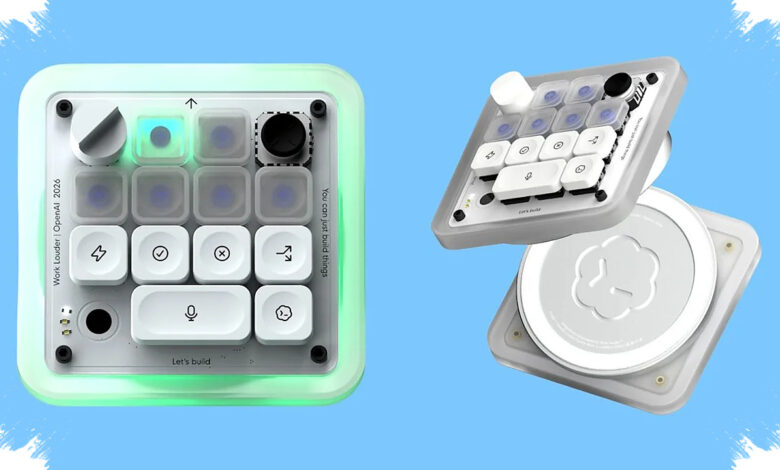
OpenAI is offering developers a $230 hardware shortcut for working with AI agents. The Codex Micro macro keypad uses six illuminated Agent Keys to show whether an agent is ready, thinking, or encountering an error.
The status lights are the product’s defining feature because they provide a visual signal without requiring users to repeatedly check an application window. That could be useful while developers remain focused on code, debugging, or other work on screen.
A Control Surface for Repeated Tasks
The device has 13 mechanical keys, with Command buttons that can be programmed for actions within the Codex workflow. These actions include accepting or rejecting code suggestions, starting a new chat, enabling voice input, and switching task context.
OpenAI Codex has developed from a code-writing tool into an AI agent-based productivity platform. The physical controls are intended to put frequently used commands under a developer’s fingertips rather than behind repeated menus or typed instructions.
| Component | Purpose | Details |
|---|---|---|
| Mechanical keys | Run shortcuts | 13 keys in total |
| Agent Keys | Track agent status | 6 keys with colored indicators |
| Mini joystick | Navigate workflows | For debugging and code refactoring |
| Rotary encoder | Adjust reasoning effort | Changes Codex thinking effort |
A mini joystick is included for navigation during more involved work, including debugging and refactoring. The keypad also has a rotary encoder for adjusting Codex reasoning effort, allowing the user to change the AI’s level of thinking effort.
Custom Labels for Individual Workflows
OpenAI and Work Louder include 32 interchangeable keycaps with the Codex Micro. Developers can assign labels such as “Test,” “Deploy,” “Git Commit,” and “Explain This” according to their own workflow.
The keycaps use clear text and intuitive icons intended to remain recognizable in low-light conditions. This makes the keypad a personalized input device rather than simply a desk accessory.
The product is aimed at developers who regularly use OpenAI Codex, teams building AI agent-based applications, and engineers seeking faster code iteration. For those users, mapping recurring commands to physical keys may reduce reliance on numerous keyboard shortcuts.
Wired or Wireless Operation
Codex Micro supports USB-C and Bluetooth 5.0 connections. USB-C is intended for low latency and stable power, while Bluetooth enables wireless use at distances of up to 10 meters.
The keypad works with Windows 10, Windows 11, and macOS Monterey or later. Users do not need a dedicated driver and can configure key mapping through a companion application from Work Louder.
| Information | Details |
|---|---|
| Price | $230 |
| Availability | Limited pre-order |
| Connectivity | USB-C and Bluetooth 5.0 |
| Shipping | Begins in late Q3 2026 |
OpenAI developed the keypad in collaboration with Work Louder, a brand focused on mechanical keyboards. Production is limited, and pre-orders are available through the OpenAI and Work Louder websites.
Codex Micro is separate from the screenless portable AI device OpenAI is reportedly developing with io Products. Bloomberg has reported that the other device may focus on natural conversation, smart-home control, and media playback, while Codex Micro is positioned specifically for developers and the Codex ecosystem.