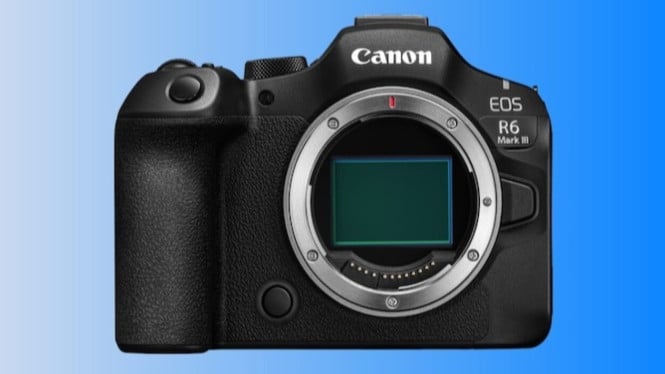
Canon has launched the EOS R6 III, setting a new benchmark in the mid-to-high end full-frame mirrorless camera market. This model focuses on three standout features: a 40 fps shooting speed, 7K RAW video recording, and advanced AI-based autofocus tracking. These upgrades make the R6 III a serious competitor against major rivals such as Sony A7 IV, Nikon Z6 III, and Panasonic S1 II.
The EOS R6 III sports a new 32.5-megapixel full-frame CMOS sensor, a significant increase from the previous 24MP. This boost enhances image detail, allows for extensive cropping without sacrificing quality, and improves oversampling for sharper and less noisy 4K and 7K video. Canon also improved the sensor’s native ISO up to 102,400, maintaining clarity even in low-light conditions.
Impressive Shooting Speed with 40 fps Burst Mode


One of the R6 III’s headline features is its remarkable continuous shooting speed. Using an electronic shutter, it can capture up to 40 frames per second, allowing photographers to seize fast-moving, unpredictable moments. Mechanical shutter mode remains available at 12 fps for those who prefer minimal rolling shutter effects.
Additionally, Canon introduced a pre-shooting buffer that records 0.5 seconds before the shutter is fully pressed. This ahead-of-time feature is ideal for wildlife photography, fast sports action, or spontaneous documentary scenarios where reacting in real time can be challenging.
AI-Powered Autofocus Tracking Boosts Precision
The camera’s Dual Pixel CMOS AF II system gets a substantial upgrade with cutting-edge AI algorithms. It now tracks faces, bodies (including eyes, heads, and hands), animals like cats, dogs, and birds, and even vehicles such as cars, motorcycles, and airplanes. Autofocus performance remains highly accurate in very low light down to -6 EV.
The new Register People Priority feature allows users to register specific faces to prioritize focus, even within crowded scenes. This innovative addition supports professional use cases like journalism and event photography, where subject tracking is critical.
7K RAW Video Recording and Advanced Stabilization
On the video front, Canon revolutionizes recording capabilities by enabling 7K RAW Light video up to 60 fps and full-width 7K at 30 fps. Slow-motion filming at 4K 120 fps is supported, offering cinematic quality footage. These formats include Canon Log 2 and Log 3 profiles for more than 14 stops of dynamic range, ideal for advanced color grading workflows.
Stabilization improves to 8.5 stops with the in-body image stabilization (IBIS), helping handheld video look smooth without the need for external gimbals. Complementary slots for CFexpress Type B and SD UHS-II cards allow continuous high-speed data writing and efficient file backup.
User-Oriented Ergonomics and Connectivity
Canon retains its signature ergonomic design with physical dials for quick adjustments of ISO, shutter speed, and exposure compensation. A joystick aids quick focus point changes, and the vari-angle 3-inch touchscreen supports vlogging and flexible shooting angles. Although the rear screen lacks a tilt-up function, the 5.76 million-dot OLED viewfinder offers a crisp viewing experience.
Connectivity includes full-size HDMI, USB-C for charging and tethering, microphone and headphone jacks, and built-in Wi-Fi and Bluetooth. These features underpin versatile workflows from studio shoots to on-the-go fieldwork. The LP-E6NH battery lasts around 390 shots via viewfinder or 510 shots using the LCD, suiting most daily photo sessions.
New RF 45mm f/1.2 STM Lens Complements the System
Alongside the R6 III launch, Canon unveiled the RF 45mm f/1.2 STM lens. It balances a wide f/1.2 aperture for beautiful bokeh with a lightweight 346 grams design. With a $470 price point, it offers a more affordable and portable alternative to the higher-end RF 50mm f/1.2L lens, appealing to creators who want cinematic look without a heavy budget.
Competitive Pricing and Market Position
The EOS R6 III is priced at $2,799 for the body only and $4,049 with the RF 24-105mm f/4L kit lens. It competes directly with the Sony A7 IV ($2,499), Nikon Z6 III (~$2,800), and Panasonic S1 II ($2,699). However, none of these rivals combine the R6 III’s unique blend of 7K RAW video, 40 fps burst shooting, sophisticated AI tracking, and a mature RF lens ecosystem.
Canon’s EOS R6 III clearly aims to satisfy hybrid users who demand high performance for both stills and video in a single gear package. By pushing boundaries in sensor resolution, speed, video quality, and AI autofocus, Canon strengthens its role as a trendsetter rather than a follower in the competitive 2025 mirrorless landscape.