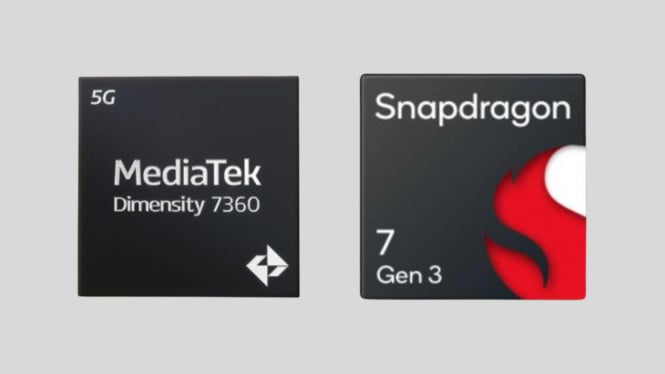
The MediaTek Dimensity 7360-Turbo and Qualcomm Snapdragon 7 Gen 3 are currently leading contenders in the mid-range smartphone chipset market. Both chipsets deliver solid performance, energy efficiency, and modern connectivity, but notable differences set them apart in power and features.
MediaTek’s Dimensity 7360-Turbo is built on a 4nm fabrication process with an octa-core layout comprising four Cortex-A78 cores clocked at up to 2.5 GHz and four Cortex-A55 cores at 2.0 GHz. It integrates a Mali-G615 MP2 GPU and supports LPDDR5 RAM up to 6400 Mbps. Connectivity options include Wi-Fi 6E and Bluetooth 5.4, making it well-suited for contemporary mid-range devices. This chipset powers models such as the Vivo V60 Lite 5G and offers features like Adaptive Gaming 3.0 that help maintain stable frame rates without excessive battery drain.
In contrast, Qualcomm’s Snapdragon 7 Gen 3 also uses a 4nm process but features an advanced octa-core Kryo CPU—one Cortex-A715 prime core running at 2.63 GHz and three performance cores at 2.42 GHz. The GPU is an Adreno 720, which Qualcomm claims to be 50% faster than its predecessor. The chipset offers robust connectivity through a 5G X63 modem with peak download speeds up to 5 Gbps, Wi-Fi 6E, and Bluetooth 5.3. Benchmark tests show the Snapdragon 7 Gen 3 scoring approximately 822,236 on AnTuTu, significantly ahead of the Dimensity 7360-Turbo’s roughly 730,000 score. This highlights its superiority in multitasking and heavy gaming performance.
Performance and Graphics
The Snapdragon 7 Gen 3’s advanced CPU cores and faster GPU provide a distinct edge in raw performance and graphics capabilities. It supports high-refresh-rate displays up to 168Hz, enhancing gaming and video playback smoothness. Meanwhile, the Dimensity 7360-Turbo can only drive WFHD+ displays at 120Hz, which remains competitive but doesn’t match Qualcomm’s lead. Those who prioritize top-tier graphics and speed will find the Snapdragon 7 Gen 3 better suited to their needs.
Connectivity Features
Snapdragon’s modem also outperforms the Dimensity 7360-Turbo, offering nearly 53% faster peak download speeds (5 Gbps vs. 3.27 Gbps). Both chipsets support Wi-Fi 6E, but the Dimensity edges out slightly in Bluetooth version with Bluetooth 5.4 vs. Snapdragon’s 5.3. Stable connectivity combined with high data rates makes Snapdragon ideal for users demanding blazing-fast internet.
Energy Efficiency and Daily Usage
Despite its lower benchmark scores, the Dimensity 7360-Turbo emphasizes power efficiency. MediaTek integrates UltraSave 3.0+ technology, enhancing battery life without compromising everyday performance. Its architecture and connectivity balance maintain long-lasting usage suitable for social media, streaming, and light productivity. Users aiming for all-day battery endurance and stable connections may find this chipset more practical.
Key Comparison Points
- CPU Architecture: Snapdragon 7 Gen 3’s Kryo cores (up to 2.63 GHz) outperform Dimensity’s Cortex-A78 cores clocked at 2.5 GHz.
- GPU Performance: Qualcomm’s Adreno 720 delivers 50% faster graphics than previous generations, surpassing Mali-G615 MP2.
- Display Support: Snapdragon allows refresh rates up to 168Hz while Dimensity caps at 120Hz.
- Modem Speed: Snapdragon’s X63 modem provides 5 Gbps peak downloads; Dimensity reaches 3.27 Gbps.
- Wireless Tech: Both support Wi-Fi 6E; Dimensity uses Bluetooth 5.4, Snapdragon 5.3.
- Power Efficiency: Dimensity’s UltraSave 3.0+ enhances battery life, favoring lighter daily use.
Choosing between these processors depends largely on user priorities. Snapdragon 7 Gen 3 is a clear choice for heavy gaming, fast multitasking, and top-tier connectivity. On the other hand, Dimensity 7360-Turbo is optimized for efficient daily operation and longer battery endurance, suitable for moderate usage.
Both chipsets signify the growing strengths in mid-range mobile processors, allowing consumers to align performance and battery life with their personal usage patterns. The competition pushes innovation, ensuring users benefit from advanced features and high value across different device segments.