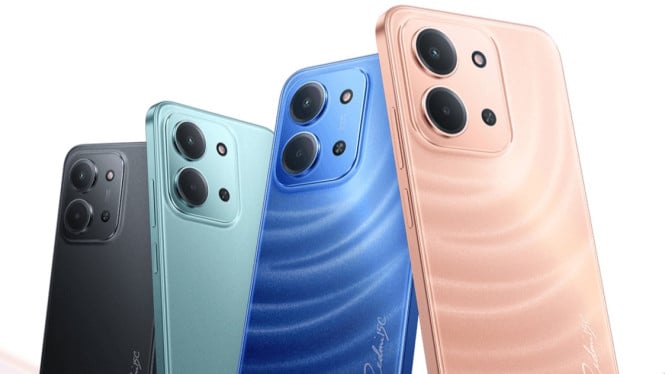
Choosing between the Redmi 15 and Redmi 15C can be puzzling because they look almost identical. Both feature a sturdy polycarbonate body and a large 6.9-inch screen, but their differences run much deeper than aesthetics.
The price difference is about $27 USD, yet this small gap separates two distinct user experiences. Redmi 15 offers higher long-term performance, while Redmi 15C provides more flexible connectivity and classic features.
Design and Display: Modern vs. Classic
Both phones share a robust polycarbonate build and the same large 6.9-inch display size. However, Redmi 15 features a punch-hole display with thinner bezels for a modern look. Redmi 15C retains a classic waterdrop notch and slightly thicker bezels.
The display resolution differs notably: Redmi 15 offers Full HD+ (2460 × 1080 pixels), making visuals sharper and more immersive. Redmi 15C comes with HD+ (1640 × 720 pixels), which may feel less detailed during close viewing or scrolling.
This makes the Redmi 15 ideal for heavy screen use such as video streaming or reading, while Redmi 15C suits more casual users.
Performance: Significant Advantage for Redmi 15
Under the hood, Redmi 15 scores about 490,000 on AnTuTu benchmarks, more than double Redmi 15C’s 200,000. The key factor is storage technology.
Redmi 15 uses UFS (Universal Flash Storage), which allows simultaneous read-write operations, boosting responsiveness. Redmi 15C relies on eMMC storage that reads or writes data one at a time, resulting in slower app launches and file transfers.
In real-world usage, Redmi 15 feels closer to a mid-range device, while Redmi 15C performs like a typical entry-level smartphone.
Battery Life and Features: Bigger Battery and Extras on Redmi 15
Redmi 15 is equipped with a 7,000 mAh battery, ensuring over a day of heavy use or one and a half days of light use. It also includes an Air Blaster (infrared remote), allowing it to control TVs, ACs, and projectors without extra apps.
Redmi 15C has an estimated 5,000 mAh battery, sufficient for daily tasks but lacks the IR blaster.
Connectivity and Slots: Flexibility vs. Modern Setup
Redmi 15C shines with a true triple slot: two nano-SIM slots plus a dedicated microSD card slot. This allows simultaneous dual SIM use and storage expansion up to 1TB without removing a SIM card.
Redmi 15 employs a dual SIM hybrid slot where the second slot doubles as microSD storage. Using a memory card disables the second SIM.
For users needing two SIMs and expandable storage simultaneously, Redmi 15C has the upper hand. However, with cloud services increasing, this may be less critical for some.
Audio and Extra Features: Headphone Jack vs IR Remote
Redmi 15C keeps the 3.5 mm headphone jack, which is rare in 2025 and ideal for wired earphones or meeting audio requirements. Redmi 15 removes this jack but offers the practical Air Blaster IR remote.
Both devices include NFC for payments and e-KTP, IP64 dust and splash resistance, and a side-mounted fingerprint sensor.
Camera: Similar Specs, Different Outputs
Both phones have a 50 MP main camera but produce different results. Redmi 15C delivers more vivid and saturated colors, great for social media uploads without editing. Redmi 15 focuses on color accuracy and detail, especially when zooming, with marginally better video stabilization.
On the front, Redmi 15’s selfie camera performs consistently under various lighting, whereas Redmi 15C tends to overexpose in bright conditions. Neither has advanced optical or electronic image stabilization.
Price and Value: Is the $27 USD Difference Worth It?
Redmi 15C is priced around $123 USD, while Redmi 15 costs about $150 USD. The $27 difference reflects tangible upgrades in speed, battery, display quality, and longevity on the Redmi 15.
Who Should Buy Which?
Choose Redmi 15 if you want smooth multitasking, longer battery life, a sharper display, and already use wireless earphones. It suits users prioritizing performance and durability.
Opt for Redmi 15C if you need a headphone jack, triple slot functionality, have a limited budget, or prefer more vibrant photos for social media. This is a practical choice for light users and those valuing flexibility in SIM and storage management.
Ultimately, ask yourself what your key priorities are for the next two to three years. This will guide you toward the model that fits your lifestyle and minimizes buyer’s remorse.
-

-

-
-