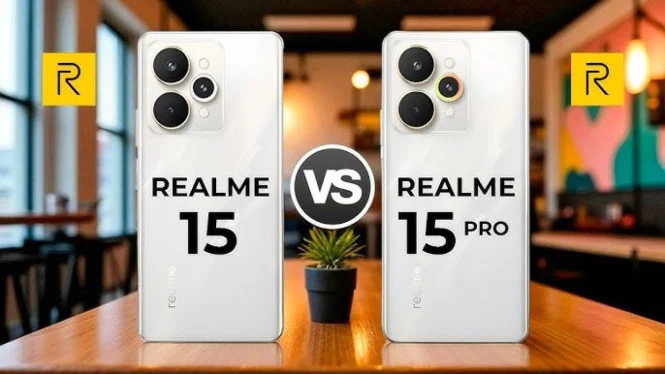
Realme recently launched two flagship smartphones: the Realme 15 5G and Realme 15 Pro 5G. Both models share many similarities in design and core features but differ in several key areas worth noting before making a purchase decision.
Starting with their dimensions, both phones weigh 187 grams and have nearly identical thickness, width, and height measurements. The Realme 15 Pro 5G has a slightly larger volume at 95.1 cm³ compared to 94.73 cm³ on the Realme 15 5G. Both devices carry an IP69 rating, ensuring dust resistance and water protection up to 2 meters deep, which is particularly useful for users with active or outdoor lifestyles.
Display and Screen Technology
Both smartphones feature a 6.8-inch OLED/AMOLED display with a resolution of 1280 x 2800 pixels and pixel density of 453 ppi. The screens support a high refresh rate of 144Hz and a touch sampling rate of 240Hz, enabling smooth animations and responsive interactions. Peak brightness reaches 1,800 nits, ensuring usability in bright environments. Scratch-resistant glass protects both displays, though the exact Gorilla Glass version remains unspecified.


Performance and Hardware Specifications
In terms of memory, both models come equipped with 12GB RAM and up to 512GB of internal storage. The major distinction lies in their chipsets. The Realme 15 5G is powered by the MediaTek Dimensity 7300, which has a CPU configuration of 4 cores at 2.5 GHz and 4 cores at 2 GHz. Meanwhile, the Realme 15 Pro 5G utilizes the newer Qualcomm Snapdragon 7 Gen 4 chipset, featuring a more complex CPU setup: 1 core at 2.8 GHz, 4 cores at 2.4 GHz, and 3 cores at 1.8 GHz. The 15 5G employs a Mali G615 MC2 GPU, while the specific GPU model for the Pro variant has not been officially disclosed.
Camera Capabilities
On the camera front, the Realme 15 5G sports a dual-camera setup with a 50 MP primary sensor and an 8 MP secondary sensor. The Realme 15 Pro 5G uses two 50 MP sensors for enhanced photographic flexibility. Both phones offer a 50 MP front camera, ideal for high-quality selfies and video calls. Optical Image Stabilization (OIS), dual-tone LED flash, and BSI sensors are included to improve low-light performance and reduce blurriness. Realme 15 Pro 5G supports video recording at 60 fps, providing smoother footage compared to the 30 fps video limit on the standard 15 5G.
Operating System and Privacy Features
Both devices run on Android 15 and incorporate advanced privacy features. Users benefit from clipboard warnings, refined location settings, and permission controls for cameras and microphones. Additionally, app tracking blockers and on-device machine learning enhance security and improve recognition of faces, places, and objects in photos.
Battery Life and Charging
Each phone is equipped with a large 7000 mAh battery, capable of supporting extended usage. Fast charging at 80W is available, enabling rapid recharging. However, neither model offers wireless charging. Both come with battery level indicators and include chargers within their packages.
Audio and Connectivity
Neither phone has a 3.5 mm headphone jack but they are fitted with stereo speakers. Audio codec support such as aptX, LDAC, or aptX HD is absent. Connectivity options include 5G, Wi-Fi 6, Bluetooth 5.4, dual SIM slots, and USB Type-C version 2 ports.
Summary of Key Differences:
- Chipset: MediaTek Dimensity 7300 (Realme 15 5G) vs. Qualcomm Snapdragon 7 Gen 4 (Realme 15 Pro 5G)
- Camera: Dual 50 MP (Pro) vs. 50 MP + 8 MP (Standard)
- Video Recording: 60 fps on Pro vs. 30 fps on Standard
- Device Volume: Slightly larger in Pro model
Overall, both Realme 15 5G and 15 Pro 5G deliver compelling features for mid-to-high-end users alike. The Pro version is geared towards those requiring a higher-performance chipset and enhanced video capabilities, suitable for gaming and multimedia consumption. Conversely, the Realme 15 5G offers reliable performance and premium features, meeting daily usage demands effectively.
Potential buyers should consider their priorities for chipset performance, camera versatility, and video functionality when choosing between these two models. Both handsets provide robust hardware, water resistance, and a modern Android experience priced competitively in the global market.