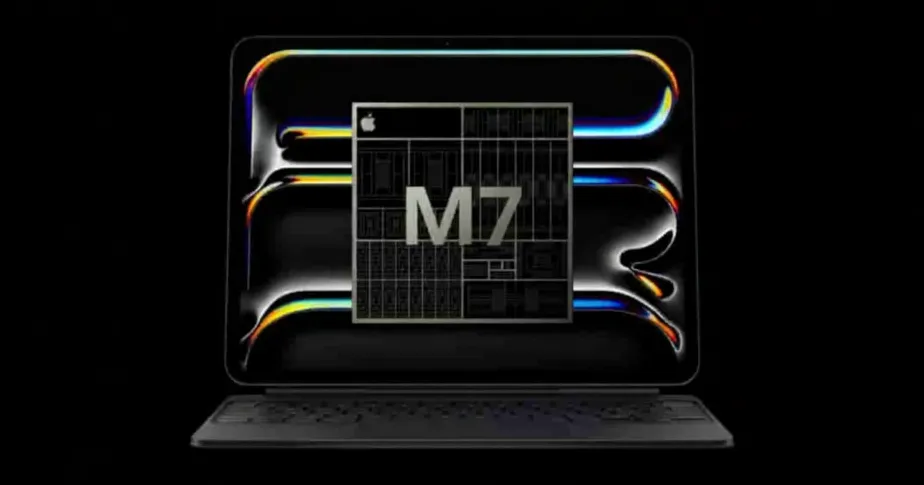
Apple is reportedly considering Intel as a manufacturer for its upcoming baseline M7 chip, potentially shifting away from its long-time partner TSMC entirely for this specific model. This strategic move was highlighted by renowned analyst Ming-Chi Kuo, who revealed that the standard M7 chip, likely destined for MacBook Air, iPad, and a more affordable Vision Pro, might be fabricated using Intel’s 18A process technology.
Intel plans to brand the optimized chip as “18AP” tailored specifically for Apple. However, mass production is not expected to start until 2027, which means consumers will have to wait a few years to see the new chip in actual devices. Meanwhile, the more advanced M7 Pro and M7 Max variants are anticipated to continue their production with TSMC, which will employ its cutting-edge N2P process or an enhanced A18 node.
Balancing Production and Maintaining Quality


Apple’s decision indicates a strategic distribution of production workload. It allows the company to maintain premium silicon manufacturing with its reliable partner TSMC while expanding Intel’s role for chip fabrication. This diversification enables Apple to secure additional manufacturing capacity for entry-level devices without compromising on quality for its flagship chips.
The arrangement is seen as a pivotal opportunity for Intel to rejuvenate its foundry business. The company has struggled with delays and client losses in recent years, and securing Apple as a key customer might boost its industry standing. Intel’s involvement could also attract other major clients, such as Qualcomm, seeking alternatives to TSMC’s dominant foundry services.
Apple’s Supply Chain Strategy
Apple’s broader supply chain approach reflects the need for high-volume production of millions of entry-level Macs and iPads. By delegating part of the chip production to Intel, Apple frees up TSMC to prioritize high-value components for premium products. This dual-sourcing strategy mitigates risks associated with dependency on a single supplier.
The success of Intel’s 18A node technology will become clearer with the launch of the Panther Lake laptop next year. Notably, Apple’s willingness to entrust Intel with actual chip production signals a significant thaw in their historical rivalry. The partnership echoes previous collaborations during the iPhone 5S era, blending design innovation with competitive manufacturing prowess.
Impact on the Semiconductor Industry
Apple’s move has broader implications for the global semiconductor industry. It underscores the increasing complexity and risk management within supply chains that now favor diversification of chip manufacturers. Intel’s emerging role in foundry operations could challenge TSMC’s near-monopoly on advanced node production.
This shift also reflects competitive pressures in the foundry market as companies seek alternatives amid geopolitical tensions and supply volatility. If the Intel-Apple collaboration proves successful, it could inspire other large tech firms to reevaluate their manufacturing partnerships, reshaping industry dynamics significantly.
Key Points to Note:
- Apple may use Intel’s 18A process for the basic M7 chip, branded as “18AP.”
- Production will likely start in 2027, focusing on entry-level devices.
- M7 Pro and M7 Max chips will remain with TSMC using N2P or enhanced A18 processes.
- Diversifying manufacturers eases supply chain constraints for Apple.
- Intel’s foundry comeback hinges on success with Apple and potentially other clients.
- This collaboration marks a strategic realignment in semiconductor manufacturing.
Apple’s consideration of Intel for M7 chip production represents a significant industry development. It highlights the evolving nature of tech supply chains and the critical role of foundry innovation in maintaining competitive advantage. The implications for both companies and the broader semiconductor ecosystem are poised to unfold over the next several years as production ramps up and new products hit the market.