


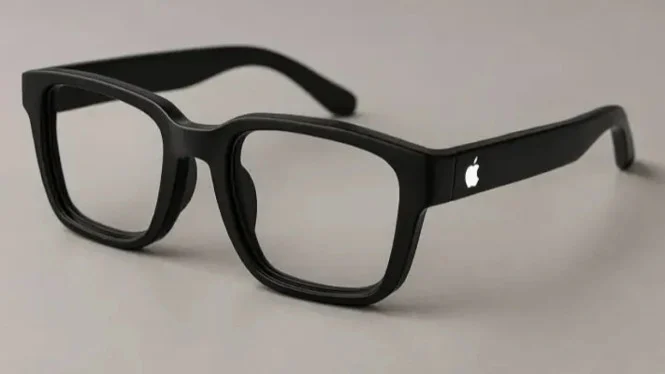
Apple is developing its first smart glasses, known as Apple Glasses, which will focus heavily on balancing performance with battery life. The company has reportedly chosen to use the Apple Watch S10 chip as the main processor instead of the more powerful A-series chips found in iPhones.
The decision stems from the critical challenge of battery life in wearable form factors. Unlike the Vision Pro headset that uses a large external 1,500 mAh battery lasting only 2 to 3 hours, Apple Glasses must be lightweight, thin, and able to last throughout the day on a much smaller battery, likely under 800 mAh.
Why Apple Chose the Apple Watch S10 Chip
Apple designs a range of chips optimized for different devices. The A19 chips are powerful but consume significant energy, suitable for high-demand devices like the iPhone 16. The M4 chip powering Vision Pro demands active cooling due to its high performance. However, smart glasses do not require intense processing power; their main tasks include capturing video, voice command processing via Siri, running lightweight AI, and syncing data with an iPhone.
The S10 chip, used in the Apple Watch Series 10 and Apple Watch Ultra 3, is built for extreme power efficiency in small devices. It offers a compact size ideal for fitting inside glasses frames while integrating a Neural Engine that supports on-device AI for speech recognition and motion tracking. It also supports dual cameras and efficient power management. Apple Watch Ultra 3 batteries with the S10 chip can last up to 42 hours under normal conditions and extend to 72 hours in low power mode.
Applying this chip in Apple Glasses is expected to deliver an 8 to 12-hour runtime, practical for daily use. This strategic trade-off sacrifices raw performance to maximize battery life and user comfort.
Minimalist Features Targeted for the First Generation
Apple Glasses will not feature built-in displays like the Vision Pro. Instead, they act as sensory extensions of an iPhone or Mac. Expected core functions include recording augmented reality videos from the wearer’s perspective, real-time transcription with Siri, visual notifications via the paired iPhone, eye and head movement tracking, and intelligent context integration through Apple’s AI.
This reduced visual processing load allows the glasses to offload intensive rendering and AR tasks to the connected devices. Thus, the S10 chip’s capabilities suffice for the intended applications.
Apple’s Long-Term Vision
The roadmap for Apple Glasses projects gradual evolution:
- 2026: Launch of first-generation glasses with the S10 chip, no integrated display, reliant on iPhone connectivity.
- 2027: Second generation featuring an adaptive operating system that can interface seamlessly with iPhone, Mac, or operate independently.
- 2028 onward: Standalone glasses with micro-LED displays, custom chips, and full augmented reality capabilities.
Starting with the S10 chip is a measured approach. It ensures the product prioritizes usability and practicality over premature feature overload.
Competitive Context
Current competitors in the smart glasses market include Ray-Ban Meta, which focuses on camera and audio functions without heavy processing, Xreal Air 2, which features a virtual display but depends on external devices, and Rokid Max, offering lightweight AR with an external battery.
Apple differentiates itself by emphasizing ecosystem integration and contextual intelligence over display-centric experiences. The S10 chip supports this vision by maintaining light weight, low heat generation, and all-day battery life—advantages not fully realized by competitors yet.
Challenges Ahead
Despite its sensible design, the approach carries risks. The limited processing power might restrain future feature expansions. Heavy reliance on the iPhone could limit appeal in markets where iPhone penetration is lower. Additionally, potential localized heating near the temples due to continuous chip operation remains a concern.
Nonetheless, Apple has a strong track record in optimizing hardware-software synergy to balance such trade-offs effectively.
Apple’s choice to prioritize efficient power usage and practical daily functionality reveals a matured design philosophy. Instead of pushing cutting-edge hardware prematurely, Apple aims for a smart glasses product that users can realistically wear and use throughout the day.
This strategy promises a wearable device that is not merely technically impressive but genuinely usable — potentially opening a new chapter in unobtrusive computing beyond the lessons learned from earlier attempts like Google Glass.