


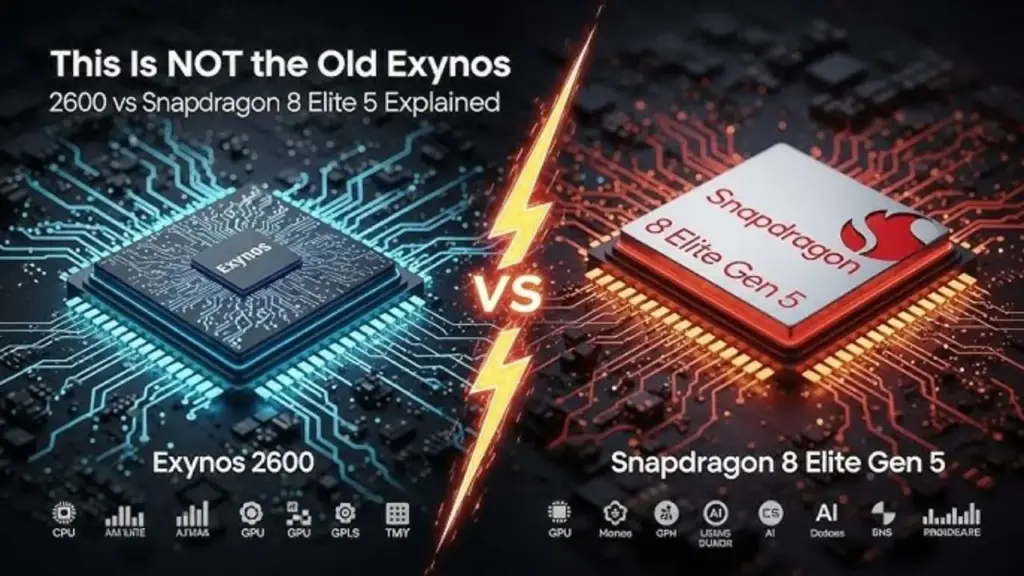
Samsung and Qualcomm have intensified their competition in the flagship mobile chipset arena with the introduction of the Exynos 2600 and Snapdragon 8 Elite Gen 5. These chipsets represent the latest advancements in CPU architecture, graphics, and AI, aiming to set new performance benchmarks for 2026 flagship smartphones.
Exynos 2600 debuts as the world’s first mobile chip fabricated on a 2nm Gate-All-Around (GAA) process by Samsung Foundry. This cutting-edge manufacturing technique is expected to dramatically improve power efficiency and transistor density. In contrast, Qualcomm’s Snapdragon 8 Elite Gen 5 uses the proven 3nm TSMC N3P process, focusing on clock speed and consistent GPU performance.
CPU Architecture and Performance
The Exynos 2600 utilizes a 10-core ARM v9.3 setup, featuring a prime Cortex C1-Ultra core clocked at 3.8GHz, three high-performance C1-Pro cores at 3.25GHz, and six efficiency cores at 2.75GHz. Samsung claims this architecture boosts CPU performance by 39% compared to its predecessor, the Exynos 2500.
Qualcomm’s Snapdragon 8 Elite Gen 5 runs on a custom third-generation Oryon CPU with two prime cores reaching up to 4.6GHz and six performance cores at 3.62GHz. The company reports a 20% performance increase and 35% CPU power efficiency improvement over the previous Snapdragon 8 Elite. This higher clock speed design suggests better single-thread task execution.
Graphics and AI Capabilities
On the graphics front, the Exynos 2600 employs the Xclipse 960 GPU, developed in collaboration with AMD, running on a custom RDNA 4-based MGFX4 architecture. This GPU doubles compute performance and accelerates ray tracing by 50% compared to previous Exynos GPUs, operating at nearly 980MHz with Vulkan 1.3 support.
Snapdragon 8 Elite Gen 5 counters with the Adreno 840 GPU, which Qualcomm says is 23% faster and 20% more power-efficient than its predecessor, with clock speeds up to 1.2GHz. Hardware-accelerated ray tracing and mesh shading further enhance its graphics capabilities. Benchmark tests reveal Adreno 840 outperforms Xclipse 960 by 10-20% in Vulkan and OpenCL workloads, making it a better choice for intense gaming and PC emulation.
Artificial intelligence processing units (NPUs) see significant upgrades on both sides. Exynos 2600 integrates an NPU claimed to boost AI performance by 113%, featuring a 35K-core design aimed at generative AI tasks, supporting Samsung’s Galaxy AI suite. Snapdragon’s Hexagon NPU is 37% faster and 16% more efficient than before, enabling more personalized AI experiences and on-device AI agents.
Thermal Management and Benchmarks
Thermal consistency has long been a concern for Exynos chips. The new Exynos 2600 tackles this with Heat Path Block technology, reportedly reducing heat by 16%, maintaining stable performance under heavy loads.
In preliminary benchmark results, a prototype Exynos 2600 scores approximately 4 million points on AnTuTu, rivaling the Snapdragon 8 Elite Gen 5’s 4.5 million points on Qualcomm’s reference devices. Geekbench 6 tests show Exynos achieving 3,455 (single-core) and 11,621 (multi-core), while Snapdragon scores higher at 3,800 and 12,400 respectively. Some tests even indicate Exynos surpasses Snapdragon in multi-core performance on specific devices like Xiaomi 17.
Market Deployment and Outlook
Samsung plans to equip the Exynos 2600 in flagship Galaxy S26 models and Galaxy Z Flip 8 in select regions, mainly Korea. Meanwhile, Snapdragon 8 Elite Gen 5 will power premium devices from Xiaomi, Oppo, Vivo, OnePlus, and Samsung’s Galaxy S26 units in the U.S. and China.
Samsung’s leap to a 2nm process and improved thermal solutions exhibit a strong push to reclaim top-tier status. Qualcomm’s Snapdragon 8 Elite Gen 5 maintains advantages in raw CPU and GPU performance, but Exynos 2600 may offer a more balanced approach with efficiency and heat control. This rivalry foreshadows more powerful and intelligent flagship smartphones shaping the market in 2026.
Comparison Summary
| Feature | Exynos 2600 | Snapdragon 8 Elite Gen 5 |
|---|---|---|
| Process Node | 2nm GAA (Samsung Foundry) | 3nm N3P (TSMC) |
| CPU Configuration | 1x 3.8GHz Ultra + 3x 3.25GHz + 6x 2.75GHz | 2x 4.6GHz Prime + 6x 3.62GHz Performance |
| GPU | Xclipse 960 (AMD RDNA 4-based) | Adreno 840 |
| GPU Clock Speed | ~980MHz | Up to 1.2GHz |
| AI Performance | 113% increase, 35K NPU cores | 37% faster Hexagon NPU |
| Thermal Tech | Heat Path Block (16% heat reduction) | Standard cooling solutions |
| AnTuTu Benchmark (approx.) | 4 million | 4.5 million |
| Geekbench 6 (Single-Core) | ~3,455 | ~3,800 |
| Geekbench 6 (Multi-Core) | ~11,621 | ~12,400 |
As the contest unfolds, consumers can anticipate flagship phones that blend blazing speed, advanced AI, and better thermal management. The Exynos 2600 and Snapdragon 8 Elite Gen 5 both push innovation boundaries, influencing the next generation of mobile experiences.