


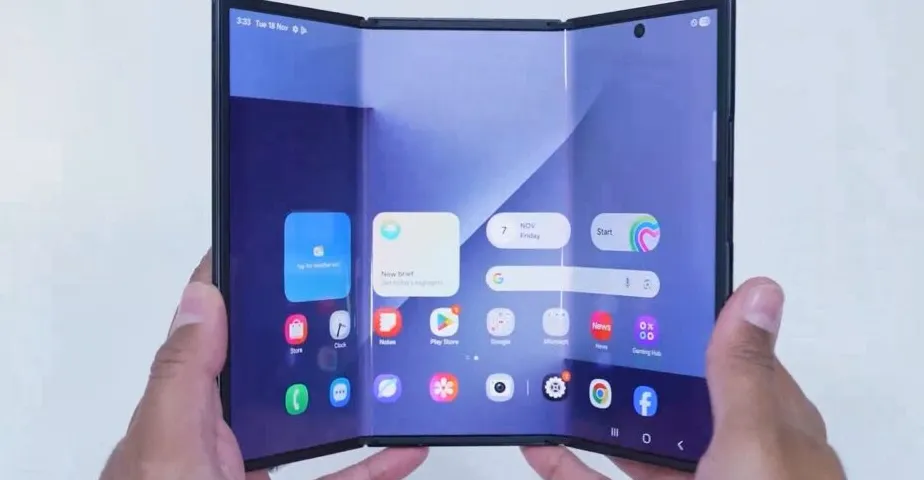
Samsung’s Galaxy Z TriFold, the company’s first triple-fold smartphone, recently underwent an extreme durability test designed to challenge its claim of withstanding 200,000 folds. The test was conducted through a continuous folding and unfolding process streamed live by the YouTube channel Omokgyo Electronics Shopping Mall. This rigorous assessment aimed to simulate mechanical stress far beyond typical daily use.
The Galaxy Z TriFold endured approximately 144,000 fold cycles before its hinges began to lose firmness. During the test, three hosts took turns folding and unfolding the device non-stop, subjecting its two hinges and flexible display to sustained pressure. This relentless handling pushed the phone to its mechanical limits, eventually revealing weaknesses that typically would not appear under normal usage conditions.
Detailed Test Findings
Early signs of hinge wear appeared after around 61,000 folds, as one hinge emitted faint creaking sounds indicative of friction or subtle internal shifts. The second hinge exhibited similar behavior after approximately 121,000 folds. At the critical threshold of 144,000 folds, both hinges had largely lost their original snap tension, meaning the phone could still open but was unable to stand flat on its own.
Despite this wear, the Galaxy Z TriFold’s flexible display maintained full functionality without damage, dead pixels, or visual inconsistencies. This outcome highlights Samsung’s advancements in foldable screen technology, emphasizing durability even under extreme mechanical strain. However, the challenge of engineering robust dual-hinge mechanisms remains significant due to the device’s complex three-panel design.
Official Endurance Ratings and Design Complexity
Samsung rates the Galaxy Z TriFold for 200,000 folds, a benchmark meant to represent years of typical user interaction involving multiple daily folds. Comparatively, Samsung’s more conventional Galaxy Z Fold 7, with a single hinge design, boasts a higher durability rating of 500,000 folds. This disparity underscores the increased difficulty in creating reliable triple-fold hinge systems.
Extreme testing scenarios like this, while not reflective of everyday usage, provide valuable insights into the physical limits of foldable devices. The triple-fold design inherently introduces more mechanical complexity, with two synchronized hinges needing to manage stress across three separate screen panels. This complexity is a key reason why foldable phone manufacturers continue to invest heavily in hinge technology innovations.
Implications for Future Foldable Smartphones
Samsung is actively focusing on improving hinge durability through better materials, lubrication techniques, and refined engineering. These efforts extend across their Galaxy Z Flip and Fold lines, aiming to enhance flexibility and longevity in future models. The results from the Galaxy Z TriFold stress test confirm that the flexible display technology has come a long way, but hinge durability remains an area ripe for innovation.
For prospective Galaxy Z TriFold users, the demonstrated endurance of 144,000 folds under continuous, extreme conditions translates to an extended lifespan in everyday usage. This performance suggests the phone can reliably meet the demands of typical folding behavior over an extended period. Continued advancements in dual-hinge systems will be crucial for the maturation and commercial success of multi-fold smartphones.
This durability assessment offers a realistic perspective on where the Galaxy Z TriFold stands in foldable technology today. It exemplifies both the potential and the current technical challenges of multi-fold smartphones, guiding future development toward more robust and user-friendly designs.