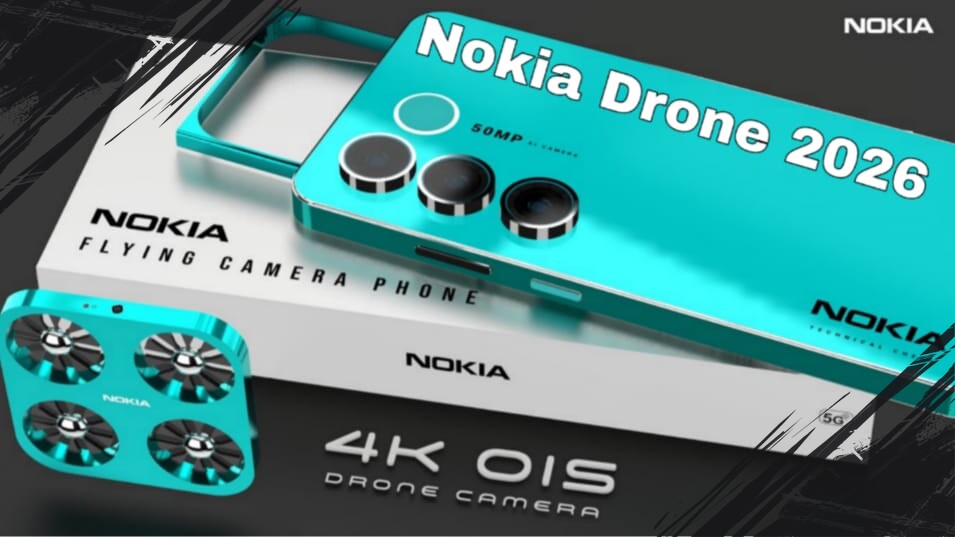
Nokia is preparing to launch an advanced drone equipped with high-definition cameras and 5G connectivity in 2026. This cutting-edge UAV targets various industrial and public applications with a futuristic design and enhanced technological capabilities.
The new drone project emerges as part of Nokia’s leadership in a European Union initiative, PROACTIF, which involves 42 organizations from 13 countries. The program focuses on developing next-generation autonomous drones and robotic systems.
Technological Innovations and Connectivity
Nokia’s drone incorporates drone-in-a-box technology integrated with 4G/LTE and 5G networks. This approach enables Beyond Visual Line of Sight (BVLOS) operations, allowing remote flights without direct visual contact. Such functionality enhances efficiency and safety in critical infrastructure monitoring and emergency response.


The drone features a dual-gimbal camera system that supports both high-definition video and thermal imaging. This is complemented by a docking station that automates recharging and maintenance. The seamless integration of these components through open APIs allows connectivity with existing industrial and public sector systems.
Thanks to 5G and multi-operator radio support, the drone maintains real-time, stable data transmission without relying on Wi-Fi. This minimizes connectivity disruptions due to limited range or latency, greatly improving operational reliability.
Power and Performance Enhancements
In partnership with Amprius, Nokia is developing a high-performance silicon anode battery for the drone. This power source promises extended flight endurance and supports heavy payloads including LiDAR sensors, thermal cameras, and advanced communication modules.
The battery innovation underpins the drone’s capability to perform longer missions while carrying demanding sensor packages. This enhances its utility for surveying, mapping, and surveillance tasks that are critical in industrial and public safety contexts.
Advanced Sensor Suite and AI Integration
The camera system is expected to provide ultra-high resolution, estimated to meet or exceed 50 megapixels, paired with stabilizing gimbals to capture professional-grade imagery. Additionally, the drone is equipped with LiDAR and radar sensors, enabling detailed inspection and mapping with precision.
Nokia’s design integrates AI-driven automation, including obstacle avoidance and real-time analytics. These features optimize flight safety and data interpretation, providing actionable insights for industries and government agencies. Edge computing capabilities further support onsite data processing, reducing the need for constant cloud connectivity.
Key Specifications of Nokia Drone 2026
-
Design & Structure
- Industrial-grade UAV with drone-in-a-box format
- Lightweight and weather-resistant materials
- Automated docking station for charging and upkeep
-
Connectivity
- Multi-operator 5G and 4G LTE networks
- BVLOS support for extended operations
- Open API for enterprise system integration
-
Camera & Sensors
- Dual-gimbal system combining HD and thermal cameras
- Ultra-high-resolution sensor (≥50MP)
- LiDAR and radar for advanced mapping and inspection
-
Power & Operation
- High-energy silicon anode battery technology
- Long endurance for prolonged missions
- Autonomous hovering and return-to-home functions
- Additional Features
- Full automation with AI analytics
- Obstacle detection and avoidance
- Real-time data streaming and edge computing
Nokia’s upcoming drone is expected to be a comprehensive end-to-end solution. It will merge robust hardware, reliable 5G connectivity, and artificial intelligence to deliver enhanced operational efficiency and safety. This development could position Nokia as a leader in the global industrial drone market.
As the launch approaches, further details about naming and exact release dates remain undisclosed. However, the collaboration with Amprius and the PROACTIF consortium signals Nokia’s strong commitment to innovation in autonomous aerial systems. This promises significant advancements in drone technology by 2026, with broad implications for infrastructure management, emergency services, and enterprise applications.