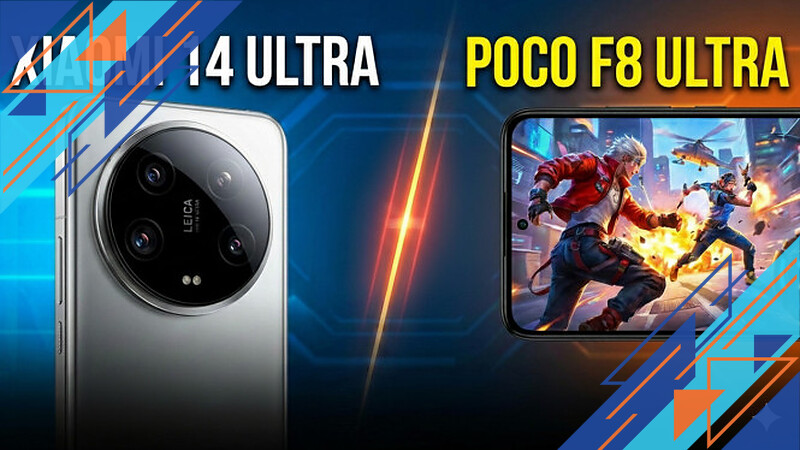
The competition in the flagship smartphone segment heats up with Xiaomi’s Poco F8 Ultra clashing against the Xiaomi 14 Ultra. Although both target high-end consumers, each model follows a distinct philosophy tailored to different user needs. This comparison highlights key aspects to help buyers decide between raw power and professional-grade photography.
The Xiaomi 14 Ultra impresses with a sturdy, premium feel, weighing around 219 grams and measuring 9.2 mm thick. On the other hand, the Poco F8 Ultra sports a slimmer 7.9 mm profile with slightly larger dimensions. Both devices boast IP68 certification, but Poco explicitly guarantees water resistance up to 1.5 meters, providing extra peace of mind.
Display and Visual Performance


Xiaomi 14 Ultra excels in delivering crystal-clear visuals using a 6.73-inch AMOLED panel with a vibrant 1440 x 3200 pixel resolution and 521 ppi pixel density. This setup ensures detailed and sharp images suited for multimedia enthusiasts. Poco F8 Ultra, meanwhile, prioritizes size and speed with its expansive 6.9-inch screen reaching an outstanding 2000 nits brightness. Its 480Hz touch sampling rate guarantees an ultra-responsive experience, especially optimized for gamers seeking minimal input lag.
Raw Processing Power: Snapdragon Chipset Battle
The biggest divergence lies under the hood. Xiaomi 14 Ultra runs on the Snapdragon 8 Gen 3, coupled with up to 16 GB RAM and 1 TB internal storage, easily handling intensive multitasking and professional workloads. Poco F8 Ultra, however, elevates performance with the cutting-edge Snapdragon 8 Elite Gen 5 chipset. It achieves a staggering AnTuTu benchmark score exceeding 3.7 million points, far surpassing Xiaomi 14 Ultra’s capabilities. For users demanding ultra-fast CPU and GPU performance, especially gamers, Poco clearly leads.
Camera Systems and Software
Photography enthusiasts will lean towards Xiaomi 14 Ultra’s versatile quad-camera setup. It features four 50 MP sensors with Optical Image Stabilization (OIS) and wide aperture lenses that ensure consistent, highly detailed photos, even in low-light scenarios. Poco F8 Ultra offers a triple 50 MP camera array enhanced by three LED flashes for balanced illumination during nighttime shooting. Both phones include a competent 32 MP front camera tailored for quality selfies.
Software-wise, Poco F8 Ultra impresses with Android 16 preloaded, promising better features, security enhancements, and system optimization. In contrast, Xiaomi 14 Ultra runs on Android 14, which is still capable but slightly behind in software updates.
Battery Life and Connectivity
Poco F8 Ultra dominates battery endurance featuring a large 6,500 mAh cell with 100W fast charging, plus 22.5W reverse wireless charging capabilities. Xiaomi 14 Ultra, with its 5,000 mAh battery, still offers convenience through 80W wireless charging, facilitating quick top-ups. Audio support is another aspect to consider—Xiaomi 14 Ultra supports high-quality LDAC codec, providing superior sound, while Poco counters with Bluetooth 6 for advanced connectivity.
Distilling the Choice
Consumers seeking a smartphone with professional photography prowess, premium design, and well-rounded multimedia features will find Xiaomi 14 Ultra appealing. Meanwhile, power users focused on extreme gaming performance, extended battery life, and the newest Android version will favor Poco F8 Ultra. The decision hinges on whether raw processing speed or superior camera technology ranks higher in user priorities.
To summarize the key points:
- Design and Durability: Both IP68, Poco is slimmer with explicit water resistance claims.
- Display: Xiaomi for sharpness and resolution; Poco for size, brightness, and touch speed.
- Performance: Poco’s Snapdragon 8 Elite Gen 5 outperforms Xiaomi’s Snapdragon 8 Gen 3.
- Camera: Xiaomi offers quad 50 MP with OIS; Poco offers triple 50 MP with enhanced flash setup.
- Software: Poco runs Android 16, Xiaomi runs Android 14.
- Battery: Poco has a larger battery and faster wired charging; Xiaomi has faster wireless charging.
- Audio/Connectivity: Xiaomi supports LDAC; Poco supports Bluetooth 6.
Understanding these core differentiators allows potential buyers to focus on what truly matters for their own smartphone experience in 2026.