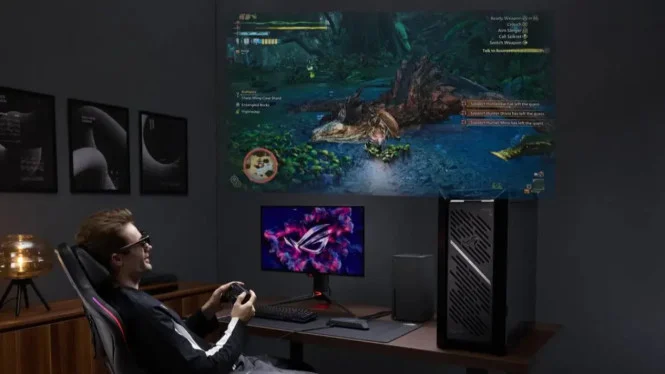
ASUS Republic of Gamers (ROG) has officially announced the ROG XREAL R1, a groundbreaking augmented reality (AR) gaming glasses designed to deliver an immersive gaming experience on a massive virtual screen. Weighing only 91 grams, this compact device projects a virtual display equivalent to a giant 171-inch screen, setting a new standard for portable, high-quality gaming visuals.
This innovation results from ASUS ROG’s strategic partnership with XREAL, a global leader in consumer AR glasses. The ROG XREAL R1 bridges the gap between the desire for large, responsive gaming screens and the freedom to game anywhere without being tethered to a monitor or television.
Immersive 171-Inch Virtual Screen Experience

The highlight of the ROG XREAL R1 is its ability to create a cinematic viewing experience on the go. With a viewing distance of about four meters, users see a virtual screen stretching 171 inches, replicating the feel of a private movie theater. The field of view (FoV) of 57 degrees ensures the virtual screen covers most of the user’s focused vision, offering a natural and immersive visual environment rather than a floating “window.”
Gamers can enjoy first-person shooters, epic RPGs, or racing simulators with extensive visual depth and scale, whether at a café, park, or during a commute. This feature makes portable gaming immersive without sacrificing the sense of presence found in dedicated gaming setups.
Top-Tier Panel Technology for Smooth Gameplay
Beyond sheer size, the quality of visuals is another critical strength of the ROG XREAL R1. It employs a micro-OLED Full HD panel from Sony, providing:
- Infinite contrast, as pixels can turn off completely for true blacks.
- Accurate color reproduction with high saturation.
- Near-zero response time for instant pixel changes.
Its remarkable 240Hz refresh rate, typically exclusive to high-end gaming monitors, delivers ultra-smooth images with minimal motion blur. Coupled with extremely low motion-to-photon latency, in-game actions and head movements feel instantaneous. This technology minimizes motion sickness, a common issue in many AR or VR devices, enhancing the competitive gaming experience in titles such as Valorant, CS2, and Overwatch 2.
Flexible Viewing Modes: Anchor and Follow
The ROG XREAL R1 offers versatile usage through two distinct viewing modes enabled by its 3 Degrees of Freedom (3DoF) tracking system:
-
Anchor Mode: The virtual screen stays fixed at a specific spot, similar to a projected display on a wall. This is ideal for stationary gaming or when a stable visual reference is needed.
- Follow Mode: The screen dynamically follows the user’s head movements, providing a personal monitor experience that remains centered in the user’s view during exploration or action.
Users can switch between these modes depending on their gaming style or environment, enhancing both immersion and convenience.
Seamless Integration Across Devices
A key advantage of the ROG XREAL R1 lies in its broad compatibility. Via the ROG Control Dock supporting HDMI and DisplayPort inputs, the glasses connect effortlessly to:
- Gaming PCs
- PlayStation 5 and Xbox Series X consoles
- Nintendo Switch (in docked mode)
Switching devices requires just one click, eliminating cumbersome driver or resolution adjustments. The device shines especially when paired with ASUS’s handheld console, ROG Ally. A single USB-C connection instantly transforms the compact ROG Ally’s display into a gigantic 171-inch virtual screen without any extra software or lag.
Moreover, the glasses feature the X1 spatial processor chip, allowing users to adjust the virtual screen’s size (from 70 to 171 inches) and viewing distance (2 to 6 meters) instantly via physical buttons.
Comfort and Real-World Awareness
Unlike full-coverage VR headsets, the ROG XREAL R1 employs smart electrochromic lenses with adaptive transparency levels. When users focus on the screen, the lenses darken slightly to optimize contrast. Conversely, they clear up to maintain awareness of real-world surroundings when needed. Manual brightness adjustments offer three levels tailored for various lighting conditions, perfect for outdoor gaming or brightly lit rooms.
Audio performance is equally impressive, powered by a collaboration with Bose. The Sound by Bose system provides spatial 3D sound, enabling gamers to pinpoint audio cues precisely in three-dimensional space. This positional audio support is vital in tactical games, where identifying footsteps or grenade directions can mean the difference between victory and defeat.
Compact Design for Extended Use
At just 91 grams, the ROG XREAL R1 is significantly lighter than traditional VR headsets, which typically weigh between 400 and 700 grams. Its ergonomic design ensures balanced weight distribution and minimal pressure on the nose and ears, allowing comfortable gameplay sessions lasting several hours.
ASUS ROG describes this as a “redefinition of the big screen,” shifting focus from mere physical dimensions to a versatile, immersive visual experience that users can carry everywhere.
Market Launch and Strategic Vision
ROG XREAL R1 is slated for a global launch in the first half of 2026 and will make its debut at CES 2026 in Las Vegas. Although pricing is yet to be officially announced, industry estimates place it between $400 and $650 based on XREAL’s current AR glasses pricing.
This launch aligns with ASUS ROG’s vision to build an integrated gaming ecosystem, seamlessly connecting handheld devices like the ROG Ally with expansive virtual displays for a comprehensive and fluid gaming experience anywhere.
The ROG XREAL R1 signals a transformative step in gaming technology. It empowers gamers to experience large-screen gaming anytime and anywhere, without being confined to conventional hardware setups. This portable and immersive innovation may redefine how players interact with digital worlds in the years ahead.