Air conditioning has long been a challenge for those living in boarding houses or rented rooms. Installing permanent AC units often requires permission from landlords and can involve complicated setups. Portable air conditioners offer a practical and flexible alternative that fits the budget and lifestyle of many students and professionals on the move.
These portable units can be plugged directly into any power outlet without the need for additional installation. They are easy to relocate, making them ideal for those who frequently change residences or live in spaces where permanent fixtures are not allowed. Here are the top portable AC models recommended for 2026, each with unique features catering to different needs.
1. Midea MPHA-05CRN7
Midea’s MPHA-05CRN7 is highly favored for balancing price and performance. With a cooling capacity of 5,000 BTU (about 1/2 PK), it effectively cools rooms up to 10 m². It consumes approximately 680 watts, offering energy efficiency without compromising on cooling power. Features include cooling, dry, and fan modes, plus a self-evaporative system that reduces the hassle of draining condensate water. Controlled via remote and timer, it simplifies usage from a distance. This model is priced around $200 USD, making it an excellent choice for budget-conscious renters.

2. Gree GPC05P2
The Gree GPC05P2 matches the capacity of the Midea at 5,000 BTU but edges out competitors with more efficient power consumption of only 650 watts. Its sleep mode gently raises the temperature overnight to avoid chills while sleeping. The design prioritizes easy maintenance and durability, with a solid build meant to last several years. Although priced around $230 USD, this model is seen as a worthy investment for electricity savings over time.
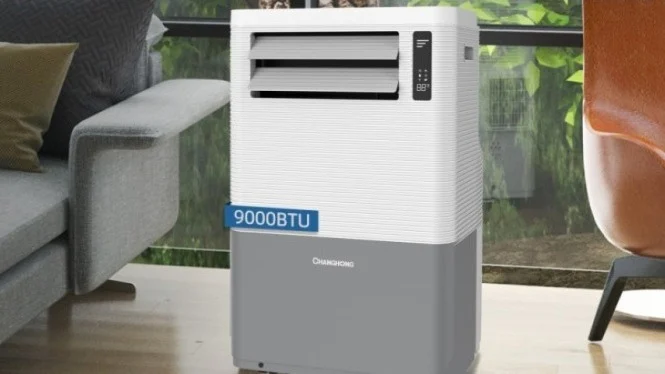
3. Chonghong CPC09PA
For those needing stronger cooling in larger spaces, the Chonghong CPC09PA offers 9,000 BTU capacity, suitable for rooms up to 16 m². While it consumes more power at approximately 1,050 watts, it delivers faster and more powerful cooling performance. The digital panel and simple mode settings make it user-friendly. Available for about $220 USD, it suits living rooms or master bedrooms demanding efficient climate control.
4. Colzi Pro
Colzi Pro targets users who want a personal cooling solution with minimal power use. Its capacity is 1,100 BTU with a remarkably low consumption of 340 watts. It is compact and lightweight, perfect for work desks or small personal spaces without drainage hoses, thanks to its smart design. The Australian-made compressor technology ensures stable and quiet operation. Priced roughly at $230 USD, this is ideal for home office or WFH setups.
5. Sharp CVP-10ZC
The Sharp CVP-10ZC represents the premium option boasting 9,000 BTU capacity with about 1,060 watts of energy use. It integrates advanced features like the Plasma Cluster Ion for cleaner air and Powerful Jet Stream technology for rapid cooling. The Koanda Airflow system ensures soft, evenly distributed air that enhances comfort without direct cold blasts. Though it costs around $360 USD, this unit is perfect for users prioritizing technology and comfort in their portable AC.
Portable air conditioners for 2026 clearly meet diverse needs, from compact personal coolers to powerful room chillers. They eliminate the need for permanent installation and address landlord restrictions efficiently. These units provide cost-effective solutions with varying capacities and power consumption to accommodate small rooms to larger living areas.
Choosing the right AC depends on room size, energy efficiency preferences, and additional features like air purification or noise levels. The top models from Midea, Gree, Chonghong, Colzi, and Sharp highlight that portable AC technology continues improving, making temporary cooling more convenient and accessible than ever.
As more people prioritize flexibility in housing and seek to avoid the hassle of installing traditional AC units, portable options stand out. With prices starting from around $200 USD up to $360 USD, investing in a portable AC is often more economical and practical than permanent solutions. Students and workers can now enjoy cool comfort in their rooms anytime without worrying about installation constraints or electricity bills spiraling out of control.