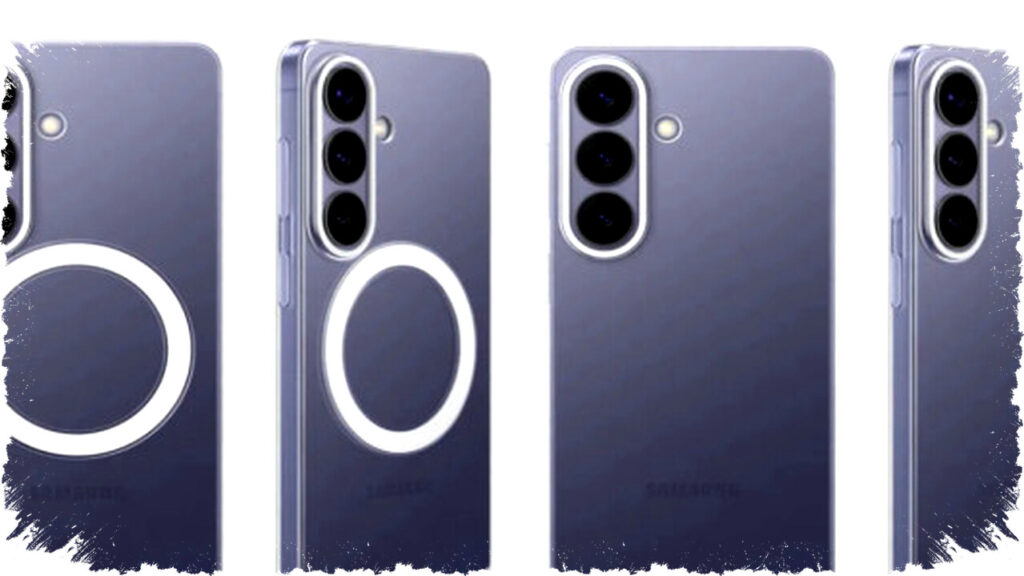
Initial excitement around the Samsung Galaxy S26’s rumored native Qi2 wireless charging support faces new challenges. Recent leaks of Samsung’s official accessories for the Galaxy S26 Ultra introduce confusion by showing magnetic rings only on the cases, not within the phone itself. This discrepancy questions earlier claims about built-in magnetic charging technology.
The Galaxy S26 series is expected to launch in February 2026 during the Galaxy Unpacked event. Early reports suggested it would natively integrate Qi2 wireless charging, enabling precise magnetic alignment for faster, more efficient charging, similar to Apple’s MagSafe and Google’s Pixel magnetic charging systems. However, a Dutch publication, Nieuwemobiel, revealed official accessory images that complicate the narrative. These images focus on transparent and silicone cases featuring clear magnetic rings on their backs, naturally raising doubts about whether the magnet is on the phone or the case.
Conflicting Interpretations of Qi2 Magnetic Support
The leaked accessories include familiar items like a dual-tone S-Pen and anti-reflective screen protectors. Yet the highlight is the transparent case with a distinct magnetic ring externally visible. This design confirms Samsung is offering both magnetic and non-magnetic cases for the Galaxy S26 Ultra and its other models. Two competing hypotheses explain this scenario:
Samsung may well be integrating native Qi2 magnetism inside the S26 hardware while also providing magnetic cases by default. Though the case has a visible magnetic ring, it might just help correctly position wireless chargers or accessories. This approach is consistent with previous wireless charging products where magnetic cases complement, rather than replace, internal magnets.
- Alternatively, Samsung could be relying on external magnetic rings embedded in the phone cases as a workaround. This means the Galaxy S26 might lack native Magnetic Power Profile (MPP) hardware internally, requiring users to buy special cases to access magnetic charging features. This would be a step back compared to competitors who embed magnets directly inside their flagship models.
Impact on the Galaxy S26’s Market Position
If the Galaxy S26 series indeed omits built-in Qi2 magnet technology, Samsung risks falling behind Apple and Google in wireless charging innovation. Both Apple’s iPhone 17 lineup and Google’s Pixel 10 phones already feature integrated magnets that secure wireless chargers reliably and enhance charging efficiency. Native Qi2 support ensures seamless user experiences without the need for accessory dependencies.
Lack of embedded magnets could inconvenience consumers by necessitating additional case purchases to enable magnetic charging. This adds cost and complexity to using the supposedly upgraded wireless charging system. For tech enthusiasts who expected Samsung to push the boundaries, this workaround may feel like a missed opportunity.
Strategic Considerations and Potential Outcomes
Samsung’s decision to use magnetic cases instead of internal magnets could reflect engineering or supply chain challenges. Ensuring stable, efficient magnet alignment in ultra-thin devices is technically demanding. Employing magnetic rings externally could be a pragmatic short-term fix, allowing Samsung to roll out Qi2-compatible charging without full hardware integration.
On the other hand, this strategy could be temporary, with the possibility of true native Qi2 support debuting in future Galaxy models. Samsung may want to gauge market response or finalize magnetic power standards before fully adopting internal magnetic hardware.
What This Means for Users
Current leaks suggest Galaxy S26 owners might have to rely on Samsung-branded or third-party magnetic cases to utilize Qi2 wireless charging. Users investing in the premium device should budget for these necessary accessories if magnetized wireless charging is a priority. Without native integration, charging will not be as fluid or streamlined as on Apple and Google’s flagships.
The upcoming Galaxy Unpacked event, tentatively set for February 25, 2026, is expected to clarify Samsung’s position. Until then, speculation will persist about whether magnetic charging support will be embedded within the phone or remain reliant on external solutions.
Summary of Key Points
| Aspect | Details |
|---|---|
| Qi2 Wireless Charging Support | Rumored, but unconfirmed as native hardware feature |
| Accessory Leak | Magnetic rings visible on cases, not on phones |
| Samsung Strategy | Possible external magnetic cases as workaround |
| Competitors | Apple iPhone 17 and Google Pixel 10 with native magnets |
| Launch Date | Expected February 25, 2026 (Galaxy Unpacked event) |
| User Impact | Additional cost and dependency on magnetic cases |
The evolving story of the Galaxy S26’s magnetic charging support highlights the challenges manufacturers face in advancing wireless charging. Samsung’s approach will influence the device’s competitive edge in a market increasingly focused on convenience and innovation in charging technology.