


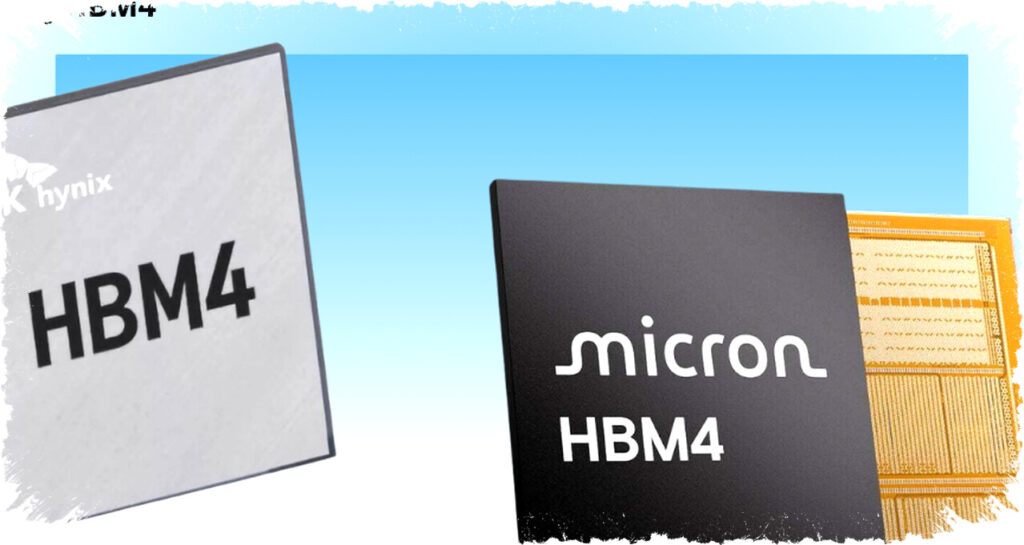
Samsung Electronics has officially started mass production and first shipments of its fourth-generation High Bandwidth Memory (HBM4). This marks a significant milestone in high-performance memory development, targeting demanding applications such as artificial intelligence (AI) and intensive computing workloads. Samsung’s latest HBM4 memory delivers a bandwidth reaching 3.3 terabytes per second (TB/s), representing a substantial leap from previous generations.
The new HBM4 modules are manufactured using Samsung’s 1c DRAM process—belonging to their sixth-generation 10nm-class technology. For the logic base die, the company applies an advanced 4nm fabrication process. These cutting-edge manufacturing techniques enable a pin speed of up to 11.7 gigabits per second (Gbps), outpacing the current industry norm of 8 Gbps. The overall bandwidth, enabled by 2,048 pins per module, reaches around 3.3 TB/s, approximately 2.7 times faster than its predecessor, HBM3E.
Innovations Behind the Performance Leap
During the standardization phase of HBM4, the JEDEC committee decided to reduce the bandwidth per pin to 9.6 Gbps from the 11.7 Gbps seen in HBM3E. This was compensated by doubling the pin count from 1,024 to 2,048, aiming to improve power efficiency and thermal management. Despite this, Samsung exceeded those standards by pushing pin speeds beyond 11.7 Gbps, with potential future enhancements targeting 13 Gbps per pin.
Samsung’s engineering team optimized HBM4 not only for speed but also for efficient energy consumption and heat dissipation. The memory modules incorporate 12-layer stacking technology, offering capacities between 24GB and 36GB per module. Future modules may include up to 16 layers, potentially reaching 48GB to meet increasing demands. Power efficiency has improved by approximately 40%, thanks to the adoption of low-voltage through-silicon vias (TSVs) and new power distribution designs.
Thermal performance also sees gains. The thermal resistance has been lowered by 10%, while heat dissipation capabilities have improved by 30%, both compared to HBM3E. This effective thermal design supports higher performance levels without compromising reliability, crucial in high-density server and data center environments.
Growing Demand and Market Outlook
Samsung forecasts a sharp increase in demand for HBM4 memory throughout 2026, projecting sales to potentially triple compared to 2025 figures. To respond to this growth, Samsung is expanding its manufacturing capacity for these high-performance memory products. Industry trends show an accelerating need for fast, power-efficient memory solutions in AI model training, machine learning workloads, and data-intensive supercomputing.
Beyond HBM4, Samsung plans to introduce an enhanced version called HBM4E, with sample shipments expected in the second half of 2026. These next-generation memory modules aim to push performance boundaries even further. Additionally, Samsung reveals plans to offer customized HBM variants tailored to specific client requirements by 2027. This approach highlights Samsung’s commitment to maintaining leadership in the competitive high-bandwidth memory sector.
Strategic Technology Choices
In an official statement, Sang Joon Hwang, Executive Vice President and Head of Memory Development at Samsung Electronics, emphasized the company’s aggressive development strategy. By adopting the industry’s most advanced DRAM node, 1c, alongside a 4nm logic process, Samsung is creating ample headroom for future performance enhancements. These design choices reflect a proactive effort to address the escalating computational demands of AI systems and data centers worldwide.
HBM4’s performance gains, power efficiency improvements, and thermal management advances collectively position Samsung as a central player in the evolving memory market. High-bandwidth memory is a foundational element enabling the rapid data processing that modern AI and HPC workloads require. Samsung’s ability to deliver mass-produced HBM4 modules with breakthrough specifications is likely to influence innovation across multiple technology sectors.
Summary of Key HBM4 Features and Improvements
| Feature | Samsung HBM4 Specification | Improvement Over HBM3E |
|---|---|---|
| Pin Speed | 11.7 Gbps per pin (potential up to 13 Gbps) | +22% over HBM3E’s 9.6 Gbps |
| Total Pins | 2,048 pins | Double HBM3E’s 1,024 pins |
| Total Bandwidth | ~3.3 TB/s | 2.7x increase |
| Memory Capacity per Module | 24GB to 36GB (up to 48GB planned) | Increased stacking layers |
| Power Efficiency Improvement | 40% more efficient | Significant reduction in energy use |
| Thermal Resistance Reduction | 10% lower | Enhanced heat dissipation by 30% |
| Manufacturing Process | DRAM 1c 10nm-class & Logic 4nm | Advanced fabrication nodes |
Samsung’s HBM4 technology leap is expected to drive advancements in AI infrastructure, supercomputing, and other performance-critical applications. The combination of higher bandwidth, larger capacities, and better energy and thermal management provides system architects additional flexibility to build faster, more efficient platforms. Samsung’s expansion of mass production capacity confirms confidence in the memory’s market potential through this decade.
The coming years will test how well Samsung can sustain innovation to maintain its lead as workloads continue to scale in complexity and size. With HBM4 available in volume and HBM4E samples soon following, Samsung is set to redefine what high-bandwidth memory can achieve, directly impacting numerous technology verticals dependent on cutting-edge data throughput.