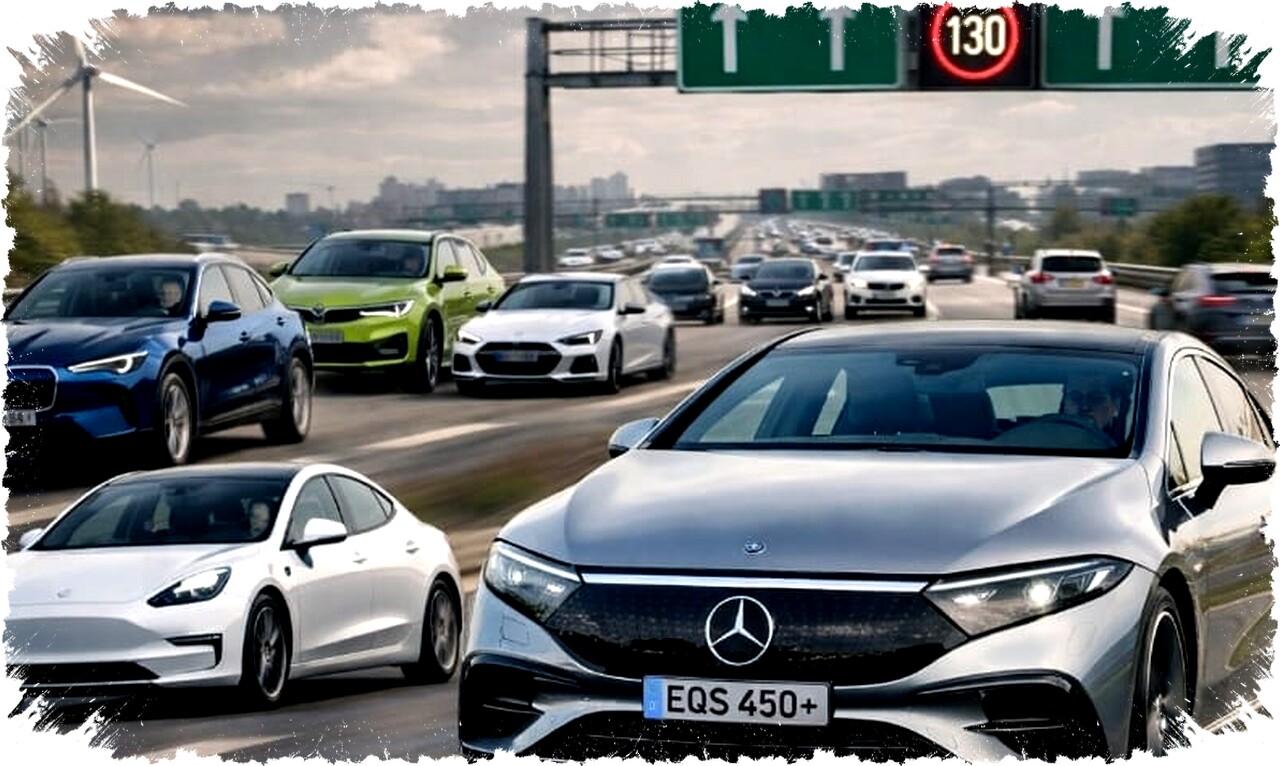
In a comprehensive highway range test, 57 electric vehicles (EVs) were evaluated for their real-world driving range at a constant speed of 130 km/h (about 81 mph). This test aimed to compare actual performance against the manufacturers’ WLTP (Worldwide Harmonized Light Vehicles Test Procedure) ratings. The results revealed significant discrepancies, with many models falling short of their claimed ranges, while a few excelled beyond expectations.
The Mercedes EQS 450+ emerged as the clear winner, covering an impressive 482 km (approximately 300 miles) under sustained high-speed conditions. This performance positions it as the only EV in the test to nearly reach the 500 km mark on the highway.
Range Performance Highlights


The detailed range figures, ordered from highest to lowest, show a significant gap between top performers and others:
- Mercedes EQS 450+ – 482 km
- BMW iX xDrive50 – 434 km
- BMW iX M60 – 430 km
- Genesis G80 Electrified – 427 km
- Mercedes EQE 350+ – 423 km
- BMW i4 eDrive40 – 415 km
- Mercedes EQS SUV 580 4MATIC – 411 km
- BMW i7 xDrive60 – 388 km
- Skoda Enyaq iV RS – 380 km
- Nissan Ariya (87 kWh) – 378 km
Further down the list, popular models like the Tesla Model 3 Long Range AWD achieved 363 km, just outperforming the Tesla Model Y Long Range AWD at 361 km. The Hyundai Kona Electric, notable for its relatively smaller battery, managed a commendable 336 km, matching the Porsche Taycan Turbo S Sport Turismo.
Efficiency vs. Battery Capacity
These findings illustrate that having a large battery capacity does not guarantee the longest highway range. Several factors influence real-world performance, such as aerodynamics and electric motor efficiency. The Mercedes EQS 450+ sets a benchmark by combining a sizable 120 kWh battery with a sleek aerodynamic design featuring a low drag coefficient. Its sophisticated energy management enables it to sustain nearly 500 km on the highway at 130 km/h, showcasing premium electric vehicle efficiency.
Conversely, some high-performance models consume energy rapidly at elevated speeds, resulting in a much lower effective driving range. This trade-off becomes evident for consumers prioritizing performance over efficiency.
Real-World Range vs. WLTP Claims
WLTP ratings often do not fully account for the increased power demand at highway speeds, typically closer to urban or mixed driving conditions. Many vehicles tested failed to approach their WLTP estimated ranges when driven at a steady 130 km/h, with some only achieving about half their rated distance. This gap emphasizes the importance of understanding driving context when considering EV range claims.
Segment and Brand Variations
The tested EVs span multiple categories, including sedans, SUVs, hatchbacks, and performance models from leading manufacturers like Mercedes-Benz, BMW, Tesla, Hyundai, Volkswagen, Audi, Porsche, Nissan, Genesis, and more. Among SUVs, the Mercedes EQS SUV 580 4MATIC stood out, crossing the 400 km mark with 411 km.
The test confirms that EVs with aerodynamic shapes and efficient drivetrains perform best on highways. However, less aerodynamic models, especially heavier SUVs or those with aggressive performance tuning, suffer from reduced range at sustained high speeds.
Value and Efficiency Highlights
Apart from outright range leaders, several vehicles distinguished themselves in specialized categories:
- SUV Best Performer: Mercedes EQS SUV 580 4MATIC (411 km)
- Best Value for Range: Hyundai Kona Electric (336 km) offering a competitive distance at a more affordable price point (approximately $30,000 to $35,000 USD)
- Most Efficient High-Performance EV: BMW i4 eDrive40, managing 415 km with sportier capabilities
- Top Tesla Model: Tesla Model 3 Long Range AWD, reaching 363 km
Implications for EV Buyers
The test underlines that real-world EV range depends on many variables beyond battery size. Aerodynamics, motor efficiency, vehicle weight, and driving speed play critical roles. Buyers intending frequent highway travel should consider models like the Mercedes EQS 450+ or BMW iX variants, which deliver closer-to-WLTP highway range.
Meanwhile, those focusing on urban or moderate-speed driving might find good efficiency from more affordable models such as the Hyundai Kona Electric or Nissan Ariya. The results stress the importance of verifying how WLTP numbers translate into actual highway usage.
Charging Infrastructure and Future Prospects
While battery technology has advanced significantly, allowing EVs to reach ranges near 500 km on highways, charging infrastructure remains a vital component for usability on long trips. Fast charging networks must expand to support the growing EV population and realizing the full potential of these vehicles.
Manufacturers continue refining energy management and aerodynamic designs, seeking to narrow the gap between WLTP ratings and real-world performance. This test offers a critical benchmark for comparing EV capabilities under demanding driving conditions.
This extensive highway test not only celebrates the efficiency of the Mercedes EQS 450+ but also provides valuable insights for consumers making informed EV purchases. As electric mobility continues evolving, understanding on-road range under practical conditions remains essential for adoption and satisfaction.