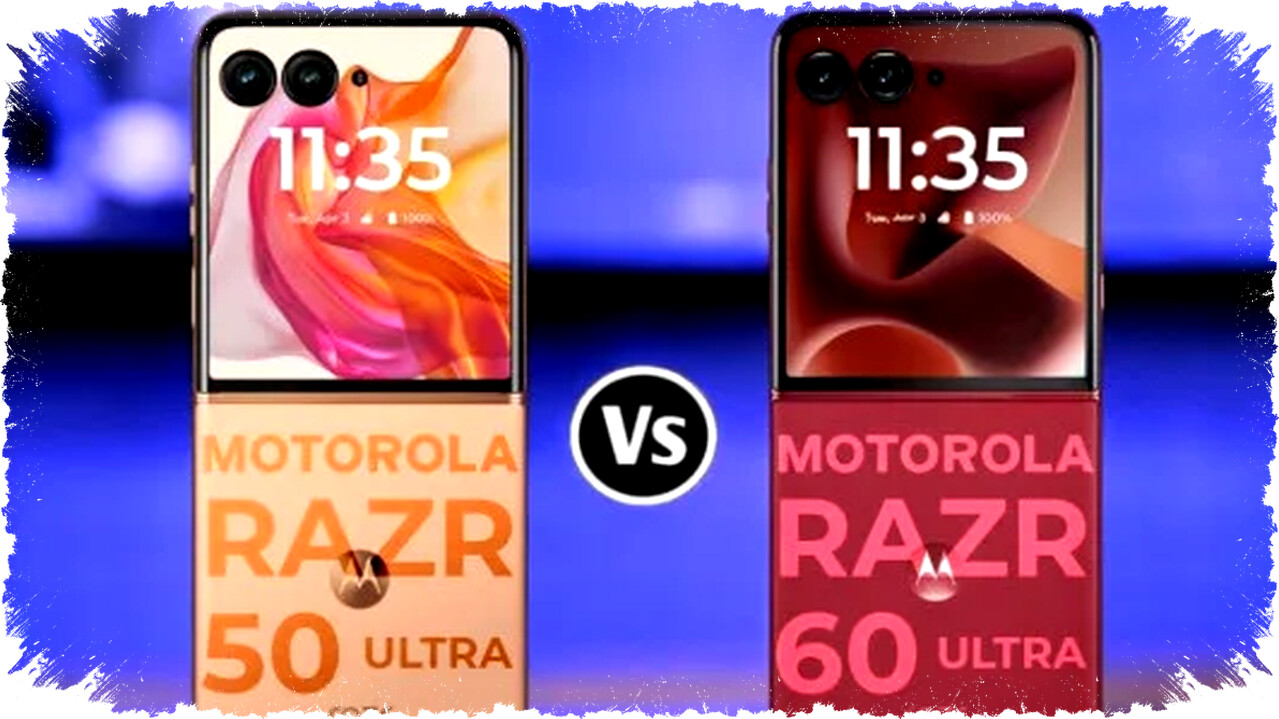
Motorola’s flagship competition heats up with two standout models: the Edge 50 Ultra and the Razr 60 Ultra. These devices target the premium segment but offer different design philosophies and user experiences. Choosing between them depends on what aspects users prioritize most in a flagship smartphone.
Design and Build
The Motorola Edge 50 Ultra features a classic full-screen design with a solid build. It measures 8.6 mm in thickness and weighs 197 grams, which balances robustness and comfort. In contrast, the Razr 60 Ultra brings a distinctive foldable design with a thinner profile of 7.2 mm when opened, though it is slightly heavier at 199 grams. This suggests that the Razr emphasizes style and portability, while the Edge focuses more on stability and ergonomic handling.
Regarding durability, both models offer water resistance but differ in dust protection. The Edge 50 Ultra holds an IP68 certification, indicating strong dust and water resistance. The Razr 60 Ultra, however, is rated IPX8, meaning it is highly water-resistant but lacks dust-proof certification. Additionally, the Edge scores a high 7.7 on the reparability index, significantly surpassing the Razr’s 3.4. This implies that the Edge is easier to repair and more environmentally friendly over its lifespan.
Display Quality
Both phones sport high-quality OLED or AMOLED panels. The Edge 50 Ultra offers a 6.7-inch display with a resolution of 1220 x 2712 pixels, yielding a pixel density of 446 ppi. Meanwhile, the Razr 60 Ultra features a larger 7-inch screen with 1224 x 2912 pixels but slightly lower pixel density. Notably, the Razr’s display supports a high 165Hz refresh rate, providing ultra-smooth animations. The Edge compensates with peak brightness reaching 2800 nits and Gorilla Glass Victus protection, enhancing visibility and durability.
Performance and Hardware
Under the hood, the Edge 50 Ultra is powered by the Qualcomm Snapdragon 8s Gen 3 chipset paired with 16GB of RAM and a generous 1TB of internal storage. This setup handles heavy multitasking and demanding games smoothly. However, the Razr 60 Ultra steps up with the more advanced Snapdragon 8 Elite, delivering higher overall benchmark scores. While the Edge slightly leads in single-core CPU performance on Geekbench, Razr excels with its GPU, the Adreno 830, making it better suited for graphic-intensive tasks.
Camera Capabilities
The Edge 50 Ultra includes a triple rear camera system with 64MP, 50MP, and 50MP sensors. The Razr 60 Ultra relies on a dual-camera setup, both 50MP. Both devices support optical image stabilization and have a 50MP front camera. Edge’s advantages come from dual-tone LED flash and 4K video recording at 60fps. Conversely, the Razr appeals to creators with support for 8K video capture at 30fps, a feature rare in foldable smartphones.
Software and Features
The Edge 50 Ultra runs Android 14 out of the box, whereas the Razr 60 Ultra ships with the latest Android 15. Both phones include advanced privacy features such as camera and microphone control, app tracking blockers, and on-device machine learning enhancements. These ensure user data remains secure without sacrificing convenience.
Battery and Charging
Battery capacity is similar, with the Edge packing a 4,500 mAh unit and the Razr slightly larger at 4,700 mAh. The Edge shines with its aggressive 125W wired charging and fast 50W wireless charging, plus 10W reverse wireless charging. Razr’s charging speed maxes out at 68W wired and lacks wireless charging in the box. Additionally, Razr comes without an included charger, unlike the Edge which provides a charger out of the box.
Audio Experience
Both models feature stereo speakers and triple microphone arrays for clear sound. For Bluetooth audio codecs, the Razr supports aptX HD, aptX Adaptive, and aptX Lossless for high-quality wireless streaming. On the other hand, the Edge uses Sony’s LDAC codec to deliver high-resolution audio. Audio preferences will depend largely on individual user priorities.
Summary of Key Differences
-
Design and Build
- Edge 50 Ultra: Classic, solid, IP68 dust and water resistance, higher reparability.
- Razr 60 Ultra: Foldable, thinner profile, IPX8 water resistance, stylish but less repair-friendly.
-
Display
- Edge: 6.7” AMOLED, 2800 nits brightness, Gorilla Glass Victus.
- Razr: 7” AMOLED, 165Hz refresh rate, smoother animations.
-
Performance
- Edge: Snapdragon 8s Gen 3, 16GB RAM, 1TB storage.
- Razr: Snapdragon 8 Elite, better graphics performance.
-
Camera
- Edge: Triple camera 64MP+50MP+50MP, 4K 60fps video.
- Razr: Dual 50MP cameras, 8K 30fps video.
-
Software
- Edge: Android 14.
- Razr: Android 15.
-
Battery and Charging
- Edge: 4,500 mAh, 125W wired, 50W wireless charging.
- Razr: 4,700 mAh, 68W wired, no bundled charger.
- Audio
- Edge: LDAC codec.
- Razr: aptX HD, Adaptive, Lossless.
Motorola demonstrates strong innovation by catering to distinct user needs. The Edge 50 Ultra is ideal for users valuing robustness, fast charging, and camera versatility. Meanwhile, the Razr 60 Ultra is suited for those drawn to cutting-edge foldable design, top-tier graphics, and premium wireless audio. Both models represent Motorola’s commitment to offering flagship experiences with unique characteristics.