


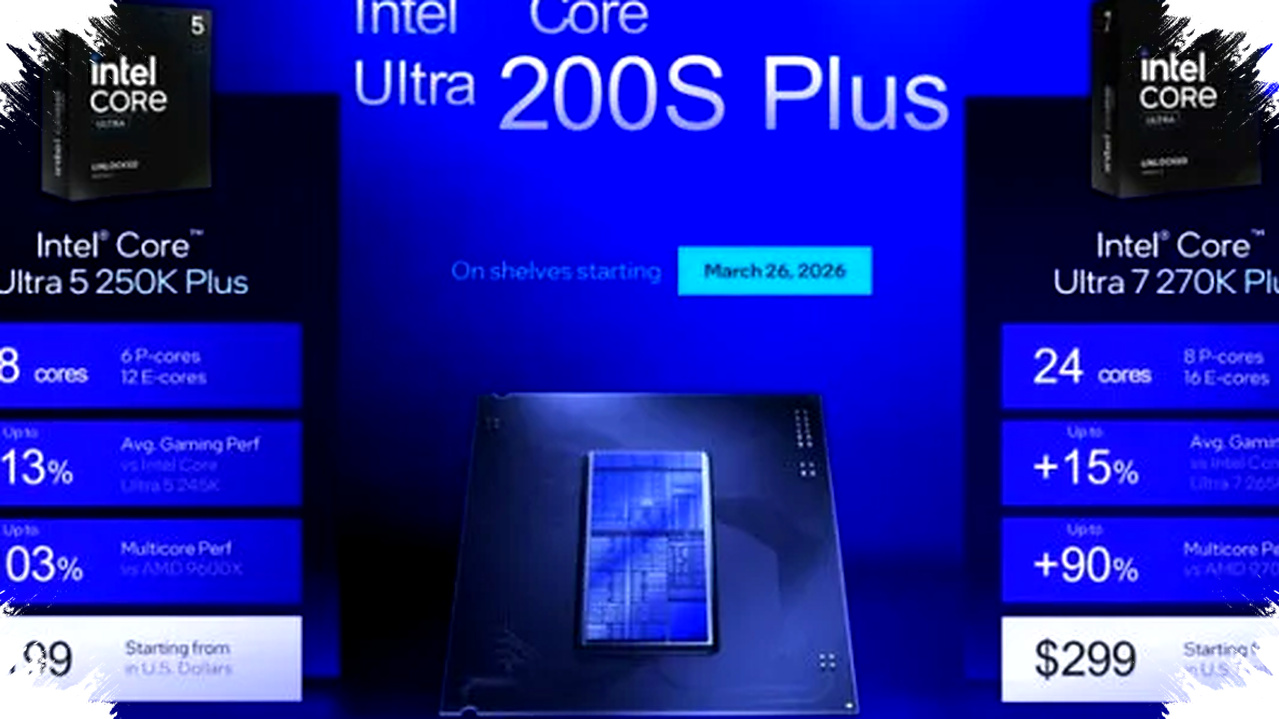
Intel recently launched the Core Ultra 7 270K Plus, a flagship desktop processor aimed at gamers and high-performance users. This new model boasts 24 cores and clock speeds up to 5.5 GHz, promising up to 39% gaming performance improvement on select titles. The upgrade signals a significant leap over its predecessor, the Core Ultra 7 265K.
The Core Ultra 7 270K Plus features an innovative hybrid architecture with 8 Performance-Cores (P-Cores) and 16 Efficient-Cores (E-Cores). This balance allows the processor to handle heavy gaming and multitasking with improved efficiency. The P-Cores maintain high clock speeds to manage demanding workloads, while the added E-Cores take care of background processes.
Key Specifications of Intel Core Ultra 7 270K Plus:
- 24 cores (8 P-Cores + 16 E-Cores)
- 24 threads
- Up to 5.5 GHz maximum clock speed
- Base clock: 3.7 GHz (P-Cores), 3.2 GHz (E-Cores)
- 36 MB Intel Smart Cache
- TDP of 125 watts; Max Turbo power at 250 watts
- DDR5-7200 memory support
The inclusion of 16 Efficient-Cores—up from 12 in the previous generation—enables the processor to delegate lighter tasks, allowing Performance-Cores to focus fully on gaming. According to Intel, this architectural enhancement results in up to 39% increase in gaming performance on certain games, and an average boost of about 15% compared to the earlier Core Ultra 7 265K.
Alongside the 270K Plus, Intel also introduced the Core Ultra 5 250K Plus. This mid-range model balances performance and cost for users not requiring the absolute highest specifications. It offers 18 cores, clock speeds up to 5.3 GHz, and improvements that result in gaming gains as high as 24% in selected titles.
Intel Core Ultra 5 250K Plus Highlights:
- 18 cores (6 P-Cores + 12 E-Cores)
- 18 threads
- Maximum clock speed of 5.3 GHz
- Base clock: 4.2 GHz (P-Cores), 3.5 GHz (E-Cores)
- 30 MB Intel Smart Cache
- TDP of 125 watts; Max Turbo power at 159 watts
- DDR5-7200 memory support
Similar to its flagship counterpart, the Core Ultra 5 250K Plus has increased its E-Cores count from 8 to 12 to streamline background workloads. This expansion contributes to an average gaming performance boost of around 13%, with peaks of 24% on certain demanding game titles.
The design philosophy behind these "Plus" series processors focuses heavily on the hybrid architecture where E-Cores play an essential role. By offloading less intensive, background tasks like streaming or system updates to the Efficient-Cores, the Performance-Cores stay dedicated to delivering smooth gameplay. This separation reduces frame drops and lag, particularly in modern games that interact constantly with the operating system and other applications.
Memory support is also a critical factor in gaming and productivity workflows. Both processors support DDR5-7200 technology, offering high data transfer rates crucial for bandwidth-intensive games and content creation tasks like video editing and 3D rendering. While Intel has yet to share full chipset and socket details, it is expected these processors require new motherboards based on upcoming 800-series chipsets.
For enthusiasts planning upgrades, Intel has announced global availability for these processors on March 26, 2026. Retail prices start at $299 for the Core Ultra 7 270K Plus and $199 for the Core Ultra 5 250K Plus. These price points put the new models in direct competition with popular AMD counterparts such as Ryzen 7 9800X3D and Ryzen 5 9600X, setting the stage for intensified rivalry in the gaming CPU market.
Here is a brief comparison of the targeted competitors:
Direct Competitors:
- Core Ultra 5 250K Plus ($199) vs AMD Ryzen 5 9600X and Ryzen 7 8700G
- Core Ultra 7 270K Plus ($299) vs AMD Ryzen 7 9800X3D with 3D V-Cache technology
This competition benefits consumers by driving innovation and keeping prices competitive across powerful gaming processors.
Intel’s decision to scale Efficient-Cores rather than Performance-Cores reflects the modern computing workload, where multitasking and background efficiency are as vital as raw performance. This approach proves effective for gamers, streamers, and creators who require steady frame rates alongside active applications.
Considering these advancements, users of previous Intel generations—from 12th to 14th—may find the upgrade compelling given the improved clock speeds and core count. However, those with recent Core Ultra 200S series processors might assess whether the roughly 13-15% performance gain justifies an upgrade, depending on their multitasking needs.
Overall, Intel’s refreshed Arrow Lake "Plus" processors offer exciting performance increases without blowing the budget. Gamers and power users should closely watch how these new CPUs perform in real-world benchmarks and game scenarios once available on March 26.