


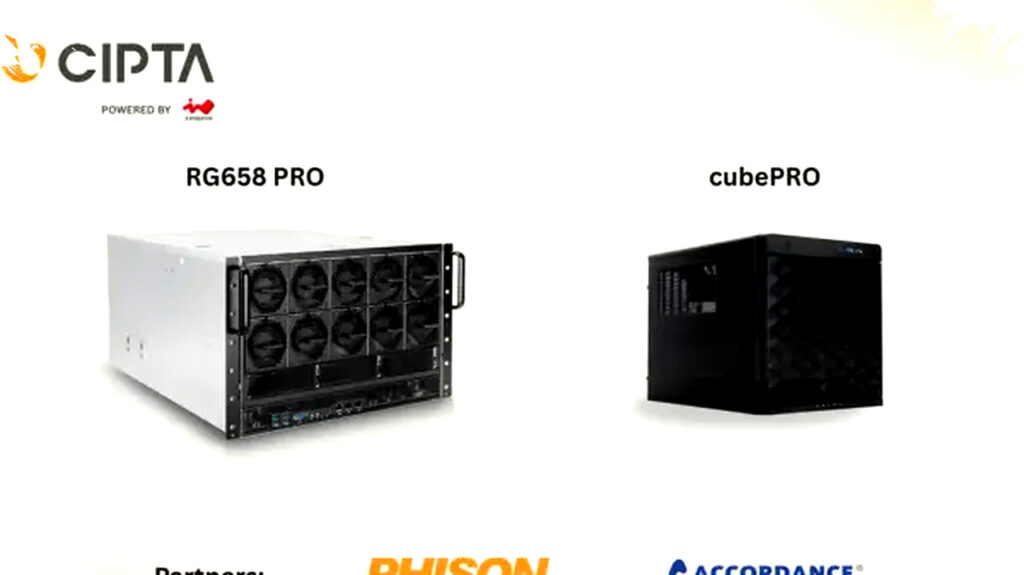
CIPTA Industrial Sdn Bhd is preparing its first international showcase at CloudFest 2026, where the Malaysian advanced electronics manufacturer will introduce a new AI infrastructure lineup built for high-performance local computing. The announcement puts CIPTA in a growing global conversation about how companies can run AI training and inference closer to where data is created, instead of relying only on large external cloud providers.
The debut will take place at Europa-Park in Rust, Germany, from March 23 to 26, 2026, and CIPTA will use the event to present its GPU server platforms and edge workstation concept to an international audience. The move also signals a broader ambition: to show that Southeast Asian manufacturing can deliver enterprise AI systems that are both powerful and practical for real-world deployment.
CIPTA’s CloudFest debut targets the enterprise AI market
CloudFest is one of the most visible events for cloud, hosting, and digital infrastructure professionals in Europe. For CIPTA, the platform offers a direct path to system integrators, cloud builders, and enterprise buyers who are looking for scalable AI hardware with lower operational friction.
CIPTA’s strategy appears focused on hybrid deployment needs, especially for organizations that want to keep sensitive workloads on site. In that context, the company is positioning its infrastructure as a way to support AI development without forcing customers into full dependence on third-party cloud services.
The timing also matters. Demand for local AI infrastructure continues to rise as businesses look for more control over latency, data governance, and long-term operating costs. That demand is especially relevant for manufacturing, research, education, healthcare, and industrial automation.
RG658 PRO will lead the product showcase
The main attraction at Booth R41 will be the RG658 PRO, a rack server developed through a collaboration with Phison. CIPTA designed the system for large-scale AI training and inference, making it suitable for organizations that need serious computing power inside their own facilities.
The server integrates Phison’s Pascari aiDAPTIV technology with enterprise-grade SSD storage. That combination is important because AI workloads need not only GPU performance, but also fast data access and stable storage behavior under heavy load.
CIPTA also made cooling a central part of the design, since thermal control often becomes the limiting factor in dense GPU systems. The RG658 PRO uses a dual-chamber architecture and 14 high-performance 80x56mm fans, each capable of reaching 17,000 rpm, which suggests a strong focus on sustained operation rather than short bursts of peak output.
Key technical and deployment highlights
- The RG658 PRO supports an 8-GPU configuration for enterprise AI workloads.
- The system combines Phison Pascari aiDAPTIV with enterprise SSDs for faster data handling.
- Its dual-chamber cooling design aims to maintain performance during 24/7 operation.
- The platform is built for on-premises AI training and inference, reducing cloud dependency.
- CIPTA plans to present the system as part of a broader AI infrastructure ecosystem.
This setup reflects a wider trend in AI infrastructure design. Many companies are now balancing raw acceleration with operational sustainability, and server vendors are being pushed to prove that their systems can run continuously without excessive heat, downtime, or maintenance overhead.
cubePRO brings AI closer to the edge
CIPTA will also introduce cubePRO at CloudFest 2026, a compact edge workstation developed in collaboration with Accordance. Unlike the larger rack-based RG658 PRO, cubePRO is designed for environments where space is limited but local processing power still matters.
The system targets edge computing use cases, which means it can run AI tasks directly at the site of operation. That approach can reduce data transfer delays and make it easier for businesses to deploy AI in factories, branch offices, labs, or field locations.
For many organizations, edge AI is not just a technical preference but an operational necessity. It supports faster decision-making, helps keep data closer to the source, and can improve resilience when wide-area connectivity is limited or costly.
Why local AI infrastructure is gaining momentum
The market for AI hardware is evolving quickly, and enterprises are asking for systems that fit different deployment models. Some workloads still belong in large data centers, but others now make more sense at the edge or inside a private server room.
This shift has several practical drivers:
- Lower latency for time-sensitive AI inference
- Better control over proprietary or regulated data
- Reduced long-term cost compared with heavy cloud usage
- Easier customization for specialized workloads
- Stronger resilience for sites with limited connectivity
CIPTA is entering this space at a moment when infrastructure buyers want flexibility, not one-size-fits-all platforms. Its combination of a high-density GPU server and a compact edge workstation suggests that the company is trying to cover both centralized and distributed AI deployment needs.
InWin support strengthens CIPTA’s manufacturing story
CIPTA’s presence at CloudFest also highlights its relationship with InWin Development Inc., which backs the company and strengthens its hardware ecosystem. InWin is widely recognized for chassis and system integration capabilities, and that support gives CIPTA a stronger foundation for industrial-grade product development.
The company says it can provide broader one-stop support, from assembly to end-to-end system testing. That matters in enterprise markets, where buyers often want more than a single device and instead need a reliable integration partner that can help validate performance, cooling, form factor, and deployment readiness.
For global customers, that kind of support can reduce deployment risk. It can also shortens the path from pilot project to production rollout, especially when AI systems need to be tailored to specific operational requirements.
What CloudFest could mean for CIPTA’s international growth
CloudFest offers more than visibility. It gives CIPTA a chance to test its message with a highly technical audience that understands infrastructure trade-offs. If the company can show that its products handle performance, thermal management, and practical deployment demands, it could open doors beyond Southeast Asia.
The event also places CIPTA inside a broader competitive field where AI hardware vendors are trying to define what next-generation infrastructure should look like. Some companies emphasize scale, others emphasize efficiency, and many now try to combine both.
For CIPTA, the message is straightforward: build local AI infrastructure that is powerful, efficient, and ready for enterprise use. The RG658 PRO and cubePRO will serve as the first public proof points of that vision when the company steps onto the CloudFest 2026 stage in Germany.