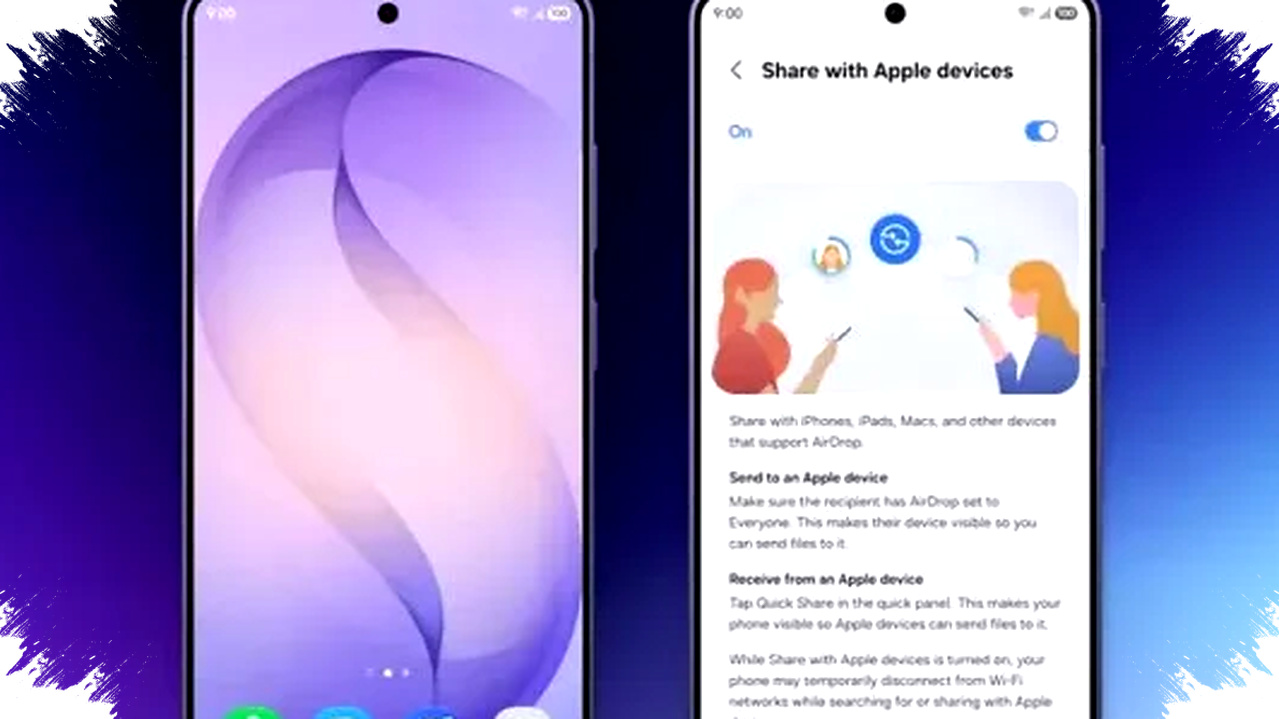
Samsung is widening one of its most useful sharing features beyond flagship devices, and that could matter a lot for Galaxy A users. The company’s updated Quick Share system is now being prepared to work with Apple devices, which means some affordable Samsung phones may soon send files to iPhones in a much simpler way.
The feature is being described as “Share with Apple devices,” and early traces of it have already been spotted on select Galaxy models after software updates. Reports from Digital Trends and Android Authority, as cited in the reference article, say the change was discovered by the GalaxyClub community, signaling that Samsung is testing a major step in cross-platform file sharing.
What Samsung is changing in Quick Share
Samsung is not replacing Quick Share with AirDrop, but it is expanding Quick Share so it can communicate with Apple devices. That is a notable shift, because Quick Share has traditionally worked inside the Android ecosystem, including Samsung phones, Chromebooks, and Windows PCs.
The new setup appears to be built on the same kind of fast, local transfer experience that users expect from AirDrop. It uses Bluetooth Low Energy to detect nearby devices, then switches to Wi‑Fi Direct to move files faster without relying on mobile data or a cloud service.
Security still matters in this system, and the reference material notes that end-to-end encryption is part of the transfer process. That detail is important because one of the biggest reasons users trust AirDrop is its mix of speed and privacy.
Why Galaxy A users should care
This update matters most for mid-range buyers, not just premium phone owners. Samsung’s Galaxy A series has a huge user base in markets like Southeast Asia, Europe, and Latin America, where people often move between Android and iPhone families at home, at school, or at work.
For those users, sharing a photo, a video, or a document has often meant using WhatsApp, email, cloud links, or third-party apps. If Samsung finishes the rollout, those steps could become unnecessary for supported phones that get the new Quick Share version.
The reference article says the feature has been seen on some devices in the Galaxy A lineup, with the strongest signs pointing to three models in particular.
| Galaxy A model | Likely status | Why it may qualify |
|---|---|---|
| Galaxy A35 | Strong candidate | Recent mid-range model with long software support |
| Galaxy A55 | Strong candidate | Higher-tier A series phone with newer hardware and updates |
| Galaxy A56 | Strong candidate | Latest-generation A series handset with extended support |
These models were launched in 2024–2025 and are expected to receive longer software support, which makes them better candidates for features that depend on a modern system build. Samsung has not officially confirmed the final list yet, so owners should treat this as likely but not guaranteed.
How the new sharing flow is expected to work
The user experience should feel familiar if you have used Quick Share before. The main difference is that when an Apple device is nearby and compatible, the Samsung phone may show a new sharing option instead of limiting the transfer to Android-only devices.
The basic flow should look like this:
- Open Gallery or File Manager on a Samsung phone.
- Select the photo, video, or document you want to send.
- Tap Share and choose Quick Share.
- Look for the option labeled “Share with Apple devices” if an iPhone or iPad is nearby.
- The Apple user accepts the transfer on their device.
That process is closer to the convenience of AirDrop than to traditional file transfer methods. It also avoids the quality loss and delay that often happen when people send media through chat apps.
Who gets it first
Samsung appears to be rolling this out in phases, and flagship phones are clearly ahead of the Galaxy A series. The reference article says the feature first arrived on the Galaxy S26 series in March 2026, beginning in South Korea before expanding to other markets.
Those expansion markets include Europe, Hong Kong, Japan, Latin America, North America, Southeast Asia, and Taiwan. Even then, the rollout is still uneven, with some Galaxy S26 Ultra units reportedly not receiving the update by the end of March 2026.
Samsung also plans to bring the feature to older flagship models, including the Galaxy S22, Galaxy S23, Galaxy S24, and Galaxy S25. For Galaxy A devices, however, Samsung has only said the support will expand to more models later, without announcing a timeline.
What this means for Galaxy A owners
The most realistic message for Galaxy A users is simple: the feature looks promising, but patience is still required. Samsung has not said exactly which A-series phones will get it first, and regional rollout policies may also affect timing.
That matters because Samsung often releases software features in stages. A phone that is eligible in one market may wait longer in another region, even when the hardware is capable of supporting the update.
If you own a Galaxy A35, A55, or A56, the chances appear better than for older A models. Still, the final decision depends on Samsung’s software plan, carrier approval in some countries, and whether the device is already on the right software base.
Why this is a bigger story than one feature
The importance of this update goes beyond file sharing. It reflects a broader trend toward interoperability between ecosystems that used to stay separate by design.
Google and Apple already took a step in that direction by improving RCS and text messaging support. Now Samsung’s Quick Share update suggests that practical, everyday tasks like sending files may also become easier across Android and iPhone devices.
For many users, that kind of change is more valuable than a flashy camera feature or a small performance boost. It reduces friction in mixed-device households, where some people use iPhones and others use Galaxy phones, yet all need the same simple way to share content.
Can users force the feature early?
Technically, some community members have found manual sideload methods to activate the feature on supported Samsung phones. That usually involves installing updated Quick Share components and additional system files by hand.
But the risks are real, as the reference article notes. Unofficial installation can cause system crashes, instability, and problems with future updates, and it is not covered by Samsung’s warranty support.
For that reason, waiting for the official rollout remains the safer choice. Samsung is likely to deliver a smoother version through normal software updates, which matters more than getting the feature a little early.
The next few update cycles will tell whether Samsung brings “Share with Apple devices” to the broader Galaxy A family or keeps it limited to newer models first. For now, Galaxy A35, A55, and A56 owners have the clearest reason to watch software updates closely, because they are the most likely mid-range phones to benefit if Samsung expands the feature beyond its flagship lineup.
-

-
-
-