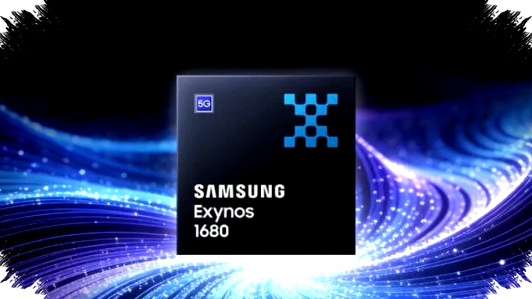
Samsung has officially introduced the Exynos 1680, a new mid-premium chipset that aims to power the next wave of Galaxy A-series phones with better speed, smarter AI, and improved graphics. The chip is positioned as the likely engine inside the upcoming Galaxy A57 5G, making it one of Samsung’s most important mobile silicon launches for 2026.
Built on a 4nm process, the Exynos 1680 focuses on balancing performance and power efficiency. Samsung appears to be targeting users who want faster everyday performance, stronger gaming output, and more on-device AI features without giving up battery life too quickly.
A shift in CPU strategy


The Exynos 1680 uses an octa-core CPU with a tri-cluster layout. It combines one Cortex-A720 core clocked up to 2.9GHz, four Cortex-A720 cores at 2.6GHz, and three Cortex-A520 efficiency cores running at 1.95GHz.
This design matters because Samsung has replaced one efficiency core with an extra performance-oriented core in the middle tier. That move should help the chip handle heavier tasks more smoothly, especially when users switch between apps, edit photos, or play demanding games.
The CPU setup also reflects a broader trend in mobile chips. Manufacturers now try to deliver stronger sustained performance while keeping thermal output and power consumption in check. Samsung seems to be following that direction with a more flexible core arrangement.
Graphics get a noticeable upgrade
Samsung pairs the Exynos 1680 with the Xclipse 550 GPU, which uses AMD RDNA 3 architecture. The company says the graphics unit includes a 2WGP and 2RB configuration and can deliver up to 16 percent better performance than the previous generation.
That improvement could be important for mobile gaming. A more capable GPU should support smoother frame rates, more stable visuals, and stronger handling of graphic-heavy scenes in popular games and creative apps.
The Xclipse branding also signals Samsung’s continued partnership with AMD for mobile graphics. In practical terms, that means the company is still betting on a custom graphics approach rather than relying only on standard ARM-based solutions.
AI becomes a bigger selling point
One of the biggest changes in Exynos 1680 is its upgraded neural processing unit, or NPU. Samsung says the new AI engine reaches up to 19.6 TOPS, which refers to trillions of operations per second.
That level of AI performance should help the chip run features directly on the device instead of sending everything to the cloud. This includes image enhancement, real-time translation, smart voice processing, and system optimization tools that respond faster and more privately.
On-device AI has become a key part of smartphone marketing in 2026. Users now expect their phones to understand photos, summarize content, and assist with communication in real time, and Samsung is clearly preparing Exynos 1680 to support those workloads.
Imaging and video support for modern phones
Samsung has also equipped the chipset with broad camera support. The Exynos 1680 can handle a single camera sensor up to 200 megapixels, while also supporting a 64MP sensor at 30fps and dual 32MP camera configurations.
For video, the chip supports 4K recording at 60fps. It also works with major codecs such as HEVC, H.264, VP9, and VP8, which gives manufacturers flexibility for recording, playback, and compression efficiency.
The chip’s AI-based image processing should improve photos in low light and other difficult conditions. That matters because midrange smartphones increasingly compete on camera quality, not just raw speed.
Display and memory support target premium midrange users
The Exynos 1680 supports Full HD+ screens with refresh rates up to 144Hz. That makes it a strong fit for phones that want a smooth interface and responsive gaming performance.
It also works with LPDDR5X RAM and UFS 4.1 storage. Those standards are important because they help improve app loading times, multitasking, and file access speed.
For buyers, this combination suggests Samsung wants the Galaxy A57 5G to feel closer to a premium device than a traditional midrange phone. The hardware support clearly points in that direction.
Connectivity covers both current and next-gen needs
Samsung has loaded the Exynos 1680 with Wi-Fi 6E, Bluetooth 6.1, and GNSS navigation support. On mobile networks, the chip supports 5G NR in both FR1 sub-6GHz and FR2 mmWave bands.
The maximum download speed reaches 5.1Gbps, while LTE Cat.18 support allows speeds of up to 1.2Gbps. That gives the chipset broad network compatibility for markets that still rely heavily on LTE as well as regions where 5G is more advanced.
Here is a simple overview of the most notable specifications:
- 4nm manufacturing process
- Octa-core tri-cluster CPU
- Cortex-A720 and Cortex-A520 core mix
- Xclipse 550 GPU with AMD RDNA 3 architecture
- AI NPU performance up to 19.6 TOPS
- Camera support up to 200MP
- 4K video recording at 60fps
- Full HD+ displays up to 144Hz
- LPDDR5X RAM and UFS 4.1 storage
- 5G, Wi-Fi 6E, and Bluetooth 6.1 support
What the Exynos 1680 means for Galaxy A57 5G
If Samsung does use the Exynos 1680 in the Galaxy A57 5G, the phone could become one of the most balanced models in the A-series lineup. The chip’s mix of stronger CPU performance, better graphics, and expanded AI support fits the needs of a device that sits just below flagship territory.
That positioning also makes strategic sense for Samsung. By improving Exynos performance in the midrange, the company can reduce reliance on outside chip vendors and keep more of its ecosystem under its own control.
The Exynos 1680 is already in mass production, which means commercial devices should not be far behind. For Samsung, that is a strong sign that the chip is not just a spec-sheet refresh, but a platform designed to shape its next generation of upper-midrange phones.
As more smartphone buyers look for fast AI features, smoother gaming, and better battery efficiency in one package, the Exynos 1680 gives Samsung a new foundation to compete more aggressively in the 2026 midrange market.