


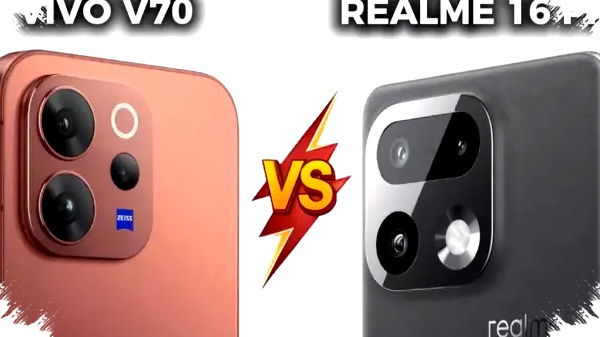
The mid-range premium smartphone market is getting more crowded, and two names now stand out for buyers who want flagship-style features without paying flagship money. Vivo V70 and Realme 16 Pro Plus 5G sit in the same price bracket, but they target different types of users.
Both phones are built around strong performance, modern displays, and large batteries, yet each brand takes a different path. Vivo leans toward camera quality, durability, and a more polished overall experience, while Realme pushes bigger numbers on paper, including a high-resolution camera and a massive battery.
What the two phones have in common
Both models use the Snapdragon 7 Gen 4 chipset built on a 4nm process. That means daily performance should be close, with enough power for multitasking, social media, gaming, and light photo or video editing.
This also makes the comparison more interesting, because the price gap is not the main difference here. Instead, the winner depends on what matters most: camera tuning, display smoothness, battery life, storage, or premium features.
Performance: nearly tied, with Realme offering more room
In real-world use, the Snapdragon 7 Gen 4 should keep both phones fast and responsive. Apps open quickly, heavy menus should move smoothly, and casual gaming should run without major issues.
Realme 16 Pro Plus 5G has one clear advantage in memory configuration. It offers up to 12GB RAM and 512GB storage, while Vivo V70 comes with 12GB RAM and 256GB storage.
- Vivo V70: 12GB RAM / 256GB storage
- Realme 16 Pro Plus 5G: up to 12GB RAM / 512GB storage
- Shared chipset: Snapdragon 7 Gen 4, 4nm
For users who store a lot of large files, games, or 4K videos, Realme looks more practical. For typical daily use, Vivo’s storage is still sufficient, but it gives less breathing room over time.
Display: Vivo aims for clarity, Realme aims for smoothness
The display story is split between sharpness and speed. Vivo uses an AMOLED panel with higher resolution, which should deliver sharper text, cleaner details, and a more comfortable viewing experience for movies and photo work.
Realme counters with a 144Hz refresh rate, which makes scrolling and animations feel more fluid. That difference matters most to gamers and users who notice motion smoothness right away.
This is the basic trade-off:
| Aspect | Vivo V70 | Realme 16 Pro Plus 5G |
|---|---|---|
| Panel type | AMOLED | Not specified in the source |
| Strength | Sharper visuals | 144Hz smoothness |
| Best for | Media viewing, detail | Gaming, scrolling |
If you watch a lot of content, Vivo may look better. If you want the most fluid on-screen movement, Realme has the edge.
Camera: Vivo focuses on consistency, Realme pushes resolution
This is where the comparison becomes more personal. Vivo V70 works with ZEISS, which usually signals stronger image tuning, more natural colors, and better consistency in difficult lighting.
The phone also uses a more flexible camera setup with main, telephoto, and ultrawide lenses. That gives users more control across different shooting conditions, from portraits to landscapes.
Realme 16 Pro Plus 5G takes a different route. It carries a 200MP main camera and a periscope lens, with zoom capability up to 10x. On paper, that sounds more aggressive and can appeal to users who like detail-heavy shots and long-range zoom.
In simple terms:
- Vivo V70 is better for natural tones and balanced results.
- Realme 16 Pro Plus 5G is better for high-detail capture and heavy zoom.
- ZEISS branding gives Vivo a credibility boost in imaging.
Numbers alone do not guarantee better photos. A 200MP sensor can capture a lot of detail, but image processing still determines the final result. That is why Vivo’s more conservative approach may appeal more to users who want dependable daily photography.
Battery: Realme wins on size, Vivo may win on charging speed
Battery life is another area where the two phones diverge. Realme 16 Pro Plus 5G comes with a massive 7,000 mAh battery, which should easily support full-day use and possibly more for moderate users.
Vivo V70 has a smaller battery, but the source notes that it compensates with faster charging. That makes Vivo more attractive for users who prioritize quick top-ups instead of the biggest possible cell.
For battery-focused buyers, the choice is straightforward:
- Realme = bigger battery capacity
- Vivo = faster charging approach
If you spend long hours away from a charger, Realme looks safer. If you charge often but want less waiting time, Vivo may feel more convenient.
Extra features: Vivo looks more premium
Beyond raw specs, Vivo adds more premium-grade details. The phone includes IP68/IP69 resistance, an ultrasonic fingerprint sensor, and AI-related features that add to both convenience and security.
Those are not minor extras. IP68/IP69 certification gives users stronger protection against dust and water exposure, while an ultrasonic sensor often feels more advanced than basic optical systems.
Realme still offers modern wireless features such as Wi-Fi 6 and newer Bluetooth support. Even so, Vivo appears to have the stronger package in build protection and premium hardware touches.
Where each phone makes the stronger case
If you look at the full package, the rivalry becomes a matter of priorities rather than a clear overall winner. Realme 16 Pro Plus 5G is the stronger pick for users who want a huge battery, more storage, a 200MP camera, and a 144Hz display.
Vivo V70 is stronger for buyers who care about camera consistency, premium durability, faster charging, and a more refined user experience. Its ZEISS-backed imaging and tougher protection make it feel more complete as an everyday premium device.
For quick reference:
| User priority | Better choice |
|---|---|
| Camera consistency | Vivo V70 |
| High resolution and zoom | Realme 16 Pro Plus 5G |
| Battery endurance | Realme 16 Pro Plus 5G |
| Faster charging | Vivo V70 |
| Storage capacity | Realme 16 Pro Plus 5G |
| Premium durability | Vivo V70 |
At the same price point, the smarter choice depends on which compromise you are willing to accept. Realme gives more headline-grabbing hardware, while Vivo builds a more balanced phone with stronger emphasis on imaging and protection, making this one of the more relevant mid-range premium matchups to watch in 2026.