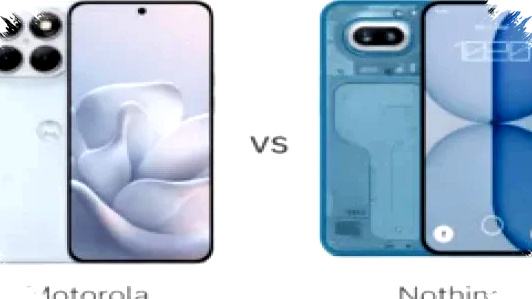
Motorola Edge 70 Fusion and Nothing Phone (4a) target the same crowded midrange market, but they solve different problems. Motorola leans on durability, battery life, and lower pricing, while Nothing pushes design, cleaner software, and a stronger camera setup.
That split makes the comparison more practical than flashy. Buyers who want the best daily value will likely look at Motorola first, while users who care about photography and visual identity may find Nothing easier to justify.
What each phone is trying to be
Motorola Edge 70 Fusion is built for users who want a phone that lasts longer in demanding conditions. It combines a large 7,000mAh battery with IP68/IP69 protection, which gives it an edge for people who work outdoors, travel often, or simply hate carrying a charger.
Nothing Phone (4a) takes a different route by focusing on style and software polish. Its transparent design, Glyph lighting, and clean Nothing OS 4.1 make it feel more distinctive than most phones in this price class.
Display and everyday experience
Motorola equips the Edge 70 Fusion with a 6.78-inch AMOLED display, a 144Hz refresh rate, and peak brightness up to 5,200 nits. Those numbers matter in real use because they help the screen stay smooth and visible in strong sunlight.
Nothing Phone (4a) uses a 120Hz display, which is still fast enough for most users. Its advantage is in tuning, with stronger HDR optimization and a viewing experience that is often described as easier on the eyes during long sessions.
- Motorola wins if you want higher refresh rate and extreme brightness.
- Nothing wins if you prefer a more refined visual feel and design identity.
- Both phones are strong for streaming, social media, and daily browsing.
Performance and software
Both phones rely on Snapdragon 7s-class chips, but the Nothing Phone (4a) has a clearer edge because it uses the Snapdragon 7s Gen 4 globally. That matters for efficiency and stability, especially when users switch between apps, game for short periods, or keep multiple services open.
Nothing OS 4.1 also adds to the appeal by staying close to stock Android and avoiding heavy bloatware. Motorola’s software is usually practical and familiar, but Nothing’s cleaner interface may feel more premium to users who care about speed and simplicity over added features.
Battery life is where Motorola pulls away
The most visible hardware advantage belongs to Motorola. Its 7,000mAh battery is far larger than the roughly 5,400mAh cell inside the Nothing Phone (4a), and that difference should show up in real-world endurance.
Motorola also supports 68W fast charging, so users do not need to wait too long even with a much larger battery. For heavy users, this combination can reduce daily charging anxiety in a way that Nothing simply cannot match.
The battery gap becomes even more important for commuters, field workers, students, and anyone who spends long hours away from a wall charger. In that sense, Motorola has the more practical hardware package.
Camera: zoom versus simplicity
This is the area where Nothing makes its strongest case. The Nothing Phone (4a) includes a triple-camera system with a 3.5x periscope telephoto lens, a feature that is still rare in this segment.
That periscope zoom gives Nothing a real advantage for portraits, distant subjects, and travel shots. It also makes the device more attractive for users who want more creative options without moving to a much pricier flagship phone.
Motorola keeps things simpler with a dual-camera setup. Its main camera should still handle typical daylight shots well, but it does not offer the same zoom flexibility.
Motorola does have one interesting edge for content creators: its front camera can record 4K video, while Nothing’s selfie camera is limited to 1080p. That makes Motorola more appealing for vloggers or users who prioritize front-camera video quality.
Price and value
Price is where the comparison becomes sharper. The Motorola Edge 70 Fusion is priced at around $250, while the Nothing Phone (4a) sits closer to $450.
That $200 gap is large in the midrange segment. Motorla’s lower price, bigger battery, and stronger protection make it the better value for buyers who want maximum utility per dollar spent.
Nothing’s higher price is easier to defend if the buyer specifically wants the periscope camera, the more distinctive design, and the cleaner software experience. In other words, Nothing charges more because it offers a more personality-driven phone, not because it is better in every category.
Who should buy which phone
For buyers still deciding, the choice can be simplified into a few clear priorities.
- Choose Motorola Edge 70 Fusion if battery life is your top concern.
- Choose Motorola if you want IP69 durability and stronger everyday practicality.
- Choose Nothing Phone (4a) if camera zoom matters more than battery size.
- Choose Nothing if you want a more unique design and cleaner Android experience.
The better phone depends on what you notice most during a normal day. If your routine includes long commutes, rough environments, or constant app use, Motorola offers more peace of mind.
If you care about design, enjoy taking photos from a distance, and want a phone that feels more special in hand, Nothing has a stronger identity. That makes the Motorola Edge 70 Fusion vs Nothing Phone (4a) matchup less about raw specs and more about whether you value endurance or creativity more in a midrange smartphone.