


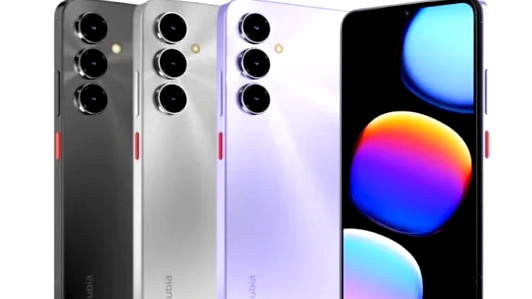
Nubia V80 Max is starting to stand out in the budget smartphone segment because it solves three everyday problems at once: navigation accuracy, battery endurance, and physical durability. For Indonesian ride-hailing drivers and frequent travelers, those are not luxury features but practical needs that affect income, safety, and daily convenience.
At around the $65–$70 class in its local market positioning, the phone targets users who want a reliable work device without spending much. It combines a large 6.9-inch display, 120 Hz refresh rate, a 6,000 mAh battery, and a GPS system with Link Booster Technology that aims to improve navigation accuracy in crowded urban areas and on long intercity routes.
GPS Accuracy Matters More for Ojol Than Many Buyers Realize
For online motorcycle taxi drivers, map precision can make a real difference in how fast they reach pickup points and complete deliveries. A GPS signal that drifts or takes too long to lock can lead to wrong turns, delayed arrivals, and more unnecessary fuel use.
Nubia says the V80 Max uses Link Booster Technology to improve GPS performance over typical entry-level phones. In practical terms, that means the device is designed to hold a steadier signal and reduce navigation errors when users move through dense streets, overpasses, or areas where satellite reception often drops.
That advantage is also useful for family trips, including holiday travel when many drivers rely heavily on navigation apps. The clearer the positioning, the easier it becomes to follow routes without repeatedly checking or stopping to recalculate directions.
Large Display Adds More Than Comfort
The phone’s 6.9-inch display is one of the most visible strengths of the device. Its 120 Hz refresh rate should make scrolling and map movement look smoother, which matters when users switch repeatedly between ride apps, messaging, and navigation tools.
A larger screen also helps drivers read route instructions more quickly while keeping their eyes on the road for shorter moments. That can improve usability in fast-moving situations, especially when the phone is mounted on a motorcycle or used during brief stops.
For many budget buyers, display size is often treated as a secondary feature. In this case, the big screen supports the main use case of the phone rather than serving only as a spec-sheet attraction.
Built for the Real Conditions of Street Work
One reason budget phones often fail working users is that they do not handle rough treatment well. Phones used by ojol drivers are exposed to frequent vibration, heat, rain, dust, and occasional drops.
Nubia V80 Max is claimed to survive drops from up to 1.8 meters, which is unusually strong for its class. It also carries IP64 protection, meaning it is built to resist dust and light splashes of water during unpredictable weather.
The phone further includes Wet Touch Control, a feature that keeps the screen responsive even when hands are wet. That matters in real-world use because rain, sweat, and humid conditions often interfere with touch controls on cheaper devices.
Battery Capacity Is One of Its Biggest Selling Points
The 6,000 mAh battery is another major reason this phone is being discussed for work-heavy use. In a market where many low-cost phones still rely on smaller batteries, that capacity gives the V80 Max an immediate advantage for long shifts and heavy navigation use.
For ojol drivers, a long battery life reduces the need to stop and recharge in the middle of work. For travelers, it helps when the phone is used for maps, ride-hailing, communication, and video calls throughout the day.
The phone also supports 22.5W fast charging, which helps reduce downtime when a recharge is finally needed. As a result, the device is not only built to last longer on a single charge, but also to recover faster between trips.
Useful Charging Features for Daily Mobility
Nubia also adds bypass charging, a feature that lets the phone stay powered in a more stable way during long charging sessions. This is helpful for users who keep their device plugged in while navigating or working for extended periods.
Reverse charging is another practical addition, since it allows the phone to act like a backup power source for other devices. For drivers who carry earbuds, secondary phones, or accessories that need a quick top-up, that feature can be genuinely useful in the field.
NFC support rounds out the package by adding convenience for payments and connectivity where supported. For many users in Southeast Asia, small features like this can be more valuable than performance numbers they rarely notice in day-to-day use.
Why This Phone Fits the Budget Work-Device Category
The V80 Max does not try to compete as a gaming phone or premium camera device. Instead, it focuses on the features that matter most for practical use, especially for users who need a phone that can keep up with a demanding routine.
Here is a simple view of what makes it relevant for Indonesian ojol drivers and travelers:
| Main Feature | Practical Benefit |
|---|---|
| Link Booster GPS | Better navigation accuracy |
| 6.9-inch 120 Hz display | Easier map reading and smoother use |
| 6,000 mAh battery | Longer work time on one charge |
| 1.8-meter drop resistance | Better durability for daily travel |
| IP64 protection | More resistance to dust and splashes |
| Wet Touch Control | Usable even with wet hands |
| 22.5W charging | Faster top-ups between shifts |
| Reverse charging | Emergency backup for other devices |
The overall combination makes sense for people who depend on a phone as a work tool rather than just a communication device. In that use case, stability and endurance often matter more than high-end performance benchmarks.
A Budget Phone With a Specific Job to Do
The most interesting part of the Nubia V80 Max is not one feature in isolation, but how the features support each other. Accurate GPS, a big screen, a long-lasting battery, and stronger physical protection create a device that feels designed for daily mobility.
That is why the phone may appeal strongly to ride-hailing drivers, delivery workers, and travelers who want a tough, affordable handset that can handle long hours on the road. In a crowded low-cost market, the V80 Max tries to separate itself by offering practical reliability rather than chasing flashy specifications.
For buyers who prioritize navigation confidence, endurance, and durability over camera prestige or gaming power, Nubia V80 Max presents a compelling option in the $1 million rupiah class translated into roughly the $65–$70 range. Its main appeal lies in being ready for the kind of work and travel conditions that many entry-level phones struggle to survive.