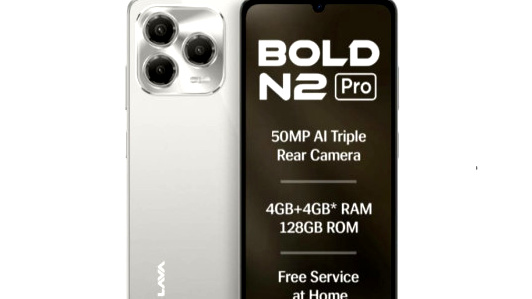
Lava has officially expanded its entry-level smartphone lineup with the Bold N2 Pro, arriving just weeks after the debut of the Bold N2. The new model stands out because it does not follow the usual “Pro means bigger and more expensive” formula, and instead aims to deliver a more balanced package at a lower price.
For buyers looking at affordable phones in India, the Bold N2 Pro is positioned as a practical option with a larger usable storage capacity, a smoother display, and a noticeably improved main camera. Lava is clearly targeting everyday users who want stable performance, modern software, and long battery life without paying much more than the most basic budget segment.
A more balanced take on the Bold series
Lava’s strategy with the Bold N2 Pro is interesting because it trims some specs while improving others that matter more in daily use. The phone is a little more compact than the Bold N2, yet it offers a better overall mix of hardware and software for users who want value rather than headline numbers.
The price is one of the biggest changes. The Bold N2 Pro is listed at around ₹8,000 on Flipkart, which is roughly $96, making it cheaper than the regular Bold N2, which sold for about ₹9,000 or around $108. That price gap may look small, but in the entry-level market it can matter a lot to first-time smartphone buyers.
What Lava changed in the Pro model
The Bold N2 Pro comes with features that are familiar for the segment, but Lava has adjusted the formula to improve usability. The phone uses a 6.67-inch LCD display with 720p+ resolution and a 120Hz refresh rate, which should make scrolling and basic navigation feel smoother than on typical 60Hz budget phones.
Here is a simple breakdown of the main hardware points:
- 6.67-inch LCD display
- 720p+ resolution
- 120Hz refresh rate
- Unisoc T7250 chipset
- 4GB RAM and 128GB storage
- 5,000mAh battery
- 18W fast charging support
- 50MP main camera
- 8MP front camera
- IP54 protection rating
The display resolution is still modest, but the high refresh rate gives the phone one clear advantage in its class. For users who spend most of their time reading, browsing, messaging, or watching short videos, the smoother screen can matter more than a sharper panel.
Performance designed for daily use
Under the hood, Lava uses the Unisoc T7250, a 12nm chipset built with Cortex-A75 and Cortex-A55 CPU cores, along with a Mali-G57 GPU. This is not a performance chip for gaming or heavy multitasking, but it is aimed at steady operation for essential tasks.
That makes the Bold N2 Pro suitable for calls, chat apps, digital payments, social media, and light video streaming. The phone ships with a single memory option, 4GB of RAM and 128GB of internal storage, which is generous enough for an entry-level model and should reduce the need for immediate storage management.
The company is also keeping expectations realistic. This is not a device meant to compete with mid-range phones, but it does appear tuned for users who want a reliable and affordable Android handset for everyday routines.
Android 15 out of the box, but support is limited
One of the stronger points of the Bold N2 Pro is its software. The phone launches with Android 15, which gives it a more up-to-date software base than many low-cost rivals that still ship with older Android releases.
Lava’s update policy is more modest, though. The brand promises one major Android update and two years of security patches, which is standard for this price range but not especially generous. For budget buyers, that is acceptable, but it also shows that the device is built for near-term practicality rather than long-term software longevity.
The fact that it runs the full version of Android also matters. The regular Bold N2 reportedly used the Go Edition, while the Pro model upgrades to a standard Android experience. That shift should translate into a more capable interface and broader app compatibility.
Battery life should be a strong point
Battery capacity remains one of the most important features for entry-level buyers, and Lava keeps things simple with a 5,000mAh unit. For a phone that uses a modest display resolution and an efficient 12nm chipset, that capacity should be enough for a full day of mixed use for most people.
Charging is more mixed. The Bold N2 Pro supports 18W fast charging, but the charger in the box is only rated at 10W. That means users will likely need a separate adapter to take full advantage of the faster charging capability.
This detail is worth noting because it changes the real-world experience. Buyers may see 18W on the spec sheet, but the bundled accessory limits the out-of-box charging speed, which is becoming more common in the budget phone market.
Camera upgrade is the biggest improvement
The most noticeable upgrade on the Bold N2 Pro is the camera system. Lava raises the main camera from 13MP on the regular Bold N2 to 50MP on the Pro model, which is a meaningful leap for people who want sharper daylight photos and more flexibility for casual photography.
The front camera is rated at 8MP, which should be enough for selfies, video calls, and basic social media use. In this price range, camera performance often depends more on processing than raw megapixel counts, but the larger main sensor specification gives the Bold N2 Pro a better starting point than its predecessor.
That camera improvement helps define the phone’s identity. Instead of focusing only on larger size or a higher sticker price, Lava seems to have chosen the upgrade that most budget users will notice first.
Durability and everyday protection
The Bold N2 Pro also carries an IP54 rating, which adds protection against dust and light splashes. That is not full waterproofing, but it does offer a helpful layer of durability for daily use, especially in markets where affordable phones are often used in more demanding conditions.
This rating is slightly lower than the IP64 rating of the standard Bold N2, so the Pro model gives up some protection while improving other areas. For many users, that trade-off may still make sense because the camera, software, and pricing gains are more visible in everyday use.
Bold N2 Pro versus Bold N2
The comparison between the two phones shows how Lava is trying to rebalance the lineup rather than simply make the Pro version bigger in every way. The Bold N2 gets a slightly larger body and better IP64 resistance, while the Bold N2 Pro offers newer processing, full Android 15, and a far better main camera.
A quick comparison helps clarify the differences:
| Feature | Bold N2 | Bold N2 Pro |
|---|---|---|
| Price | around $108 | around $96 |
| Display | slightly larger | 6.67-inch, 120Hz |
| Protection | IP64 | IP54 |
| Main camera | 13MP | 50MP |
| Software | Android Go Edition | Android 15 |
| Chipset | older config | Unisoc T7250 |
That table shows why Lava’s new model may appeal to a different type of buyer. The Pro version is not the absolute spec champion, but it is the more sensible purchase for users who value camera hardware and a cleaner Android experience.
Why this launch matters in the budget segment
The entry-level smartphone market is crowded, and most devices in this range try to win by adding one standout number while cutting elsewhere. Lava’s Bold N2 Pro takes a more measured route, combining a high-refresh display, large storage, current software, and a stronger camera at a lower price.
That formula is important because budget buyers are often more concerned with balance than with benchmark scores. In practical terms, the phone is built for people who want something affordable that still feels modern when used for messaging, payments, streaming, and light photography.
With the Bold N2 Pro, Lava is sending a clear message that “Pro” can also mean smarter value, not just a larger shell or a higher price tag. For users watching the sub-$100 segment closely, this model could become one of the more practical options in Lava’s current lineup.