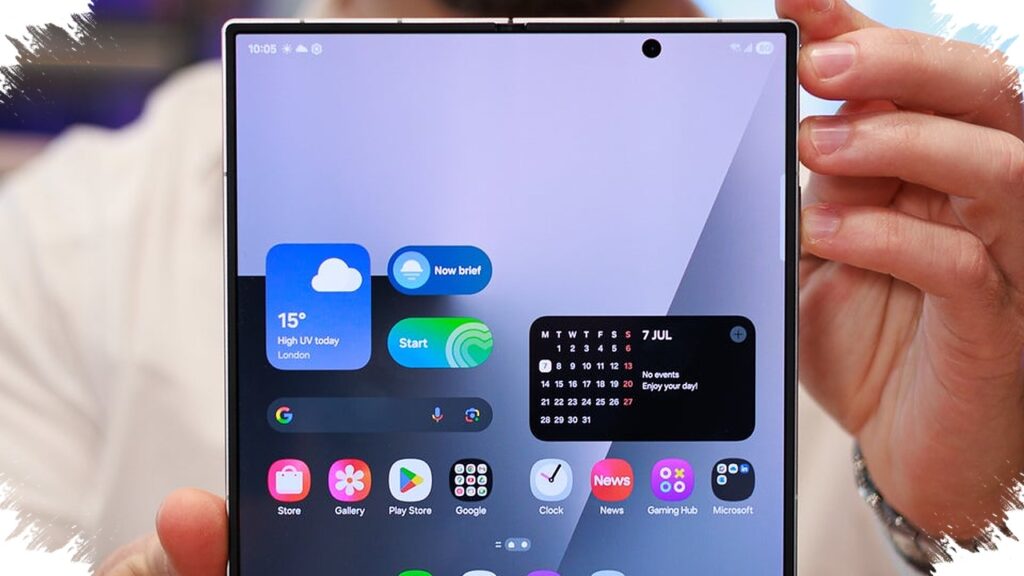
Samsung appears to be preparing a major rethink for its next large foldable, and the latest leak points to a device that could change how the Galaxy Z Fold line feels in daily use. The rumored Galaxy Z Fold 8 Wide, internally identified as “H8,” is said to move away from Samsung’s long-running near-square inner display and toward a much wider panel that aims to improve usability, multitasking, and media consumption.
The most notable detail is the display ratio shift from roughly 1.11:1 on the current Fold generation to 1.3:1 on the leaked model. That sounds subtle, but in practice it would make the inner screen feel closer to a compact tablet than a tall, narrow phone, and it could finally address one of the biggest complaints about Samsung’s foldables: the inner screen often looked impressive on paper but felt awkward for reading, typing, and side-by-side app work.
A coded clue in One UI 9
The leak did not come from a product brochure or a marketing slide. It reportedly came from system code tied to One UI 9, where software sleuths noticed references to “H8” alongside updated animation assets and interface behavior. That matters because Samsung usually leaves recognizable internal markers when it is preparing a major hardware shift, especially when the software team has to adapt the interface to a new form factor.
Several elements in the code suggest this is more than a minor revision. The mirrored behavior between the outer display and the inner display appears to have been redesigned, and the multitasking layout now seems to assume more horizontal space. Icons, navigation bars, and transition animations also look optimized for a wider canvas, which fits the idea that Samsung is adjusting both hardware and software at the same time rather than simply changing one part.
That combination is important because foldables often fail when the software does not fully match the hardware. A larger screen only helps if the operating system understands how to use it efficiently. Samsung seems to be trying to fix that gap with a more unified experience.
Why the new 1.3:1 ratio matters
The jump to a 1.3:1 inner display ratio is one of the most significant parts of the leak. The ratio is close to 4:3, a format many users already know from tablet design, e-readers, and older productivity devices.
Here is a simple comparison of what that could mean in real use:
| Area | Current Fold-style design | Leaked Z Fold 8 Wide |
|---|---|---|
| Reading and browsing | Narrower view, more scrolling | More page content visible |
| Video playback | Larger black bars on the sides | Better screen utilization |
| Multitasking | Tight app windows | More comfortable split-screen use |
| Document editing | Less room for text and tools | Better spreadsheet and document visibility |
The practical gain is not just about visuals. A wider screen can reduce the feeling that users are working inside a tall strip. It can also make the device more forgiving for productivity apps such as Google Docs, Excel, and messaging tools that benefit from a broader layout.
For content viewing, the change could also reduce the amount of unused space during video playback. Samsung has long promoted its Fold series as a productivity and entertainment device, so an inner screen that behaves more like a tablet would make that pitch stronger.
The leaked 82.2 mm width could change ergonomics
The new display shape may come with a trade-off. According to the report, the Galaxy Z Fold 8 Wide could measure about 82.2 mm across when folded, which is noticeably wider than the roughly 71 to 73 mm range associated with the Fold 6.
That increase could affect how the phone feels in hand and how easy it is to carry. A wider device may be less comfortable in tight pockets and slightly harder to use one-handed, especially for users with smaller hands. It may also add around 10 to 15 grams of weight, based on the leak’s expectations.
Still, Samsung may be making a deliberate exchange here. The company could be choosing better usability when unfolded over maximum portability when closed. For many power users, that would be a logical move. A foldable aimed at productivity has to feel like a useful mini-tablet first and a pocketable phone second.
What improved screen mirroring could fix
One of the most promising parts of the leak is the reported improvement to screen mirroring between the outer and inner displays. Foldable owners know this problem well. An app can shift awkwardly when the phone opens, the interface may reload, and the position of text, video, or a form field can be lost in the transfer.
The new software behavior appears to address that with a more seamless transition. Based on the code analysis, Samsung may be aiming for a continuous experience where the cover screen and inner display are treated as a single environment.
- The device keeps the app state when switching screens.
- The cursor, scroll position, and focus remain in place.
- The interface adjusts in real time as the device opens or closes.
- Layout shifts happen smoothly without forcing a full reload.
If that works as intended, it would remove a major frustration from the foldable experience. It would also bring Samsung closer to the “seamless computing” promise the company has talked about for years.
A response to stronger competition
Samsung is not making this move in a vacuum. Foldables from Huawei and Xiaomi have already pushed wider designs and productivity-first layouts in some markets. At the same time, Apple’s rumored interest in foldable device concepts has increased pressure across the category, especially around tablet-like use cases.
A broader Fold model would help Samsung defend its position in a category it helped define. It would also signal that the company is willing to move beyond a design that critics have described as too narrow or too “square” for everyday work.
That matters because the foldable market is still small compared with traditional smartphones. To grow, these devices need to feel less experimental and more intuitive. Users who buy premium phones usually expect convenience first, not a learning curve. A wider Fold could help Samsung meet that expectation.
What the leak suggests about Samsung’s design direction
The internal “H8” label is also interesting because Samsung has historically used certain prefixes to mark bigger architectural transitions. That does not guarantee a dramatic product at launch, but it often suggests a project with deeper hardware and software changes than a routine yearly refresh.
If the leak holds, the Galaxy Z Fold 8 Wide may represent a broader shift in Samsung’s foldable philosophy. Instead of continuing to refine the old narrow shape, the company appears ready to admit that a slightly more tablet-like profile could be the better long-term direction.
That would be a meaningful change for a product line that has spent years trying to balance novelty, durability, and practicality. The new design could make foldables more useful for work, easier to navigate with split-screen apps, and more comfortable for reading and streaming.
The most important question now is whether Samsung can deliver the wider body, the smoother mirroring, and the updated interface without making the device feel unwieldy. If it succeeds, the Z Fold 8 Wide may mark the point where Samsung finally moves past the “boxy” foldable era and turns the inner display into a tool that feels genuinely built for everyday use.