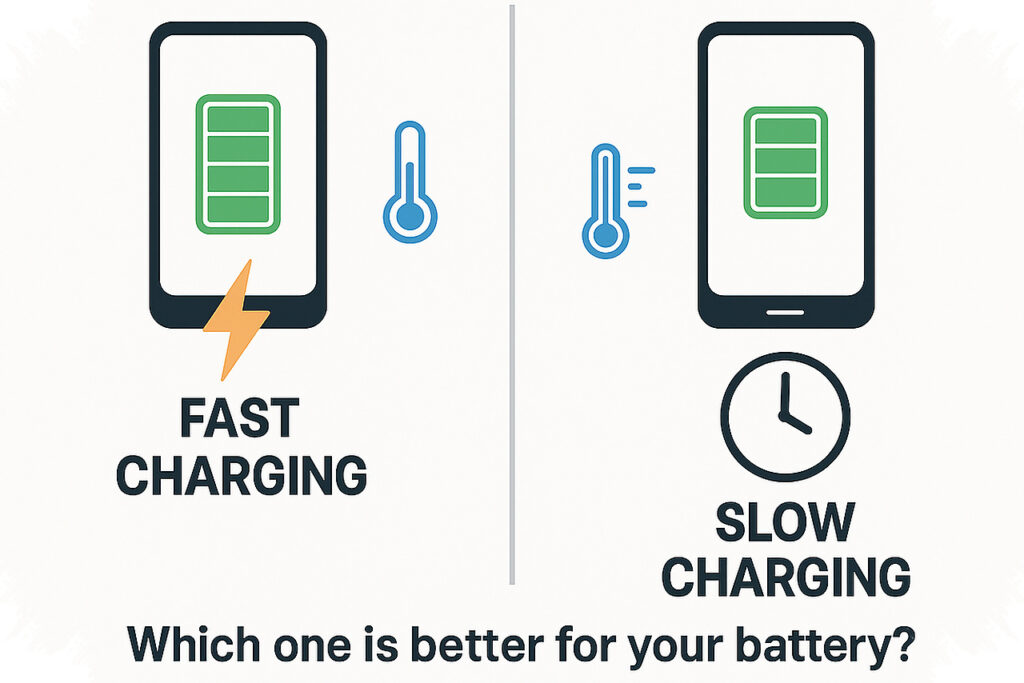
A common phone habit may be quietly shortening battery life: charging all the way to 100 percent every day. Chao-Yang Wang, director of the Electrochemical Engine Center at Penn State University, says lithium-ion batteries age faster when they are kept at full charge for long periods.
The effect is not always visible right away, but the damage builds over time. Wang said, as quoted by HuffPost, that frequent full charges can make battery health decline about 10 to 15 percent faster than charging to a slightly lower level.
Why 100 Percent Can Stress a Battery
Modern smartphones mostly use lithium-ion batteries, and these batteries do not like staying at maximum capacity too often. When the battery sits at a very high charge level, the internal cells stay under more pressure, which can speed up capacity loss over time.
That does not mean a full charge is dangerous every time. The issue appears when 100 percent becomes a daily habit, especially if the phone stays plugged in for long periods after reaching full charge.
What Experts Recommend Instead
Wang says charging to 100 percent is still acceptable when the phone needs maximum endurance, such as before travel or a long day away from a charger. For normal daily use, however, many experts suggest stopping earlier to reduce stress on the battery.
A more battery-friendly range is often around 85 to 90 percent. Some specialists prefer an even wider buffer, keeping the battery between 20 percent and 80 percent whenever possible.
- Start charging when the battery drops to around 20 percent.
- Stop around 80 to 90 percent for daily routines.
- Charge to 100 percent only when extra battery life is needed.
- Avoid letting the phone regularly fall to 0 percent.
Why Letting the Phone Die Is Also a Problem
Running a phone down to zero battery can also place extra strain on the cell inside. The battery works best when it does not repeatedly move between extreme low and extreme high charge levels.
That is why experts often point to a middle range as the healthiest daily pattern. Charging earlier, before the phone shuts off, helps reduce unnecessary wear and can support better long-term performance.
Heat May Matter More Than Charging to Full
Wang also warns that temperature can be even more harmful than charging to 100 percent. Excessive heat or very cold conditions can damage battery chemistry and shorten its usable life.
Dibakar Datta, an associate professor at the New Jersey Institute of Technology, has issued a similar warning. He advises keeping the phone at room temperature and using fast charging carefully because it creates more heat than slower charging.
Heat is not only a battery issue, but also a safety concern. In extreme cases, overheating during charging has contributed to device fires, which makes temperature control an important part of battery care.
Signs the Battery May Be Wearing Out
Datta also suggests checking battery health in the device settings from time to time. If battery capacity has dropped below 80 percent, replacement at an authorized service center may be worth considering for stable performance and safer use.
Here is a practical summary of the habits most often recommended by battery experts:
| Habit | Recommended approach |
|---|---|
| Daily charging | Stop at 80–90 percent if possible |
| Full charge | Use 100 percent when needed for long use |
| Low battery level | Do not make 0 percent a routine |
| Ideal range | Keep between 20 percent and 80 percent |
| Temperature | Keep the phone near room temperature |
The key point is not that 100 percent charging must always be avoided, but that it should not become the default habit. A more moderate charging pattern, along with lower heat exposure, can help slow battery degradation and keep a smartphone performing well for longer.