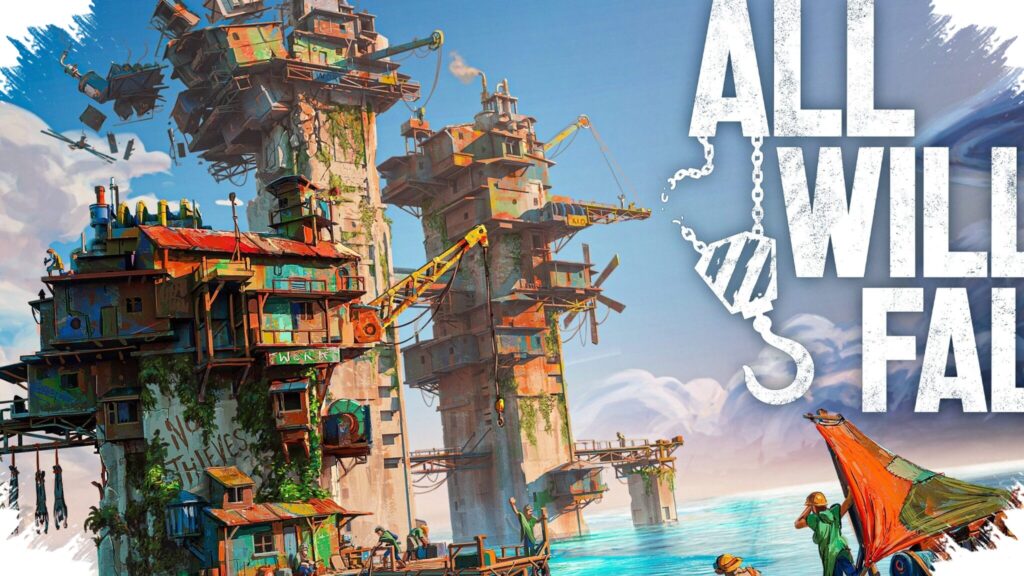
A city builder can usually forgive a bad layout, but All Will Fall is built around the opposite idea. The game turns every structure into a physical risk, so a single mistake in placement can send an entire vertical settlement collapsing into the sea.
Now available on Steam, the game comes from All Parts Connected and tinyBuild, and it places players in control of what may be the last surviving civilization in a flooded post-apocalyptic world. Instead of expanding across open land, progress happens on stacked layers rising from the water, where stability matters as much as expansion.
Building on a structure that can break
All Will Fall stands out because its city does not sit safely on solid ground. The game uses 3D physics simulation to calculate weight, balance, and structural strain, which means every new building affects the wider settlement in a measurable way.
Heavy construction cannot simply be dropped anywhere without consequences. Material quality and how weight is distributed can decide whether the city remains upright or collapses under its own load.
That design shifts the game away from ordinary urban planning. It resembles a dangerous engineering project, where the player must constantly judge how much stress the structure can handle before the whole settlement tips into the ocean.
Three factions with different roles
The challenge is not limited to architecture. Players also have to manage three core factions: Workers, Sailors, and Engineers, each contributing to the survival of the city in a different way.
Workers handle physical construction, Sailors venture onto the water to search for materials, and Engineers operate heavy equipment such as cranes. Their functions depend on one another, so progress slows quickly if coordination breaks down.
Each faction also brings its own demands. Food, housing, clean water, and entertainment all need attention, or social tension can start to build inside the settlement.
A world shaped by sea level changes and sudden events
The surrounding ocean is never simply background scenery. When the water recedes, players may uncover seabed islands or old technological ruins that were hidden beneath the surface.
Those moments open a narrow window for expeditions and resource gathering. The danger is that access can disappear again when the water rises, so timing becomes part of the strategy.
Unpredictable events add another layer of pressure. A city may suddenly face a clean water shortage while a refugee ship arrives at the dock asking for shelter, forcing quick decisions under strain.
Choices that carry moral weight
The game does not treat those decisions as purely logistical. Accepting or turning away refugees affects more than supplies, since the choice can influence the city’s stability and the direction of the playthrough.
That system gives the survival aspect a harsher edge. Each session can unfold differently because player choices directly shape the fate of residents and the relationships between factions.
As a result, All Will Fall pushes players to decide what matters most when the settlement begins to wobble. The tension comes not only from the threat of collapse, but also from the difficult balance between survival and responsibility.
A space for experimentation
For players who want less pressure than the campaign, All Will Fall includes a Sandbox Mode. The mode allows more freedom to test city designs without the same level of punishment for failure.
The game also supports Steam Workshop, which gives the community room to expand the experience with additional content. That support suggests the project is not built only around strict challenge, but also around creativity and experimentation.
With its physics-driven construction, faction management, and constant pressure from the sea, All Will Fall arrives on Steam with a clear identity. In a world already lost beneath the water, the central task is simple to state but difficult to master: keep the last city standing long enough to survive the next mistake.