


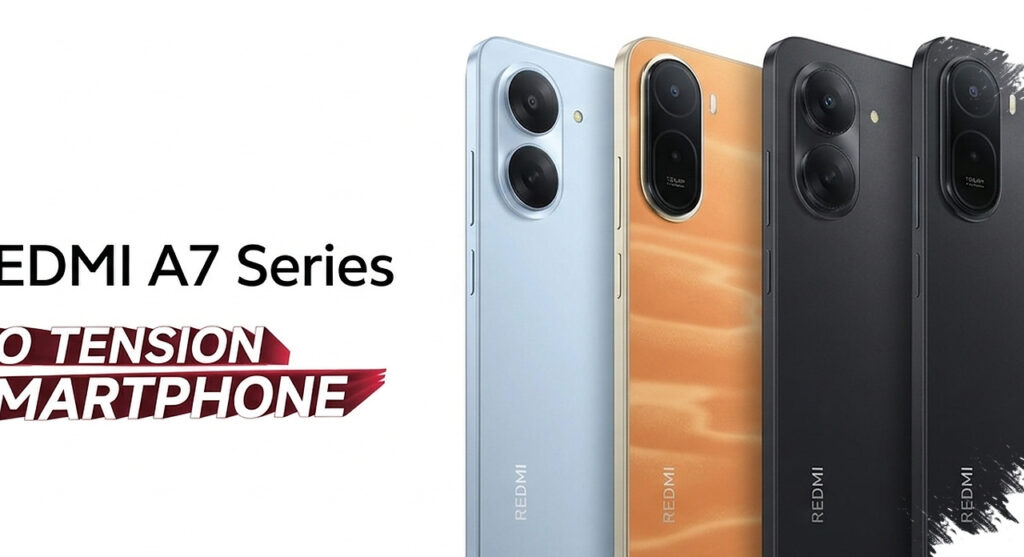
Xiaomi has expanded its budget lineup in India with two new 4G phones, the Redmi A7 4G and Redmi A7 Pro 4G. Both models target buyers who want a low-cost device with a large display, long battery life, and the essential features needed for everyday use.
The new release also broadens the Redmi A7 Pro family, which was previously available in a 5G version. By introducing a standard Redmi A7 4G alongside the Pro model, Xiaomi gives shoppers a wider choice based on price and battery needs.
Large 120Hz displays
Display performance stands out as one of the most visible selling points on both phones. The Redmi A7 4G uses a 6.88-inch LCD panel, while the Redmi A7 Pro 4G comes with a slightly larger 6.9-inch screen.
Both devices offer HD+ resolution and a 120Hz refresh rate, which should make scrolling and menu navigation feel smoother. Xiaomi also includes a 240Hz touch sampling rate on both models, a specification that is still uncommon in the entry-level segment.
Entry-level hardware with familiar storage options
Under the hood, the two devices share the same Unisoc T7250 chipset. Xiaomi pairs it with LPDDR4X RAM and 64GB of UFS 2.2 storage, which is intended for routine tasks such as messaging, social media, and light video playback.
The Redmi A7 4G arrives in a 3GB/64GB version, while the Redmi A7 Pro 4G offers 4GB of RAM with the same 64GB storage. A microSD card slot is also retained, giving users a way to expand storage without relying only on the internal memory.
Cameras remain matched across both models
Xiaomi keeps the camera setup identical on the two phones. Each device carries a 13MP rear camera and an 8MP front camera.
That approach suggests Xiaomi is focusing its differentiation on other areas such as display, battery, and software support rather than on camera hardware. For basic photography, selfies, and video calls, the setup remains aligned with the entry-level position of the phones.
Battery capacity separates the standard and Pro models
Battery life is where the Redmi A7 4G and Redmi A7 Pro 4G diverge most clearly. The standard model includes a 5,200mAh battery, while the Pro version steps up to a larger 6,300mAh unit.
Both phones support 15W wired charging and 7.5W reverse wired charging. For users who prioritize endurance over other features, the larger battery on the Pro model is likely to be a major advantage.
Core features still present
Despite their low price positioning, both phones include a set of features that remain important for daily use. Xiaomi equips them with a side-mounted fingerprint scanner, a 3.5mm headphone jack, IP52 protection, and dual-SIM support.
Connectivity is also kept practical, with Bluetooth 5.2, GPS, Wi-Fi, and a USB Type-C port on both devices. Those details help the phones remain functional for users who still want familiar hardware conveniences in an affordable package.
Different software paths and long update support
Software is another area where Xiaomi draws a bigger line between the two models. The Redmi A7 4G runs HyperOS 2 based on Android 15, while the Redmi A7 Pro 4G ships with HyperOS 3 based on Android 16.
The update promise also differs significantly. Redmi A7 4G is set to get 2 years of Android upgrades and 4 years of security patches, while Redmi A7 Pro 4G is promised 4 years of Android upgrades and 6 years of security updates.
Price and color options
In India, the Redmi A7 4G is priced at INR 10,499 for the 3GB/64GB version. The Redmi A7 Pro 4G is listed at INR 11,499 for the 4GB/64GB configuration.
Color choices also vary between the two phones. Redmi A7 4G comes in Black and Sky Blue, while Redmi A7 Pro 4G is offered in Sunset Orange and Black. Both models are scheduled to go on sale through Xiaomi’s official online store, Flipkart, and offline retail channels on April 24.
Source: www.gsmarena.com